element14 Community
element14 Community
    Register Log In
  • Site
  • Search
  • Log In Register
  • Community Hub
    Community Hub
    • What's New on element14
    • Feedback and Support
    • Benefits of Membership
    • Personal Blogs
    • Members Area
    • Achievement Levels
  • Learn
    Learn
    • Ask an Expert
    • eBooks
    • element14 presents
    • Learning Center
    • Tech Spotlight
    • STEM Academy
    • Webinars, Training and Events
    • Learning Groups
  • Technologies
    Technologies
    • 3D Printing
    • FPGA
    • Industrial Automation
    • Internet of Things
    • Power & Energy
    • Sensors
    • Technology Groups
  • Challenges & Projects
    Challenges & Projects
    • Design Challenges
    • element14 presents Projects
    • Project14
    • Arduino Projects
    • Raspberry Pi Projects
    • Project Groups
  • Products
    Products
    • Arduino
    • Avnet & Tria Boards Community
    • Dev Tools
    • Manufacturers
    • Multicomp Pro
    • Product Groups
    • Raspberry Pi
    • RoadTests & Reviews
  • About Us
  • Store
    Store
    • Visit Your Store
    • Choose another store...
      • Europe
      •  Austria (German)
      •  Belgium (Dutch, French)
      •  Bulgaria (Bulgarian)
      •  Czech Republic (Czech)
      •  Denmark (Danish)
      •  Estonia (Estonian)
      •  Finland (Finnish)
      •  France (French)
      •  Germany (German)
      •  Hungary (Hungarian)
      •  Ireland
      •  Israel
      •  Italy (Italian)
      •  Latvia (Latvian)
      •  
      •  Lithuania (Lithuanian)
      •  Netherlands (Dutch)
      •  Norway (Norwegian)
      •  Poland (Polish)
      •  Portugal (Portuguese)
      •  Romania (Romanian)
      •  Russia (Russian)
      •  Slovakia (Slovak)
      •  Slovenia (Slovenian)
      •  Spain (Spanish)
      •  Sweden (Swedish)
      •  Switzerland(German, French)
      •  Turkey (Turkish)
      •  United Kingdom
      • Asia Pacific
      •  Australia
      •  China
      •  Hong Kong
      •  India
      •  Korea (Korean)
      •  Malaysia
      •  New Zealand
      •  Philippines
      •  Singapore
      •  Taiwan
      •  Thailand (Thai)
      • Americas
      •  Brazil (Portuguese)
      •  Canada
      •  Mexico (Spanish)
      •  United States
      Can't find the country/region you're looking for? Visit our export site or find a local distributor.
  • Translate
  • Profile
  • Settings
Test & Tools
  • Technologies
  • More
Test & Tools
Forum Accuracy of 3.5 digit multimeters
  • Blog
  • Forum
  • Documents
  • Files
  • Members
  • Mentions
  • Sub-Groups
  • Tags
  • More
  • Cancel
  • New
Join Test & Tools to participate - click to join for free!
Actions
  • Share
  • More
  • Cancel
Forum Thread Details
  • Replies 12 replies
  • Subscribers 360 subscribers
  • Views 3262 views
  • Users 0 members are here
  • multimeters
  • digital_multimeter
  • reading_error
  • multimeter
  • digital_multimeters
Related

Accuracy of 3.5 digit multimeters

Gough Lui
Gough Lui over 11 years ago

Low cost 3.5 digit multimeters are pretty much ubiquitous amongst hobbyists, but how accurate are they? I try to find out, using the Keithley 2110 I was awarded in a RoadTest as a reference source.


The full details are in my blog post: Investigation: How Accurate is that 3.5 digit Multimeter? | Gough's Tech Zone

  • Sign in to reply
  • Cancel

Top Replies

  • jw0752
    jw0752 over 11 years ago +1
    This is a nice looking study and a good application for the Keithly. I enjoyed looking it over. John
  • Problemchild
    Problemchild over 11 years ago in reply to mcb1 +1
    I think this depends on if you have a 1% application or a0.1% or better application. I have 3 pretty cheap meters and don't have an expensive one. I did calibrate them some significant time ago and they…
  • mcb1
    mcb1 over 11 years ago in reply to Gough Lui +1
    Your testing has shown some of the fineprint in those 'cheap' meters. I think the heading was "Best Accuracy", but didn't say it was across the whole range Tenma basic Tenma advanced Fluke Basic (113)…
  • shabaz
    shabaz over 11 years ago

    Wow, that will take some time to absorb but it's clearly very comprehensive!!

    We're currently purchasing some more bench and handheld multimeters and so it will be fun to follow your post.

    • Cancel
    • Vote Up 0 Vote Down
    • Sign in to reply
    • Cancel
  • Gough Lui
    Gough Lui over 11 years ago in reply to shabaz

    If you have time to compare the accuracy specs, you should be able to get an idea of what they are capable of. The fun comes when you start comparing values ... but admittedly, with 3.5 digit multimeters being so inaccurate, it's very easy to discount any error contribution from the 5.5 digit meter used as reference because the error magnitude is much greater than the 5.5 digit meter! But it also shows that we shouldn't necessarily be putting that much faith in the last digit (almost regardless of meter)!

    • Cancel
    • Vote Up 0 Vote Down
    • Sign in to reply
    • Cancel
  • jw0752
    jw0752 over 11 years ago

    This is a nice looking study and a good application for the Keithly. I enjoyed looking it over.

    John

    • Cancel
    • Vote Up +1 Vote Down
    • Sign in to reply
    • Cancel
  • mcb1
    mcb1 over 11 years ago

    Nice work Gough


    I've tended to stick with Fluke mainly because they differentiate between the ac and dc component of mixed waveforms much better than some others.


    However if you're after a cheap meter to give you some readings then element14's Tenma range start from NZD$11.85.


    Mark

    • Cancel
    • Vote Up 0 Vote Down
    • Sign in to reply
    • Cancel
  • Gough Lui
    Gough Lui over 11 years ago in reply to mcb1

    Fluke is pretty much the gold standard - now I have an incentive to purchase one image. That being said, I only decided to give it a test because I thought it was worthwhile knowing - once you know the limits, you know what's meaningful and what's not. And it puts the Keithley to another good use aside from testing power banks (many ... many ... Power Banks).


    That being said, Tenma is a "rebadge" operation - remember the DSE Q1459 I have in my testing, well that was a Uni-Trend UT33D. As it turns out, this Tenma is too ... http://au.element14.com/tenma/72-7770/multimeter-digital-hand-held-1999/dp/7430566


    So ... uh ... I'd have to be an advocate of looking for something with a proper error spec sheet, and probably something a bit more resolution (digits, premium cost) if you want to have more faith in your readings. I suppose half of it is knowing just how trustworthy your instruments are - gone are the days I'd try to differentiate 5.00 and 5.05v on those meters image. You do get what you pay for, but I don't think it's necessarily value paying $50 upwards for a questionable 3.75 digit Tenma meter when for about three times more, you can have a basic Fluke. That's just my opinion anyhow.

    • Cancel
    • Vote Up 0 Vote Down
    • Sign in to reply
    • Cancel
  • mcb1
    mcb1 over 11 years ago in reply to Gough Lui
    I don't think it's necessarily value paying $50 upwards for a questionable 3.75 digit Tenma meter when for about three times more, you can have a basic Fluke

    I'd support that view, and it was proven by a guy I worked with figuring out exactly that, some of the cheaper option flukes give better accuracy for not much more money.


    While that is the upper end, paying peanuts for a meter that gives you anything with 5-10% accuracy is better than nothing.


    Mark

    • Cancel
    • Vote Up 0 Vote Down
    • Sign in to reply
    • Cancel
  • Problemchild
    Problemchild over 11 years ago in reply to mcb1

    I think this depends on if you have a 1% application or a0.1% or better application. I have 3 pretty cheap meters and don't have an expensive one. I did calibrate them some significant time ago and they are still a fraction of a % of one another.  They are great for testing that power rails aren't too vastly off  but I wouldn't use them to set a precision reference or anything .


    Still any reason for a posh Fluke or similar!

    • Cancel
    • Vote Up +1 Vote Down
    • Sign in to reply
    • Cancel
  • Gough Lui
    Gough Lui over 11 years ago in reply to Problemchild

    I was just doing some gawking at the element14 catalogue - looks like the Flukes are 0.5% +/- 2 digits or thereabouts for their basic models, but some of the equivalent Keysight (ex. Agilent) are boasting 0.09% +/- 5 digits or thereabouts for the same price. So I suppose part of the whole thing with Fluke is indeed the "posh" brand. The improvement in accuracy is probably nice for setting up variable voltage regulators, checking for small voltage drops along low voltage DC wiring (some of their voltage tolerances are pretty small), but I agree. Many applications just need some indication - and old fashioned analog meters were lucky to be read back at less than 2% of error! Aren't we all spoiled!


    - Gough

    • Cancel
    • Vote Up 0 Vote Down
    • Sign in to reply
    • Cancel
  • mcb1
    mcb1 over 11 years ago in reply to Gough Lui

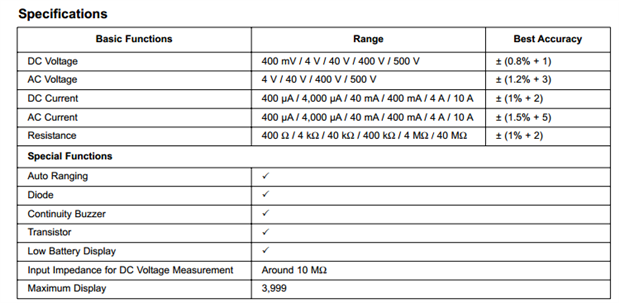
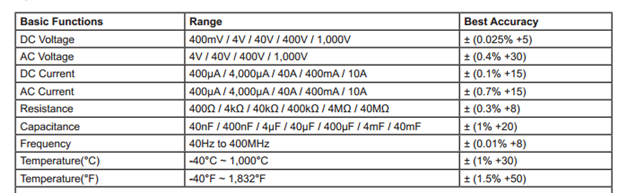
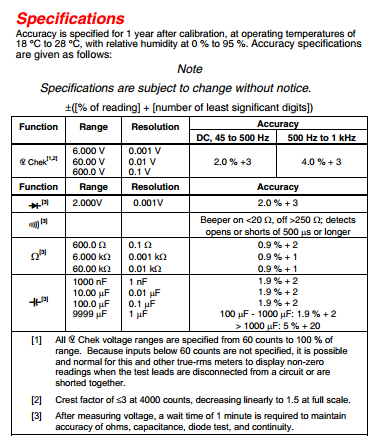
    Your testing has shown some of the fineprint in those 'cheap' meters.


    I think the heading was "Best Accuracy", but didn't say it was across the whole range

    image

    Tenma basic

    image

    Tenma advanced


    image

    Fluke Basic (113)


    So it seems that 2% is not gone and we aren't spoiled at all.


    mark

    • Cancel
    • Vote Up +1 Vote Down
    • Sign in to reply
    • Cancel
  • Gough Lui
    Gough Lui over 11 years ago in reply to mcb1

    Very well spotted. I always assumed "Best Accuracy" was a translation error on Uni-Trend's behalf. I suppose, instead, they might mean that's where the bottom of the "curved" error percentage slope is guaranteed to hit instead, in which case it's a fairly useless spec. It's like saying that my kitchen scales have a best error of 0gm!


    Alas, the Fluke 113 specs seem a little disappointing, but also, a lot more truthful. I suspect one must spend even more than that ...


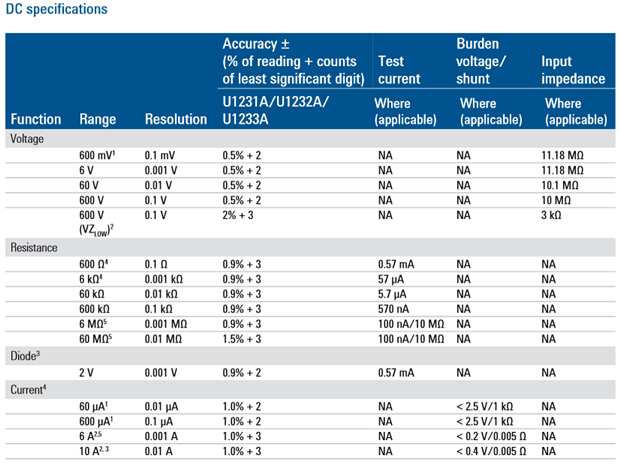
    At the basic end of Agilent Technologies/Keysight Technologies range is the U1231A, listed at AU$116 (http://au.element14.com/keysight-technologies/u1231a/multimeter-trms-6600-count-4-digit/dp/1903369):

    image

    So, it looks like it's a 0.5% + 2 digits for the "basic" voltage. Surprising the difference in spec between the Fluke and this one - but it seems that's where the 3.5 digit meters "wanted to be" but weren't.


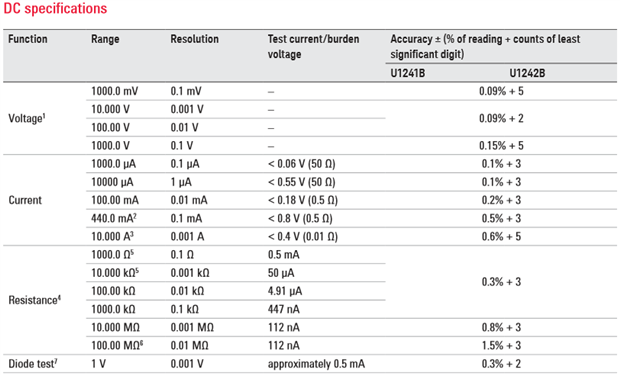
    Spending a little more, we might be able to improve the accuracy further - Agilent Technologies/Keysight Technologies U1241B, listed at AU$241 (http://au.element14.com/keysight-technologies/u1241b/multimeter-trms-10000-count-4-digit/dp/1780325):

    image

    Considering that both units are 4-digit, this one says it's 0.09% + 5 digits. So while its percentage error is much less, the error number of digits in the least significant digit is higher.


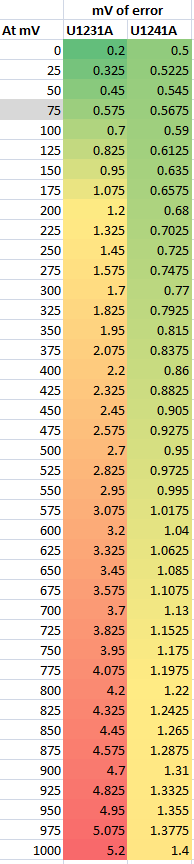
    How would this affect a range, I wondered ... so I did a quick Excel calculation using the 1000mV range as an example:

    image

    It seems that ~75mV into the 1000mV scale, we are close to the break-even point where the increased error of 0.5% overtakes the +5 digits of uncertainty. So the more expensive meter is likely to show more errors for readings below ~75mV on the 1000mV scale (i.e. 0.75% scale deflection). I suppose this can be an issue if the ranges are strict and feature no overlap - so say measuring 1.002v on the 10v scale ...


    Still rather fascinating and head-scratch inducing specs image.

    • Cancel
    • Vote Up 0 Vote Down
    • Sign in to reply
    • Cancel
>
element14 Community

element14 is the first online community specifically for engineers. Connect with your peers and get expert answers to your questions.

  • Members
  • Learn
  • Technologies
  • Challenges & Projects
  • Products
  • Store
  • About Us
  • Feedback & Support
  • FAQs
  • Terms of Use
  • Privacy Policy
  • Legal and Copyright Notices
  • Sitemap
  • Cookies

An Avnet Company © 2025 Premier Farnell Limited. All Rights Reserved.

Premier Farnell Ltd, registered in England and Wales (no 00876412), registered office: Farnell House, Forge Lane, Leeds LS12 2NE.

ICP 备案号 10220084.

Follow element14

  • X
  • Facebook
  • linkedin
  • YouTube