element14 Community
element14 Community
    Register Log In
  • Site
  • Search
  • Log In Register
  • Community Hub
    Community Hub
    • What's New on element14
    • Feedback and Support
    • Benefits of Membership
    • Personal Blogs
    • Members Area
    • Achievement Levels
  • Learn
    Learn
    • Ask an Expert
    • eBooks
    • element14 presents
    • Learning Center
    • Tech Spotlight
    • STEM Academy
    • Webinars, Training and Events
    • Learning Groups
  • Technologies
    Technologies
    • 3D Printing
    • FPGA
    • Industrial Automation
    • Internet of Things
    • Power & Energy
    • Sensors
    • Technology Groups
  • Challenges & Projects
    Challenges & Projects
    • Design Challenges
    • element14 presents Projects
    • Project14
    • Arduino Projects
    • Raspberry Pi Projects
    • Project Groups
  • Products
    Products
    • Arduino
    • Avnet & Tria Boards Community
    • Dev Tools
    • Manufacturers
    • Multicomp Pro
    • Product Groups
    • Raspberry Pi
    • RoadTests & Reviews
  • About Us
  • Store
    Store
    • Visit Your Store
    • Choose another store...
      • Europe
      •  Austria (German)
      •  Belgium (Dutch, French)
      •  Bulgaria (Bulgarian)
      •  Czech Republic (Czech)
      •  Denmark (Danish)
      •  Estonia (Estonian)
      •  Finland (Finnish)
      •  France (French)
      •  Germany (German)
      •  Hungary (Hungarian)
      •  Ireland
      •  Israel
      •  Italy (Italian)
      •  Latvia (Latvian)
      •  
      •  Lithuania (Lithuanian)
      •  Netherlands (Dutch)
      •  Norway (Norwegian)
      •  Poland (Polish)
      •  Portugal (Portuguese)
      •  Romania (Romanian)
      •  Russia (Russian)
      •  Slovakia (Slovak)
      •  Slovenia (Slovenian)
      •  Spain (Spanish)
      •  Sweden (Swedish)
      •  Switzerland(German, French)
      •  Turkey (Turkish)
      •  United Kingdom
      • Asia Pacific
      •  Australia
      •  China
      •  Hong Kong
      •  India
      • Japan
      •  Korea (Korean)
      •  Malaysia
      •  New Zealand
      •  Philippines
      •  Singapore
      •  Taiwan
      •  Thailand (Thai)
      • Vietnam
      • Americas
      •  Brazil (Portuguese)
      •  Canada
      •  Mexico (Spanish)
      •  United States
      Can't find the country/region you're looking for? Visit our export site or find a local distributor.
  • Translate
  • Profile
  • Settings
Wireless
  • Technologies
  • More
Wireless
Blog Bad Antennas
  • Blog
  • Forum
  • Documents
  • Polls
  • Quiz
  • Events
  • Mentions
  • Sub-Groups
  • Tags
  • More
  • Cancel
  • New
Join Wireless to participate - click to join for free!
  • Share
  • More
  • Cancel
Group Actions
  • Group RSS
  • More
  • Cancel
Engagement
  • Author Author: gervasi
  • Date Created: 23 Oct 2013 8:14 PM Date Created
  • Views 963 views
  • Likes 0 likes
  • Comments 3 comments
  • matching
  • cb
  • antenna
Related
Recommended

Bad Antennas

gervasi
gervasi
23 Oct 2013

imageThere's a saying in EMI that any conductive feature longer than a quarter wavelength can be an antenna.  All it takes is one piece of metal a quarter wavelength long and another piece of metal to be the “ground” or the other half of the dipole. The metal will radiate all frequencies above this point, the saying goes. 


The positive thing about this is you can generally use a larger antenna for shorter wavelengths.  An antenna that resonates on the 10m band will usually work decent on the 2m band.  At my home I have a  5-meter-long vertical designed to be a half-wave antenna for 10m.  Despite it being poorly matched for 2m, I can still use it for that band.  When I measure it with a network analyzer, about half the power I send to it at 2m is reflected back.  Some of the power is lost both ways in the coax, so maybe only 25% of the power gets to the antenna.  All received and transmitted signals will be 6dB weaker than they would be with a good antenna.  If two stations with such poor antennas try to communicate, they lose 12dB of link budget.  That means they could cut their output power by over 15 times if they both used good antennas.  That sounds horrible, but each 6dB is only one S-unit.  If one side switched to a well-matched antenna, that side would only send and receive one unit stronger on a signal meter. 


I tried to take advantage of this a few weeks ago when I was at a park about 30 miles outside of town.  I wanted to listen to NOAA weather radio, so I connected my Uniden BC95XLT scanner to a Cobra HGA-1000 mag mount antenna on my car roof.  The antenna is designed for the 11 meter CB band.  It's one of those designed to look like an 80s-era mobile phone antenna.  There were few cell towers in those days, so you needed a decent antenna to access the AMPS cellular network.  A mobile phone and antenna was a status symbol.  11m CB was a free-for-all and not a status symbol.  The look-alike antenna is much shorter than a quarter wavelength.  A built-in loading coil matches the antenna to the 50-ohm feedline. 


The NOAA weather stations are around 162MHz, just under 2 meters, so I figured the 11m antenna would work fine.  Surprisingly, the rubber duck that came with the BC95XLT scanner worked much better even in the passenger compartment than the 11m antenna centered on the roof.


When I got back to town I threw both antennas on the vector network analyzer (VNA).  As expected the CB antenna looked fine in the CB band, which is centered on 27.185MHz:
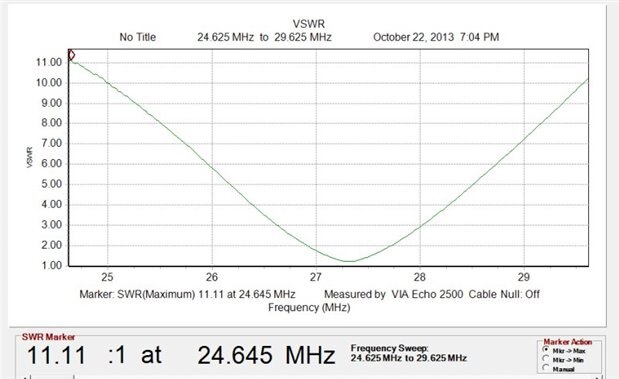
image


Here is the Smith Chart plot of S11 of the CB antenna:
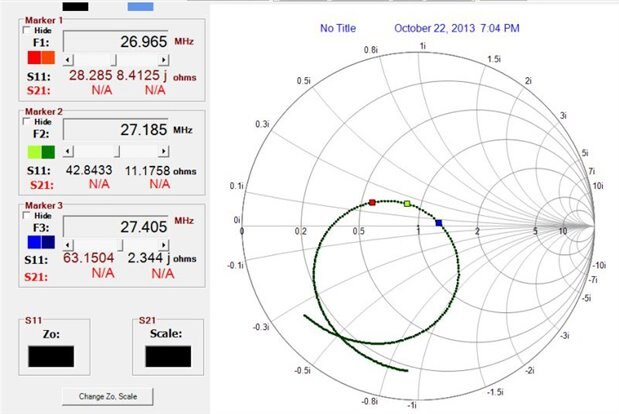
image


imageEven though the BC95XLT scanner covers the CB band and works pretty well there, the duck antenna that comes with it is god-awful for VHF-low (26-54MHz).
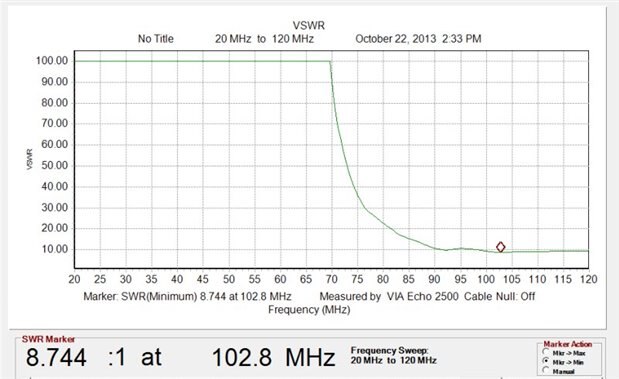
image


The duck on the scanner just looks like an open at low frequencies on the Smith Chart.
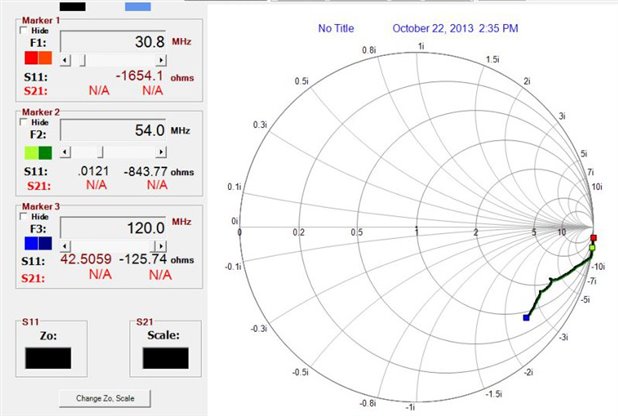
image


The CB antenna on the car stays at a constant level of mismatch, with an SWR around 6.5:1 but makes a loop into near perfect match in the CB band.
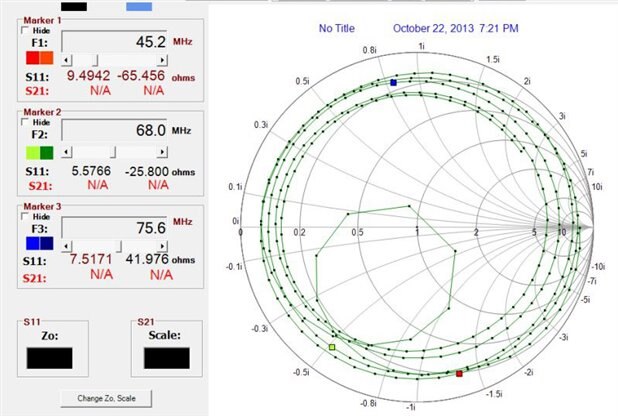
image


When I look at the rubber duck across the entire band (a zoomed out version of the 20MHz-120MHz plot above), it looks decent across the entire coverage of the scanner, except for VHF-low. 

image


The CB antenna shows modest reflections at higher frequencies, but this may be because the feedline and the matching network are lossy at high frequencies.  Despite this plot, the CB antenna clearly does not work well for VHF:
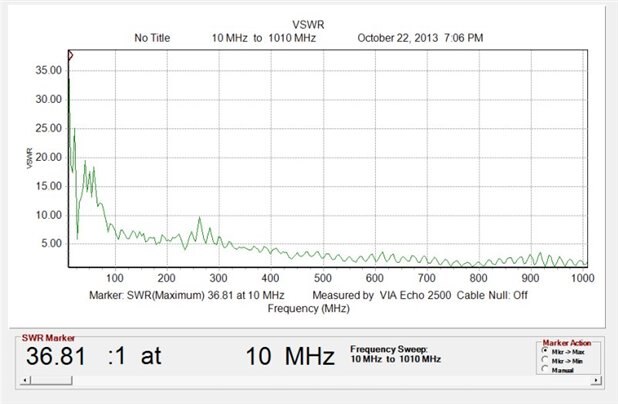
image


After I took this data, I tried again to listen to weather stations with both antennas.  The duck that came with the scanner clearly does better at 162MHz than the antenna on the car. 


This case shows that just because the power isn't being reflected doesn't mean the antenna is working well.  I suspect the loading coil on the CB antenna absorbs power at VHF, making it look better on the SWR meter. 


This case also shows that the notion that antennas will work at okay somewhat on bands well above their design frequency is not always true. 

  • Sign in to reply
  • gervasi
    gervasi over 11 years ago in reply to kas.lewis

    Thanks.  It comes down to my thinking that any CB antenna would work decent (not great) for VHF.  It turns out that antenna works great for its side on CB but hardly works at all on VHF.

    • Cancel
    • Vote Up 0 Vote Down
    • Sign in to reply
    • More
    • Cancel
  • kas.lewis
    kas.lewis over 11 years ago

    Very interesting post. I will probably read it again when I'm not at work so I can read it a bit more carefully and not just do a quick skim.

    • Cancel
    • Vote Up 0 Vote Down
    • Sign in to reply
    • More
    • Cancel
  • DAB
    DAB over 12 years ago

    Great Post.


    My dad was big into CB's when they first got popular back in the 1960's,

    He started off with the cheap antennas, but soon found that he needed better equipment to do the things he wanted.

    He mounted a huge antenna on the house with the full rotation control.  He did miss the point about properly matching impedences, but he still was able to do some impressive things with his setup.


    As you and I have discussed before, the manufacturers just build to meet a basic spec.  Little if any optimization is done, but in their defence, there is no way to plan for everyones basic setup.  I have seen some really creative ways to hook the equipment together.


    I soon realized that the CB gear was just like the computer gear.  Compatibility is in the eye of the user, not the manufacturer.


    Plus, people can have a lot of fun with devices that they really do not understand.  The really serious ones end up taking a lot of electronics courses and acquiring good test equipment so that they can squeeze better performance from their gear.


    DAB


    • Cancel
    • Vote Up 0 Vote Down
    • Sign in to reply
    • More
    • Cancel
element14 Community

element14 is the first online community specifically for engineers. Connect with your peers and get expert answers to your questions.

  • Members
  • Learn
  • Technologies
  • Challenges & Projects
  • Products
  • Store
  • About Us
  • Feedback & Support
  • FAQs
  • Terms of Use
  • Privacy Policy
  • Legal and Copyright Notices
  • Sitemap
  • Cookies

An Avnet Company © 2025 Premier Farnell Limited. All Rights Reserved.

Premier Farnell Ltd, registered in England and Wales (no 00876412), registered office: Farnell House, Forge Lane, Leeds LS12 2NE.

ICP 备案号 10220084.

Follow element14

  • X
  • Facebook
  • linkedin
  • YouTube