element14 Community
element14 Community
    Register Log In
  • Site
  • Search
  • Log In Register
  • Community Hub
    Community Hub
    • What's New on element14
    • Feedback and Support
    • Benefits of Membership
    • Personal Blogs
    • Members Area
    • Achievement Levels
  • Learn
    Learn
    • Ask an Expert
    • eBooks
    • element14 presents
    • Learning Center
    • Tech Spotlight
    • STEM Academy
    • Webinars, Training and Events
    • Learning Groups
  • Technologies
    Technologies
    • 3D Printing
    • FPGA
    • Industrial Automation
    • Internet of Things
    • Power & Energy
    • Sensors
    • Technology Groups
  • Challenges & Projects
    Challenges & Projects
    • Design Challenges
    • element14 presents Projects
    • Project14
    • Arduino Projects
    • Raspberry Pi Projects
    • Project Groups
  • Products
    Products
    • Arduino
    • Avnet & Tria Boards Community
    • Dev Tools
    • Manufacturers
    • Multicomp Pro
    • Product Groups
    • Raspberry Pi
    • RoadTests & Reviews
  • About Us
  • Store
    Store
    • Visit Your Store
    • Choose another store...
      • Europe
      •  Austria (German)
      •  Belgium (Dutch, French)
      •  Bulgaria (Bulgarian)
      •  Czech Republic (Czech)
      •  Denmark (Danish)
      •  Estonia (Estonian)
      •  Finland (Finnish)
      •  France (French)
      •  Germany (German)
      •  Hungary (Hungarian)
      •  Ireland
      •  Israel
      •  Italy (Italian)
      •  Latvia (Latvian)
      •  
      •  Lithuania (Lithuanian)
      •  Netherlands (Dutch)
      •  Norway (Norwegian)
      •  Poland (Polish)
      •  Portugal (Portuguese)
      •  Romania (Romanian)
      •  Russia (Russian)
      •  Slovakia (Slovak)
      •  Slovenia (Slovenian)
      •  Spain (Spanish)
      •  Sweden (Swedish)
      •  Switzerland(German, French)
      •  Turkey (Turkish)
      •  United Kingdom
      • Asia Pacific
      •  Australia
      •  China
      •  Hong Kong
      •  India
      • Japan
      •  Korea (Korean)
      •  Malaysia
      •  New Zealand
      •  Philippines
      •  Singapore
      •  Taiwan
      •  Thailand (Thai)
      • Vietnam
      • Americas
      •  Brazil (Portuguese)
      •  Canada
      •  Mexico (Spanish)
      •  United States
      Can't find the country/region you're looking for? Visit our export site or find a local distributor.
  • Translate
  • Profile
  • Settings
Wireless
  • Technologies
  • More
Wireless
Blog Full-duplex wireless, deployment imminent
  • Blog
  • Forum
  • Documents
  • Polls
  • Quiz
  • Events
  • Mentions
  • Sub-Groups
  • Tags
  • More
  • Cancel
  • New
Join Wireless to participate - click to join for free!
  • Share
  • More
  • Cancel
Group Actions
  • Group RSS
  • More
  • Cancel
Engagement
  • Author Author: Eavesdropper
  • Date Created: 9 Sep 2011 7:46 PM Date Created
  • Views 1084 views
  • Likes 1 like
  • Comments 4 comments
  • research
  • on_campus
  • full_duplex
  • eavesdropper
  • wireless
  • university
  • innovation
  • communication
  • transmission
Related
Recommended

Full-duplex wireless, deployment imminent

Eavesdropper
Eavesdropper
9 Sep 2011
image
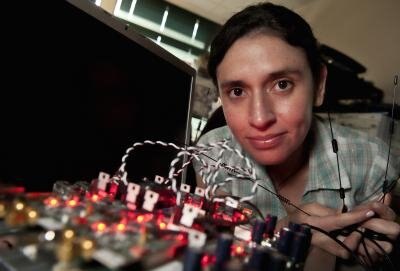
Ashutosh Sabharwal (via Rice University)
 
Full duplex Wireless Communication means getting your cake while you're eating it too. Ashutosh Sabharwal, a brilliant professor from Rice University, has made an amazing breakthrough in wireless data communications world of possibilities. The concept is like two people screaming at the same time in a large arena very far away from each other, but how can they hear each other? The answer is canceling out the sound of the screams coming from the sender so that the only sound they can hear is the sound of the other person's voice.
 
Sabharwal explained, "We send two signals such that they cancel each other at the receiving antenna -- the device ears. The canceling effect is purely local, so the other node can still hear what we're sending." These extra antennas send out canceling frequencies from the sending receiver.
 
Sabharwal continued, "We repurposed antenna technology called MIMO, which are common in today's devices. MIMO stands for 'multiple-input multiple-output' and it uses several antennas to improve overall performance. We took advantage of the multiple antennas for our full-duplex scheme, which is the main reason why all wireless carriers are very comfortable with our technology."

 
Rice University's idea was conceived and tested some months ago.
 
 
Now the team is back with a new goal, Sabharwal stated that their technology could be added to all cell towers, and no additional structures will be needed.  They have already "attracted the attention of just about every wireless company in the world." No wonder, the possibility of doubling the data throughput is quite exciting.
 
This technology will not be available until carriers upgraded their speed to "4 1/2G" or "5G" speeds, but the team is hopeful that this will be available in the next couple of years. Sabharwal is head of the WARP project at Rice University the acronym WARP stands for wireless open-access research platform. This enables them to be able to experience full-duplex wireless communication.
 
Eavesdropper
  • Sign in to reply
  • gervasi
    gervasi over 12 years ago

    Inexpensive MIMO is the most amazing technology I have worked with. 

    • Cancel
    • Vote Up 0 Vote Down
    • Sign in to reply
    • More
    • Cancel
  • gervasi
    gervasi over 12 years ago in reply to Former Member

    I've been trying to learn more about undersea cables.  I don't think it would have been this exact same technique, though, because this technique requires sources (antennas) spaced at least a half wavelength apart. 

    • Cancel
    • Vote Up 0 Vote Down
    • Sign in to reply
    • More
    • Cancel
  • Former Member
    Former Member over 14 years ago in reply to DAB

    Wasn't this technique used on undersea cables to get rid of echos and with Ethernet cables to overcome near-far signal strength interference?

    Carl007

    • Cancel
    • Vote Up 0 Vote Down
    • Sign in to reply
    • More
    • Cancel
  • DAB
    DAB over 14 years ago

    I love these simple solutions.  When you find them, you smack yourself in the forehead and say "why didn't I think of that?"


    That said, I have usually found it confusing to be talking and listening at the same time.  Even with the best intention, you miss important issues.  Now for data, this approach makes perfect sense.


    DAB

    • Cancel
    • Vote Up 0 Vote Down
    • Sign in to reply
    • More
    • Cancel
element14 Community

element14 is the first online community specifically for engineers. Connect with your peers and get expert answers to your questions.

  • Members
  • Learn
  • Technologies
  • Challenges & Projects
  • Products
  • Store
  • About Us
  • Feedback & Support
  • FAQs
  • Terms of Use
  • Privacy Policy
  • Legal and Copyright Notices
  • Sitemap
  • Cookies

An Avnet Company © 2025 Premier Farnell Limited. All Rights Reserved.

Premier Farnell Ltd, registered in England and Wales (no 00876412), registered office: Farnell House, Forge Lane, Leeds LS12 2NE.

ICP 备案号 10220084.

Follow element14

  • X
  • Facebook
  • linkedin
  • YouTube