


 When I wrote about the mobile data explosion last year, I was surprised so much mobile data is video. When I use video even on a coffee shop Wi-Fi I feel like a bandwidth hog because I remember tying up my parents’ phone for hours to download software at 2.4kbps. I suspect the average user is not aware of how bandwidth intensive video is. Even if they are aware, digital video is something people want and are willing to pay for.
Amazingly, one single service, YouTube, currently accounts for 25% of mobile data traffic. It almost makes the mobile data network seem like a platform for a single company. As of last year, Netflix accounted for 5% of mobile bandwidth and is predicted to increase.
To avoid being a burden on the network, the YouTube app needs to buffer some of the data quickly and then keep that buffer fill without needlessly downloading the entire video at once. In addition to increased instantaneous demand on the network, buffering an entire video would be wasteful since many videos are aborted before the end.
 Researchers at the University of Granada tested the way the YouTube app downloads and buffers data on various platforms. When the YouTube video player gets search results, the server returns the clip ID, title, thumbnail, and a list of URLs for various formats of the video. The application selects a different format depending on whether it’s connected to the mobile network or Wi-Fi.
When a user selects a video, there is an initial high data rate burst phase followed by a lower rate throttling phase. The burst phase downloads 40s of video on a wired network or 34s on the wireless. The Android app also limits the initial burst to 2MB on the mobile network and 4 to 8 MB when connected to WiFi.
During the throttling phase, download proceeds at the encoding rate of the video times a throttling factor. The mobile YouTube app uses a throttling factor of 2.0 while the PC website uses 1.25. For low rate videos, the app and the PC website download at at least 200kb/sec even if this is many times faster than the encoding rate.
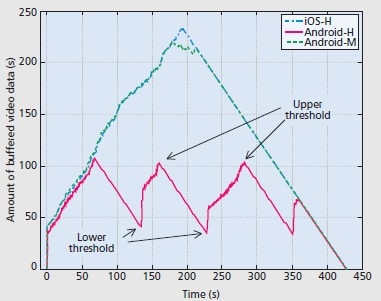 The YouTube app on an iOS device (iPhone 4s) and a mid-range Android (Sony Xperia U) device appear to carry on downloading at the throttling factor until the entire video is downloaded or until the app runs out of buffer memory. The high-end Android device that researchers tested (Samsung Galaxy S-II) deploys what the researchers call a double-threshold rule to buffering. When the amount of buffered video falls below 40 seconds, it goes back to downloading in throttling mode until 100 seconds of video is buffered. A clearer name for this for this might be a hysteresis region around a desired duration of buffered video.
Conclusion
I hope technologies to deal with the mobile data explosion work, so that users don’t need to be mindful of the cost of digital video. When I first heard of this, I thought it seems so inefficient to use mobile data to transport video, but it doesn’t have to be. It’s inefficient compare to a TV broadcast, but on-demand video is much more valuable.
One idea is to buffer the most popular content, including video, locally on base stations. Downloading a locally-buffered video from a pico-cell base is in some ways more efficient than having one high-power TV transmitter high on a tower.
If this works, watching video over the mobile network inexpensively will be a fact of life. Maybe it has already become that for people with inexpensive 3G or 4G service. I just heard my local 2G provider, AirFire Mobile, is going out of business. My first reaction to the idea of streaming video over the mobile network may change once I have higher-speed access.
Further Reading
