element14 Community
element14 Community
    Register Log In
  • Site
  • Search
  • Log In Register
  • Community Hub
    Community Hub
    • What's New on element14
    • Feedback and Support
    • Benefits of Membership
    • Personal Blogs
    • Members Area
    • Achievement Levels
  • Learn
    Learn
    • Ask an Expert
    • eBooks
    • element14 presents
    • Learning Center
    • Tech Spotlight
    • STEM Academy
    • Webinars, Training and Events
    • Learning Groups
  • Technologies
    Technologies
    • 3D Printing
    • FPGA
    • Industrial Automation
    • Internet of Things
    • Power & Energy
    • Sensors
    • Technology Groups
  • Challenges & Projects
    Challenges & Projects
    • Design Challenges
    • element14 presents Projects
    • Project14
    • Arduino Projects
    • Raspberry Pi Projects
    • Project Groups
  • Products
    Products
    • Arduino
    • Avnet & Tria Boards Community
    • Dev Tools
    • Manufacturers
    • Multicomp Pro
    • Product Groups
    • Raspberry Pi
    • RoadTests & Reviews
  • About Us
  • Store
    Store
    • Visit Your Store
    • Choose another store...
      • Europe
      •  Austria (German)
      •  Belgium (Dutch, French)
      •  Bulgaria (Bulgarian)
      •  Czech Republic (Czech)
      •  Denmark (Danish)
      •  Estonia (Estonian)
      •  Finland (Finnish)
      •  France (French)
      •  Germany (German)
      •  Hungary (Hungarian)
      •  Ireland
      •  Israel
      •  Italy (Italian)
      •  Latvia (Latvian)
      •  
      •  Lithuania (Lithuanian)
      •  Netherlands (Dutch)
      •  Norway (Norwegian)
      •  Poland (Polish)
      •  Portugal (Portuguese)
      •  Romania (Romanian)
      •  Russia (Russian)
      •  Slovakia (Slovak)
      •  Slovenia (Slovenian)
      •  Spain (Spanish)
      •  Sweden (Swedish)
      •  Switzerland(German, French)
      •  Turkey (Turkish)
      •  United Kingdom
      • Asia Pacific
      •  Australia
      •  China
      •  Hong Kong
      •  India
      • Japan
      •  Korea (Korean)
      •  Malaysia
      •  New Zealand
      •  Philippines
      •  Singapore
      •  Taiwan
      •  Thailand (Thai)
      • Vietnam
      • Americas
      •  Brazil (Portuguese)
      •  Canada
      •  Mexico (Spanish)
      •  United States
      Can't find the country/region you're looking for? Visit our export site or find a local distributor.
  • Translate
  • Profile
  • Settings
Wireless
  • Technologies
  • More
Wireless
Blog Testing Wireless Power
  • Blog
  • Forum
  • Documents
  • Polls
  • Quiz
  • Events
  • Mentions
  • Sub-Groups
  • Tags
  • More
  • Cancel
  • New
Join Wireless to participate - click to join for free!
  • Share
  • More
  • Cancel
Group Actions
  • Group RSS
  • More
  • Cancel
Engagement
  • Author Author: gervasi
  • Date Created: 21 Jan 2013 4:13 AM Date Created
  • Views 912 views
  • Likes 0 likes
  • Comments 3 comments
  • qi_complaint
Related
Recommended

Testing Wireless Power

gervasi
gervasi
21 Jan 2013

In the mid 90s someone posted a question in an online forum asking what kind of network cable it would be good to install in a house with the idea of it being an addition that future owners of the house could use.  Someone replied that wireless networking would replace cables in home networks.  I wrote that this claim was optimistic.  To get the throughput needed, you’d need a high symbol rate, which would make it vulnerable to inter-symbol interference.  Or you could have a large alphabet size, but that would require a high SNR.  imageMoreover you’d need collision avoidance that works well.  I knew it worked in MATLAB, but I didn’t foresee it being adopted widely in the home.

 

Two years ago, when I bought my home, I found there were Ethernet cables connected to an each room.  In some of the rooms they weren’t terminated, and the easiest way to deal with them was to pull all the slack and cut them.  It would be a pain if I ever wanted to have those cables in those rooms, but I was completely confident I wouldn’t.  As I did it, I felt like the universe was ribbing me about my forum post 15 years earlier.


So I try to be open-minded about the idea of eliminating power cables.  It’s easy to couple power magnetically.  The efficiency drops rapidly, though, when the distance between the coils exceeds one coil diameter. 


I tried testing some Qi-complaint TI eval boards.  The transmitter was bq500210EVM-689.  The receiver was bq51013EVM-725. You provide 19V DC to the transmitter.  The receiver provides 5V DC and provides a maximum of 1A. 


I observed the efficiency decrease when I placed paper between the the coils, but not by all the much. 


Coil SeparationOutput LoadInput Power Output PowerEfficiency
No LinkNA0.17 W0
Direct Contact of Eval ModulesOpen0.80 W0
170 mils [4.3mm] of paperOpen1.00 W0
Direct Contact of Eval Modules50 ohms1.69 W0.5 W30%
170 mils [4.3mm] of paper50 ohms2.02 W0.5 W25%


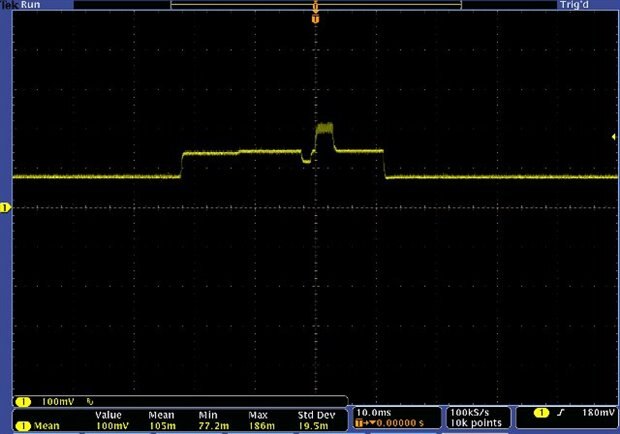
With no link, the "analog ping" looking for a load drew an irregular current for 35ms every 400ms.  (Below I measure it with a 10-ohm current sense resistor.)
 

image


I couldn’t go more than about a quarter inch [6mm] before it would shut off.  I suspect this is because it needs communication.  The Qi standard is not designed to operate at distances where efficiency would be very low. 


I suspect non-Qi-compliant products will appear that receive a tiny fraction of transmitted power.  If someone works out a way, say, to harvest 5% of the power coming from a 100W transmitter over a distance of a meter, applications will crop up everywhere.  Coffee shops could put them under the tables so computer users wouldn’t have to plug in.  The efficiency is terrible, but people will plug in those 100W transmitters with the same lack of thought people used to give to turning on a 100W incandescent bulb.

  • Sign in to reply
  • sleuz
    sleuz over 12 years ago

    I love the over-all idea of wireless power...I am sure we can increase the efficiency and the distance of it so it gets even more convenient for people.


    Maybe check out Wireless Power Solution for more information about this technology and Qi.

    • Cancel
    • Vote Up 0 Vote Down
    • Sign in to reply
    • More
    • Cancel
  • gervasi
    gervasi over 12 years ago in reply to DaveYoung

    I certainly hope coffee shops don't implement 95W-wasting tables!  Aside from the environmental concerns, think of the heat dissipation!


    It's not desirable, but I could easily see it happening.  People put 100W incandescents over each table in some places.  I'm thinking if it could do 5% efficiency over several meters, places would spend several hundred watts on such a system.  It definitely is an environmental issue, esp in the summer and in warm climates where you don't need the extra heat. 

    • Cancel
    • Vote Up 0 Vote Down
    • Sign in to reply
    • More
    • Cancel
  • DaveYoung
    DaveYoung over 12 years ago

    Thanks for the data!  I'm glad you're keeping an open mind about wireless power -- although I'll be the one to say widespread wireless power is optimistic.  At least until there is a way to bring up the efficiencies, which I guess is what happened with wireless data figuring out how to effectivly transmit data.  I certainly hope coffee shops don't implement 95W-wasting tables!  Aside from the environmental concerns, think of the heat dissipation!

    • Cancel
    • Vote Up 0 Vote Down
    • Sign in to reply
    • More
    • Cancel
element14 Community

element14 is the first online community specifically for engineers. Connect with your peers and get expert answers to your questions.

  • Members
  • Learn
  • Technologies
  • Challenges & Projects
  • Products
  • Store
  • About Us
  • Feedback & Support
  • FAQs
  • Terms of Use
  • Privacy Policy
  • Legal and Copyright Notices
  • Sitemap
  • Cookies

An Avnet Company © 2025 Premier Farnell Limited. All Rights Reserved.

Premier Farnell Ltd, registered in England and Wales (no 00876412), registered office: Farnell House, Forge Lane, Leeds LS12 2NE.

ICP 备案号 10220084.

Follow element14

  • X
  • Facebook
  • linkedin
  • YouTube