


Traditional landline telephones may disappear by 2018. Many calls today are carried by VoIP on both ends and pass through the old switching network only because governments and industry have been slow to work out an upgrade path.
The issue came up again on earlier this year Verizon said it would not replace some copper phone wire connections damaged by Hurricane Sandy. Instead it would offer a device called Voice Link that connects to the Verizon network and simulates a plain old telephone service (POTS) connection. Customers in Fire Island, off of Long Island, would have no landline option. Verizon backed away from the plan due to customer dissatisfaction with Voice Link for several reasons: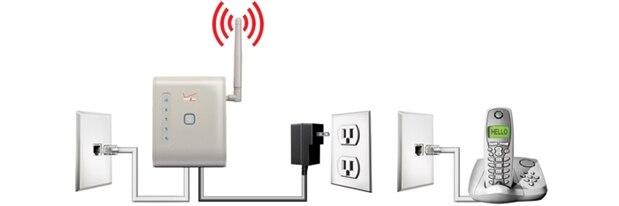
- The copper wires provide DSL. DSL would no longer be available to these customers if landline service were discontinued.
- Voice Link does not support fax and modem connections, including merchant credit card processing, medical device updates, and burglar alarms..
- Voice Link is unreliable, according to some customers.
- Voice Link cannot accept collect calls. Outgoing calls cannot be placed through another company using a dial-around number. (People still use 10-10-[code] dial-around long-distance service?)
 Just last week, Verizon said it will phase out landline service for Mantoloking, NJ. Verizon seems determined to phase out landline service in some markets and eventually everywhere.
The New York Times in another article put it that residents of Fire Island wanted “some kind of wire connecting their home phone to the outside world.” I question that claim. People buy a drill not because they want a drill but because they want holes. People care about the performance issues, not the underlying technology. It sounds like Voice Link is not “ready for prime time”, but the bugs will be worked out before legacy phone equipment is gone. Data functionality, similar to copper transporting data from the DSLAM to the user, can happen wirelessly. Bandwidth will be an issue, but it’s already an issue due to the explosion in mobile data.
Verizon’s media relations department did not respond to my requests for an interview.
Phasing Out Landlines
Daniel Berger, founder of the Voice Communication Exchange Committee, talked to me in detail about the Verizon issue and how it relates to phasing out of landline telephones.
1995 was the last year the voice calls were carried 100% on the telephone network. This was the same system that had been in place since 1876. For this reason Berger sometimes refers to the voice telephone network as the landline system of 1995.
Berger says the issues Verizon customers had on Fire Island are typical early adopter bugs. Everyone will have to transition away from the traditional landline. The first people to do so will experience less reliability. The trouble in Fire Island was the early adopters were not early adopters by choice.
The motivation for the switch is that fewer people are using landlines. The system requires a certain number of users to remain economically viable. As people abandon the 1995 landline system, more markets will be forced to be early adopters of the wireless telephones.
Will we still have “five nines”?
In the old days, kids chatting on the phone got the same priority and reliability as emergency calls. In the future, context will determine the level of service. People willing to pay for five nines will be able to get it, but never again will all phone users get the exact same reliability. Berger makes an analogy to attorneys buying a faster and more reliable printer than someone buying a copier for casual home use.
The DSL Issue
Eliminating landlines makes DSL more expensive. This may mean some customers in suburban areas losing the option of DSL. Berger says many services are harder to get in less urban regions, and Internet service is no exception. Whether the government should subsize service to those areas is a political issue. Staying with the 1995 system for the benefit of those rural users, Berger says, is not an option. IP technology is fundamentally better. The cost of maintaining a wire to a rural house is the same, regardless of what you put on that wire.
Telecommunications / IT Merger
All telecommunications technology will be part of IT. Whether people want seven-digit numbers to initiate a voice chat to them will be entirely up to users.
Conclusion
The POTS telephone will disappear. Some method of high-speed low-latency (i.e. not satellite) Internet will be made available to customers who lose DSL service. At the same time, the TDM switching network that connects dialed calls will be used less and eventually disappear. Keeping the POTS over twisted pair service going indefinitely to preserve reliability is not an option.
We are living in a watershed time for communications technology. Throughout living memory, people have made voice calls on the same system, a system planned to disappear in the next few years.
Further Reading
- Lost in America: Still no Phone Service After Hurricane Sandy (May 14, 2012) - Seven months after Sandy, Verizon says it may not replace all damaged phone lines.
- Wireless Home Phones: A Plan Strikes a Cord (May 20, 2012) - NYT writes about Verizon “nudging” people toward wireless
- Verizon Backing Off Plans for Wireless Home Phones (Sept 12, 2013) - Verizon agrees to maintain landline service on Fire Island but says it will continue offering wireless home phone service in Mantoloking, NJ
- On a New Jersey Islet, Twilight of the Landline (Oct 14, 2013)-
- Stop Verizon’s Voice Link - An article critical of Voice Link from a website critical of the telco industry.
Top Comments
-

DAB
-
Cancel
-
Vote Up
+1
Vote Down
-
-
Sign in to reply
-
More
-
Cancel
Comment-

DAB
-
Cancel
-
Vote Up
+1
Vote Down
-
-
Sign in to reply
-
More
-
Cancel
Children