By: Ahmad Radhy
Volatile organic compounds (VOCs) are gases that are given off by many indoor sources. Concentrations of most volatile organic compounds are higher in indoor air than outdoor air. VOCs include a variety of chemicals that can cause eye, nose, and throat irritation, shortness of breath, headaches, fatigue, nausea, dizziness, and skin problems. Higher concentrations may cause irritation of the lungs, as well as damage to the liver, kidney, or central nervous system. Long-term exposure may also cause damage to the liver, kidneys or central nervous system (https://www.healthlinkbc.ca/healthlinkbc-files/air-quality-VOCs).
WHO revealed that Covid-19 is transmitted through droplets, aka splashes of saliva from people infected by the coronavirus when they cough or sneeze. The droplet that was sprayed by a large Covid-19 sufferer was 0.125 micrometers in diameter, so it was not light enough to stay long and far in the air. The farthest, the throw is about one or two meters. The particles will float briefly before finally falling to the surface of objects around the patient. There is no evidence that airborne transmission can occur in the natural environment. That is why washing hands is the main suggestion for the prevention of contracting Covid-19. On the other hand, in medical procedures at hospitals that produce aerosols, airborne transmission is possible. The explanation is simple. Head of the WHO Emerging Disease and Zoonosis Unit Dr. Maria Van Kerkhove said, due to medical procedures, the coronavirus droplet particles can become aerosols, which are fine particles that can last long in the air.
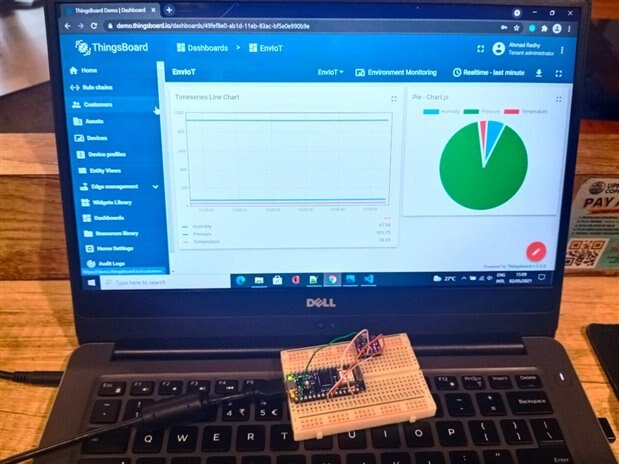
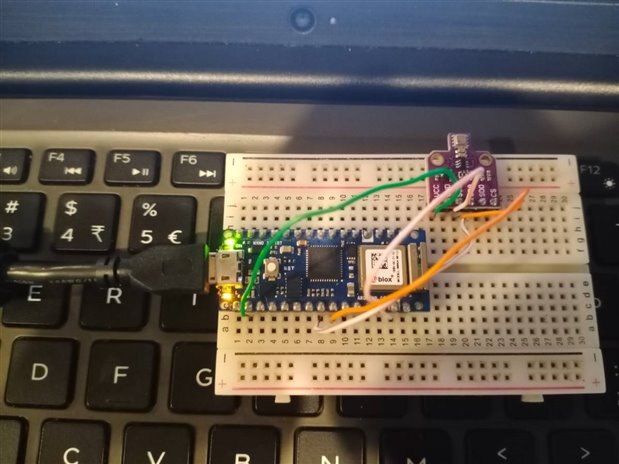
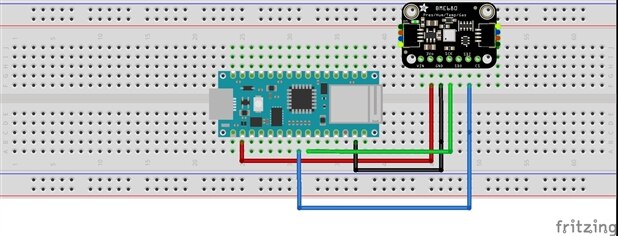
BME680 sensor (https://www.bosch-sensortec.com/products/environmental-sensors/gas-sensors/bme680/) integrated with IoT cloud is based on the Internet of Things (IoT) integrated with smart sensors able to collect data for monitoring every day in the hospital and schoolroom. The duration of monitoring could be set as well as the monitoring results are also directly connected and actually recorded on the cloud database. IoT technology updates information on environment parameters and volatile organic compounds in real-time. The core of technology in this project is now applying sensors through IoT to monitor physical quantities affect the air quality, what is the relationship between environmental condition inside the room like working space, hospital room, and school.
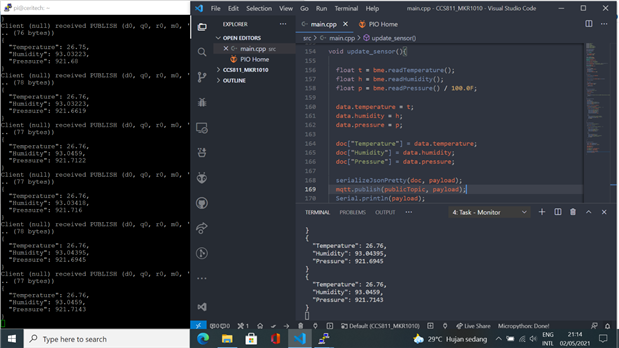
IoT hardware system consisting of Arduino Nano 33 IoT and BME680 environment sensor from Bosch is used to measure air temperature, humidity, pressure, and total volatile organic compound (VOC), temperature, pressure, and humidity sensor module inside the room to make sure sterilization. Data sent to IoT cloud is by using PubSubClient MQTT library (https://github.com/knolleary/pubsubclient).
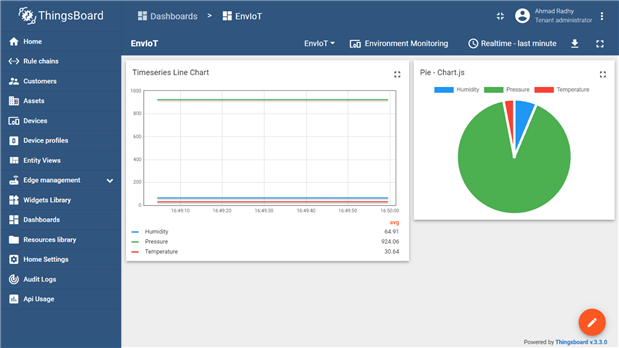
To integrate the BME680 sensor with Arduino Nano 33 IoT, we could use the library https://github.com/adafruit/Adafruit_BME680. Then All data collected to publish payload data on IoT cloud by using Arduino Json packet (https://arduinojson.org/) are visualized on Thingsboard IoT cloud (https://thingsboard.io/ ).