element14 Community
element14 Community
    Register Log In
  • Site
  • Search
  • Log In Register
  • Community Hub
    Community Hub
    • What's New on element14
    • Feedback and Support
    • Benefits of Membership
    • Personal Blogs
    • Members Area
    • Achievement Levels
  • Learn
    Learn
    • Ask an Expert
    • eBooks
    • element14 presents
    • Learning Center
    • Tech Spotlight
    • STEM Academy
    • Webinars, Training and Events
    • Learning Groups
  • Technologies
    Technologies
    • 3D Printing
    • FPGA
    • Industrial Automation
    • Internet of Things
    • Power & Energy
    • Sensors
    • Technology Groups
  • Challenges & Projects
    Challenges & Projects
    • Design Challenges
    • element14 presents Projects
    • Project14
    • Arduino Projects
    • Raspberry Pi Projects
    • Project Groups
  • Products
    Products
    • Arduino
    • Avnet & Tria Boards Community
    • Dev Tools
    • Manufacturers
    • Multicomp Pro
    • Product Groups
    • Raspberry Pi
    • RoadTests & Reviews
  • About Us
  • Store
    Store
    • Visit Your Store
    • Choose another store...
      • Europe
      •  Austria (German)
      •  Belgium (Dutch, French)
      •  Bulgaria (Bulgarian)
      •  Czech Republic (Czech)
      •  Denmark (Danish)
      •  Estonia (Estonian)
      •  Finland (Finnish)
      •  France (French)
      •  Germany (German)
      •  Hungary (Hungarian)
      •  Ireland
      •  Israel
      •  Italy (Italian)
      •  Latvia (Latvian)
      •  
      •  Lithuania (Lithuanian)
      •  Netherlands (Dutch)
      •  Norway (Norwegian)
      •  Poland (Polish)
      •  Portugal (Portuguese)
      •  Romania (Romanian)
      •  Russia (Russian)
      •  Slovakia (Slovak)
      •  Slovenia (Slovenian)
      •  Spain (Spanish)
      •  Sweden (Swedish)
      •  Switzerland(German, French)
      •  Turkey (Turkish)
      •  United Kingdom
      • Asia Pacific
      •  Australia
      •  China
      •  Hong Kong
      •  India
      • Japan
      •  Korea (Korean)
      •  Malaysia
      •  New Zealand
      •  Philippines
      •  Singapore
      •  Taiwan
      •  Thailand (Thai)
      • Vietnam
      • Americas
      •  Brazil (Portuguese)
      •  Canada
      •  Mexico (Spanish)
      •  United States
      Can't find the country/region you're looking for? Visit our export site or find a local distributor.
  • Translate
  • Profile
  • Settings
Design For A Cause 2021
  • Challenges & Projects
  • Design Challenges
  • Design For A Cause 2021
  • More
  • Cancel
Design For A Cause 2021
Blog EpiDoor: a door guard preventing epidemics | #1 Introduction & Concept
  • Blog
  • Forum
  • Documents
  • Polls
  • Files
  • Mentions
  • Sub-Groups
  • Tags
  • More
  • Cancel
  • New
  • Share
  • More
  • Cancel
Group Actions
  • Group RSS
  • More
  • Cancel
Engagement
  • Author Author: embedded_sergey
  • Date Created: 6 Mar 2021 11:47 AM Date Created
  • Views 1096 views
  • Likes 8 likes
  • Comments 8 comments
  • design_challenge
  • arduino project
  • designforcause
  • arduino nano 33 iot
  • arduino
  • design_for_a_cause_2021
Related
Recommended

EpiDoor: a door guard preventing epidemics | #1 Introduction & Concept

embedded_sergey
embedded_sergey
6 Mar 2021

Problem description

image

In the era of COVID19 and new pandemics in future, it becomes critical to count and limit the number of people physically located in the same place at the same time. That policy allows national governments to hold the spreading of epidemics down and adapt their health systems to new medical and economical challenges. To cope with that, researchers and engineers shall develop new technologies and tools which will be easily implemented in all countries despite their economical situations. So, in other words, such inventions should be open-source and inexpensive to be available for everyone.This is the point where open-source prototyping boards meet urgent needs of all humankind. They are relatively cheap, customisable and reliable devices that may not only perform loaded programs and control the situation based on input information from sensors, but also communicate to each other. The last feature, also known as "Internet of Things" (IoT), allows engineers and IT enthusiasts build and control complex systems for themselves and organisations with a limited budget. I would like to develop one of such systems, called 'EpiDoor', which would help local organisations such as shops, gyms, schools and universities to cope with COVID19 and future epidemics in a more efficient way.

Aim of the device

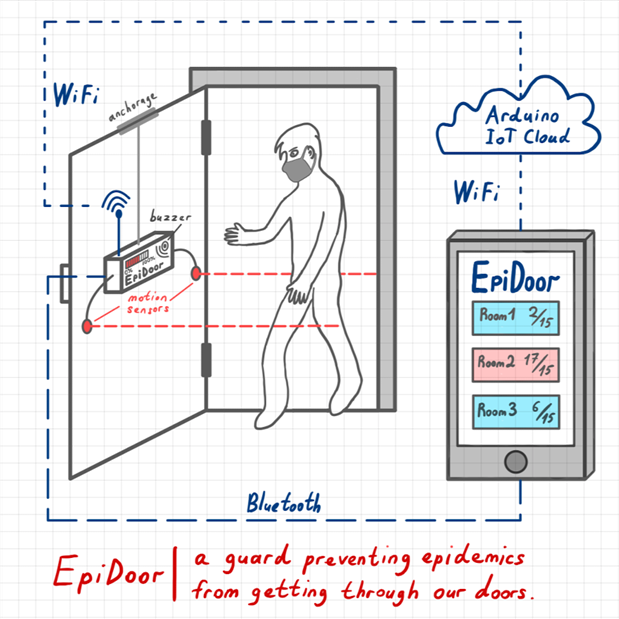
The main aim of the 'EpiDoor' device is to count, control and report the number of people going in and out of a particular indoor location, e.g. a shop, a lecture room, or a cinema hall. Several 'EpiDoor' devices will be connected into a network via WiFi allowing an administration of a local organisation to monitor the situation via a phone in real-time. Such automation will make the process of following official policies from health organisations a more effective tool to prevent the spreading of epidemics in the field.The conception of the 'EpiDoor' device is illustrated bellow.
 

image


Key features of the device

  1. quick installation on a door
  2. only wireless communication
  3. battery-powered
  4. ease to assemble
  5. low-budjet hardware (< 50$ in total)
  6. free software including an IoT service.

Why Arduino Nano IoT?

Arduino Nano IoT represent an ideal platform for realisation of the "EpiDoor" project. It is a relatively inexpensive prototyping board providing wireless communications, power-efficiency, reliability and compactness. The Bluetooth communication allows a user to control the situation directly using a mobile phone in the absence of Internet, while WiFi connects devices to the Internet through an IoT service/server. The most suitable IoT service for this project is Arduino IoT Cloud having a free service plan and mobile applications for both Android and iOS mobile devices.

About the kit and its components

The "EpiDoor" device will consists of seven elements:

  • Arduino Nano IoT
  • two ultrasonic/IR sensors
  • ten segment LED bar
  • buzzer
  • breadboard
  • pack of batteries
  • enclosure

Two ultrasonic or IR sensors are used for counting the number of people coming in and out. A ten segment LED bar shows the occupancy rate, while a buzzer will be activated when there are more people than allowed. In addition, the notification will be sent via Bluetooth or WiFi from Arduino Nano IoT to a mobile phone. All the components and Arduino will be connected through a breadboard, supplied by 5V power-source, and packed into an enclosure.

Implementation plan

In brief, the beginning of April will be devoted to setting up the 'EpiDoor' prototype without any wireless communication: testing sensors and the idea itself. In the second part of April and the beginning of May, I will work on Bluetooth and WiFi communication of 'EpiDoor' with a mobile phone. Particularly, testing IoT service(s) and API(s), working on remote alarm notifications and monitoring of occupancy rate in several locations. The remaining days in May will be used for testing autonomous work in the field, packing the components into a solid enclosure and recording a demonstration video how to use the device for the final blog post. The schedule will be as in the following table.

Note: the Arduino IoT device will be delivered only on April 1. Thus, implementation plan has been edited.


Date


To do
March 6-31

- order all the components

- write a Blog 1 Introduction & Concept

April 1 - April 4

- connect and test the ultrasonic or IR sensors to Arduino Nano

- write first Arduino sketch for counting people using two sensors

- make a Blog 2

April 5-11

- connect a buzzer and a 10 LED display to the circuit

- write the code for a sound alarm

- write the code for occupancy rate visualisation

- make a Blog 3

April 12-18

- get familiar with Bluetooth communication

- connect EpiDoor with a phone via Bluetooth

- make a Blog 4

April 19-25

- get familiar with WiFi communication

- connect EpiDoor with a phone via Arduino IoT Cloud

- make a Blog 5

April 26-May 2

- design a small app to monitor EpiDoor remotely (Bluetooth)

- design a small app to monitor EpiDoor remotely (WiFi)

- make a Blog 6

May 3-9

- solve the case with a few doors in the location

- solve how to monitor several EpiDoor devices simultaneously

- make a Post 7

May 10-16

- test batteries and autonomic work of EpiDoor

- pack it into an enclosure

- make a Blog 8

May 17-23

- apply last improvements to the device and the code

- record a short movie about real-life applications of EpiDoor

- editing the video

- make a Blog 9

May 24-27

- publish the video on YouTube

- make a Final Blog 10


Thank you for your attention!

  • Sign in to reply

Top Comments

  • embedded_sergey
    embedded_sergey over 4 years ago in reply to skruglewicz +2
    Thank you, Steve! I am glad to get feedback from more experienced users and collaborate with them. Let's see how it goes.
  • skruglewicz
    skruglewicz over 4 years ago in reply to embedded_sergey +2
    This is a big group for this challenge. I'm New to the Arduino MCU, but plan to learn quit a bit....Steve K
  • embedded_sergey
    embedded_sergey over 4 years ago +1
    P.S.: I had to republish this post as I could not edit it properly and then found in the gmail that there were a couple of comments. I have read these comments in gmail, thanks for your considerations…
  • DAB
    DAB over 4 years ago

    I look forward to seeing the buildout.


    DAB

    • Cancel
    • Vote Up +1 Vote Down
    • Sign in to reply
    • More
    • Cancel
  • embedded_sergey
    embedded_sergey over 4 years ago in reply to skruglewicz

    I am pretty sure you will enjoy learning it! That is an easy and powerful prototyping board, at least from my beginner's perspective.

    • Cancel
    • Vote Up +1 Vote Down
    • Sign in to reply
    • More
    • Cancel
  • skruglewicz
    skruglewicz over 4 years ago in reply to embedded_sergey

    This is a big group for this challenge.  I'm New to the Arduino MCU, but plan to learn quit a bit....Steve K

    • Cancel
    • Vote Up +2 Vote Down
    • Sign in to reply
    • More
    • Cancel
  • embedded_sergey
    embedded_sergey over 4 years ago in reply to skruglewicz

    Thank you, Steve! I am glad to get feedback from more experienced users and collaborate with them. Let's see how it goes.

    • Cancel
    • Vote Up +2 Vote Down
    • Sign in to reply
    • More
    • Cancel
  • skruglewicz
    skruglewicz over 4 years ago in reply to embedded_sergey

    Welcome to the design challenge embedded_sergey

    Creating a blog can be dauting sometimes, but once you get the hang of it, it quit helpful to collaborate online.

    This is my second Challenge. You my friend have a good start.


    Steve K

    • Cancel
    • Vote Up +1 Vote Down
    • Sign in to reply
    • More
    • Cancel
>
element14 Community

element14 is the first online community specifically for engineers. Connect with your peers and get expert answers to your questions.

  • Members
  • Learn
  • Technologies
  • Challenges & Projects
  • Products
  • Store
  • About Us
  • Feedback & Support
  • FAQs
  • Terms of Use
  • Privacy Policy
  • Legal and Copyright Notices
  • Sitemap
  • Cookies

An Avnet Company © 2026 Premier Farnell Limited. All Rights Reserved.

Premier Farnell Ltd, registered in England and Wales (no 00876412), registered office: Farnell House, Forge Lane, Leeds LS12 2NE.

ICP 备案号 10220084.

Follow element14

  • X
  • Facebook
  • linkedin
  • YouTube