element14 Community
element14 Community
    Register Log In
  • Site
  • Search
  • Log In Register
  • Community Hub
    Community Hub
    • What's New on element14
    • Feedback and Support
    • Benefits of Membership
    • Personal Blogs
    • Members Area
    • Achievement Levels
  • Learn
    Learn
    • Ask an Expert
    • eBooks
    • element14 presents
    • Learning Center
    • Tech Spotlight
    • STEM Academy
    • Webinars, Training and Events
    • Learning Groups
  • Technologies
    Technologies
    • 3D Printing
    • FPGA
    • Industrial Automation
    • Internet of Things
    • Power & Energy
    • Sensors
    • Technology Groups
  • Challenges & Projects
    Challenges & Projects
    • Design Challenges
    • element14 presents Projects
    • Project14
    • Arduino Projects
    • Raspberry Pi Projects
    • Project Groups
  • Products
    Products
    • Arduino
    • Avnet & Tria Boards Community
    • Dev Tools
    • Manufacturers
    • Multicomp Pro
    • Product Groups
    • Raspberry Pi
    • RoadTests & Reviews
  • About Us
  • Store
    Store
    • Visit Your Store
    • Choose another store...
      • Europe
      •  Austria (German)
      •  Belgium (Dutch, French)
      •  Bulgaria (Bulgarian)
      •  Czech Republic (Czech)
      •  Denmark (Danish)
      •  Estonia (Estonian)
      •  Finland (Finnish)
      •  France (French)
      •  Germany (German)
      •  Hungary (Hungarian)
      •  Ireland
      •  Israel
      •  Italy (Italian)
      •  Latvia (Latvian)
      •  
      •  Lithuania (Lithuanian)
      •  Netherlands (Dutch)
      •  Norway (Norwegian)
      •  Poland (Polish)
      •  Portugal (Portuguese)
      •  Romania (Romanian)
      •  Russia (Russian)
      •  Slovakia (Slovak)
      •  Slovenia (Slovenian)
      •  Spain (Spanish)
      •  Sweden (Swedish)
      •  Switzerland(German, French)
      •  Turkey (Turkish)
      •  United Kingdom
      • Asia Pacific
      •  Australia
      •  China
      •  Hong Kong
      •  India
      • Japan
      •  Korea (Korean)
      •  Malaysia
      •  New Zealand
      •  Philippines
      •  Singapore
      •  Taiwan
      •  Thailand (Thai)
      • Vietnam
      • Americas
      •  Brazil (Portuguese)
      •  Canada
      •  Mexico (Spanish)
      •  United States
      Can't find the country/region you're looking for? Visit our export site or find a local distributor.
  • Translate
  • Profile
  • Settings
Design For A Cause 2021
  • Challenges & Projects
  • Design Challenges
  • Design For A Cause 2021
  • More
  • Cancel
Design For A Cause 2021
Blog MicroGrid Connection Unit #3: First Prototype
  • Blog
  • Forum
  • Documents
  • Polls
  • Files
  • Mentions
  • Sub-Groups
  • Tags
  • More
  • Cancel
  • New
  • Share
  • More
  • Cancel
Group Actions
  • Group RSS
  • More
  • Cancel
Engagement
  • Author Author: makervanlabs
  • Date Created: 9 May 2021 5:03 PM Date Created
  • Views 427 views
  • Likes 4 likes
  • Comments 1 comment
  • microgrid
  • breadboard
  • designforacause
  • arduino
Related
Recommended

MicroGrid Connection Unit #3: First Prototype

makervanlabs
makervanlabs
9 May 2021

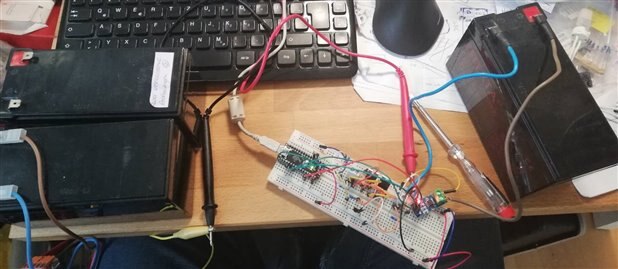
Having done a rough design of the MicroGrid Connection Unit, the next step was to build it on a breadboard and start writing some code. I decided to use a regular Arduino Nano for the first phase, in order to not risk breaking the Nano33 IoT. They are mostly pin compatible so that should be only a small adjustment later on.
 

image

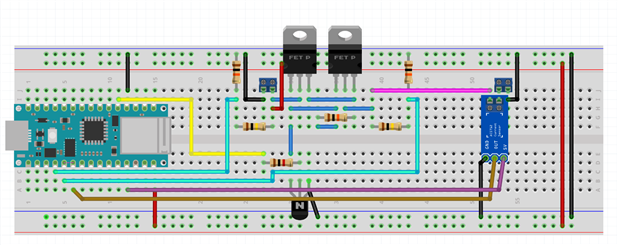
One thing I noticed that I missed in the orginial design post was a way to measure current, which I feel is rather critical. I had some ACS712 modules on hand, so I decided to use one in here. They are supposed to run on 5V, so they work on the regular Nano, but I'll likely have to find a different solution when going back to the Nano33 IoT. But that's for later to figure out. Here's the updated breadboard design:
image


For easy testing, I used two batteries, one to represent the "local system", and one to represent the grid. A few things that I decided to test:

  • Voltage measurement on both sides, with the MOSFET disabled
  • Current measurement
  • MOSFET duty cycle calculation
  • Emergency cutoff


The grid battery has a little less charge, so ideally the local system should feed some energy to the grid battery. I didn't manage to take any pictures, but it seemed to work fine. Using a multimeter, I was able to verify the measurements of both voltage dividers as well as the current measurement. The batteries themselves were not enough to trigger the overcurrent protection, so I added a 12V LED bulb, which did the job. The dutycycle calculation did not manage to quite deal with that situation properly. The overcurrent triggered as it should, but it wasn't able to dial in a decent dutycycle to make it work as I would've liked.
 

image


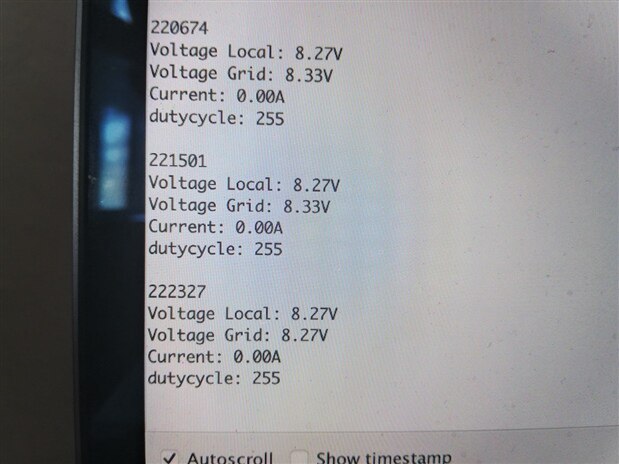
The arduino code provides a bit of debug output, which allowed for some more details on what the connection unit is doing, and why. There'll need to be a bit more testing, which probably requires a better test setup than what you can currently see on my bench. But we have a decent start


The Fritzing file as well as the Arduino source code is now up on GitHub: https://github.com/tiefpunkt/microgrid_connection_unit

  • Sign in to reply
  • DAB
    DAB over 4 years ago

    Nice update.


    DAB

    • Cancel
    • Vote Up 0 Vote Down
    • Sign in to reply
    • More
    • Cancel
element14 Community

element14 is the first online community specifically for engineers. Connect with your peers and get expert answers to your questions.

  • Members
  • Learn
  • Technologies
  • Challenges & Projects
  • Products
  • Store
  • About Us
  • Feedback & Support
  • FAQs
  • Terms of Use
  • Privacy Policy
  • Legal and Copyright Notices
  • Sitemap
  • Cookies

An Avnet Company © 2025 Premier Farnell Limited. All Rights Reserved.

Premier Farnell Ltd, registered in England and Wales (no 00876412), registered office: Farnell House, Forge Lane, Leeds LS12 2NE.

ICP 备案号 10220084.

Follow element14

  • X
  • Facebook
  • linkedin
  • YouTube