


Hi All,
My project synopsis for those who didn't see my application is quite basic in its theory. What I intend to do is create an IoT message bus and transaction system.
I will either roll my own, or something off the shelf with RabbitMQ and then build an API so that devices can readily communicate their results across the network
into the message queueing system and have them displayed in a portal. Of course there are solutions out there that do this already, but there is no harm in rolling
your own proof of concept. I want to do this so I can continue to customise my solution down the track and be able to control how I interact both from the client side and the
server side.
Now onto what I did over the Easter weekend long weekend..
Well I received my kit of parts from Element 14 and after building my new desk on Friday night I was finally in a position to get setup and start work on this design challenge.
Warning.. picture may contain traces of easter eggs... :-)
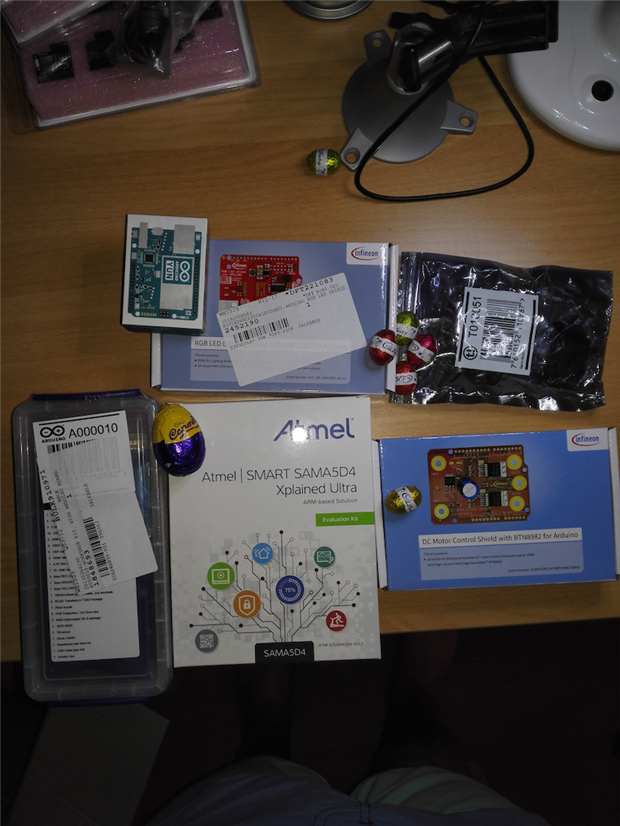
My new corner L shaped desk. 2100mm x 2100mm x 750mm x 730mm (length x width x height)

I'd read a lot about the Atmel SADA5D4 and the trouble people were having, so I figured, let's give this a go. It can't be that hard, right?
Glad to see that people were not exaggerating. If you want a lesson in calm and patience, buy yourself one of these and try to figure out how to make
it work. I managed to get the serial interface working so I could actually talk to the device and was able to build myself a new linux kernel based on Ubuntu.
Currently I am failing because my unix VM can't properly mount my SDCard, which means I can't easily write the OS to the card, but I'll overcome that in the next day or two, I hope.
The operating system installed on the SAMA5D4 is a huge disappointment. The implementation is severely lacking in those everyday tools which could have made
this SBC into a 5 star performer. Had they been able to bundle it with a more complete implementation of UNIX, or even standardised it a little more towards Debian and given us an install
where we could readily use a development toolchain it would have immediately changed how the board can be used. What they really need to do is re-evaluate the board
and enable the functionality that exists on the board via the various interfaces. A good example of this is the HDMI port.
If you are providing a HDMI port, at least include the necessary modules to allow the HDMI port to be used as a console.
I could see this card easily rivalling a Raspberry Pi 2 if a bit more forethought had been put into the software/operating system layer of the card.
Now there are a couple of useful tools installed, there is a http light server as well as python. I could probably use these to roll my own MQ, so even in its vanilla flavour, the SAMA5D4 may
prove to be useful yet. I just can't spend a lot of time working against the tools, I'd rather work with them.
Top Comments