Project Roadmap
Part 1 - Experimental Smart Assistive Platform for Elderly and Disabled People
Part 3 - Wireless Command and H-Bridge Direct Drive
Part 4 - Introducing Autonomous Line Following (TCRT5000)
Part 5 - Non-Contact Proactive Shielding (HC-SR04 Range Finder)
Part 6 - Strict Priority Hierarchy with Tactile Mechanical Bumpers
Part 7 - Mobile Robot Control and Live Video Streaming
The development of intelligent transportation systems is becoming increasingly important, especially in areas related to healthcare, elderly care, and assistive technologies. Autonomous mobility solutions may one day help people with limited mobility move safely and independently inside hospitals, rehabilitation centers, nursing homes, or smart buildings. Before such systems can be implemented in real-life environments, their control algorithms, safety mechanisms, and sensor systems must first be tested on smaller experimental platforms. The SmartAssist EV project was created with this purpose in mind.
SmartAssist EV is not intended to be a full-sized transport vehicle, but rather an experimental prototype platform designed for testing autonomous navigation, obstacle detection, and smart mobility algorithms. The project is based on a compact DIY DC Smart Robot Car Chassis equipped with magnetic speed encoders. Although small in size, the platform is capable of carrying lightweight objects such as a cup of tea, medicine, or small personal items. This makes it ideal for demonstrating assistive transport concepts in a safe and affordable way.
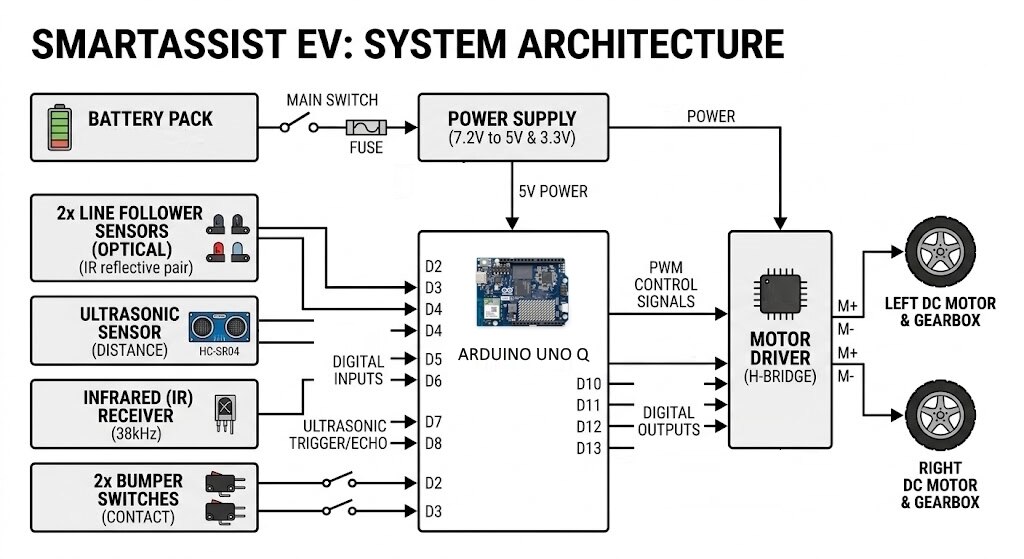
The vehicle is controlled by the Arduino UNO Q SBC, which acts as the main processing unit of the system. Motor control is handled using the L9110 PWM motor drivers, allowing smooth speed regulation, controlled acceleration, and directional movement of the two DC motors. The magnetic wheel encoders provide feedback about wheel rotation and traveled distance, enabling the platform to follow predefined movement paths with improved precision.
A major focus of the project is safety and environmental awareness. To achieve this, the prototype uses a multi-sensor obstacle detection system based on ultrasonic, infrared (IR) and collision sensors. Each sensing technology provides different advantages and helps improve the reliability of the platform.
Ultrasonic sensors measure the distance to nearby obstacles and help prevent collisions with walls, furniture, or people. Infrared sensors are especially useful for detecting edges, stairs, or low obstacles close to the floor surface.
The data collected from all sensors is processed by the Arduino UNO Q SBC, creating a simple sensor fusion system. This allows the platform to intelligently react to its surroundings by slowing down, stopping, changing direction, or warning the operator when obstacles are detected. The project therefore serves as a practical environment for testing mobility-related safety algorithms and autonomous driving logic.
Main Vehicle Features:
1. Remote Control Operation
The user or caregiver can take full control of the vehicle using a wireless remote controller. This feature increases safety and allows manual obstacle avoidance or route modification whenever needed.
2. Advanced Obstacle Detection System
SmartAssist EV uses a multi-sensor safety system based on ultrasonic, infrared (IR), and collision sensors. By combining multiple sensing technologies, the vehicle can effectively detect obstacles and react in real time.
Ultrasonic sensors are responsible for measuring the distance to obstacles located in front of and beside the vehicle.
Infrared sensors are used to detect:
- edges,
- stairs,
- small obstacles,
- objects located close to the ground.
This solution significantly improves user safety, especially in indoor environments.
The Arduino UNO Q SBC processes data from all sensors simultaneously, creating a basic sensor fusion system. This allows the vehicle to:
- make more accurate decisions,
- reduce false alarms,
- improve driving safety,
- automatically adjust navigation paths.