element14 Community
element14 Community
    Register Log In
  • Site
  • Search
  • Log In Register
  • Community Hub
    Community Hub
    • What's New on element14
    • Feedback and Support
    • Benefits of Membership
    • Personal Blogs
    • Members Area
    • Achievement Levels
  • Learn
    Learn
    • Ask an Expert
    • eBooks
    • element14 presents
    • Learning Center
    • Tech Spotlight
    • STEM Academy
    • Webinars, Training and Events
    • Learning Groups
  • Technologies
    Technologies
    • 3D Printing
    • FPGA
    • Industrial Automation
    • Internet of Things
    • Power & Energy
    • Sensors
    • Technology Groups
  • Challenges & Projects
    Challenges & Projects
    • Design Challenges
    • element14 presents Projects
    • Project14
    • Arduino Projects
    • Raspberry Pi Projects
    • Project Groups
  • Products
    Products
    • Arduino
    • Avnet & Tria Boards Community
    • Dev Tools
    • Manufacturers
    • Multicomp Pro
    • Product Groups
    • Raspberry Pi
    • RoadTests & Reviews
  • About Us
    About the element14 Community
  • Store
    Store
    • Visit Your Store
    • Choose another store...
      • Europe
      •  Austria (German)
      •  Belgium (Dutch, French)
      •  Bulgaria (Bulgarian)
      •  Czech Republic (Czech)
      •  Denmark (Danish)
      •  Estonia (Estonian)
      •  Finland (Finnish)
      •  France (French)
      •  Germany (German)
      •  Hungary (Hungarian)
      •  Ireland
      •  Israel
      •  Italy (Italian)
      •  Latvia (Latvian)
      •  
      •  Lithuania (Lithuanian)
      •  Netherlands (Dutch)
      •  Norway (Norwegian)
      •  Poland (Polish)
      •  Portugal (Portuguese)
      •  Romania (Romanian)
      •  Russia (Russian)
      •  Slovakia (Slovak)
      •  Slovenia (Slovenian)
      •  Spain (Spanish)
      •  Sweden (Swedish)
      •  Switzerland(German, French)
      •  Turkey (Turkish)
      •  United Kingdom
      • Asia Pacific
      •  Australia
      •  China
      •  Hong Kong
      •  India
      •  Japan
      •  Korea (Korean)
      •  Malaysia
      •  New Zealand
      •  Philippines
      •  Singapore
      •  Taiwan
      •  Thailand (Thai)
      •  Vietnam
      • Americas
      •  Brazil (Portuguese)
      •  Canada
      •  Mexico (Spanish)
      •  United States
      Can't find the country/region you're looking for? Visit our export site or find a local distributor.
  • Translate
  • Profile
  • Settings
In the Air Design Challenge
  • Challenges & Projects
  • Design Challenges
  • In the Air Design Challenge
  • More
  • Cancel
In the Air Design Challenge
Blog HAB monitoring Post#6 ( Sensor node enclosure design )
  • Blog
  • Forum
  • Documents
  • Polls
  • Files
  • Events
  • Mentions
  • Sub-Groups
  • Tags
  • More
  • Cancel
  • New
  • Share
  • More
  • Cancel
Group Actions
  • Group RSS
  • More
  • Cancel
Engagement
  • Author Author: rmlab
  • Date Created: 11 Dec 2014 1:09 AM Date Created
  • Views 2290 views
  • Likes 3 likes
  • Comments 14 comments
  • buoy
  • carbon_dioxide
  • pvc
  • iot_algal
  • airvantage
  • boosterpack
  • msp430fr5969
  • sierra
  • box
  • launcpad
  • water
  • beagleboneblack
  • in_the_air
  • enclosure
  • texas_instruments
  • iot
  • msp430
  • wireless
  • cc3200
  • solar
  • iot_water
Related
Recommended

HAB monitoring Post#6 ( Sensor node enclosure design )

rmlab
rmlab
11 Dec 2014


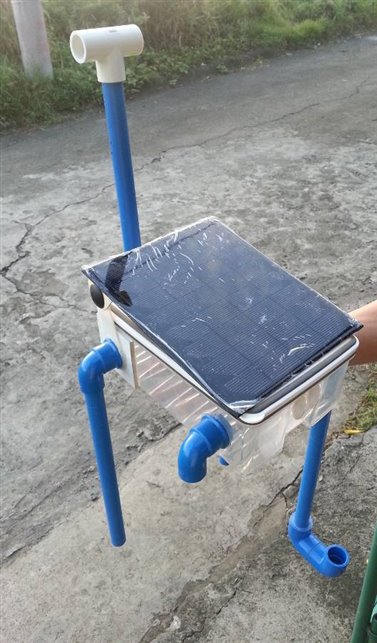
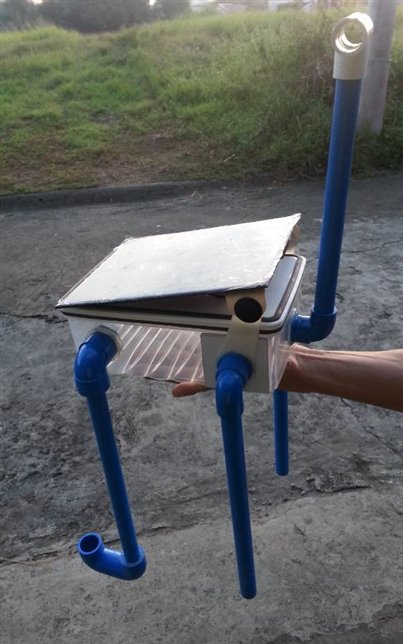
The image below shows my sensor node enclosure. The enclosure is an air-tight box where all electronics ( MSP430FR5969, batteries, C110L tranceiver) will be fixed inside. A total of four PVC elbows with 12 inches pipes are mounted on two longer sides of the air-tight box for sensor probes that will be submerged in the water. Additionally, upward pipe on one of the shorter side is also mounted for the Air temperature and Carbon dioxide sensors. A 5W soloar panel is placed in an inclined position on top of the box. I am still working on the removable holder for the solar panel that can adjusted 45 degrees on the pivot point. This enclosure will be embedded on a bamboo tray before deploying in sea water.
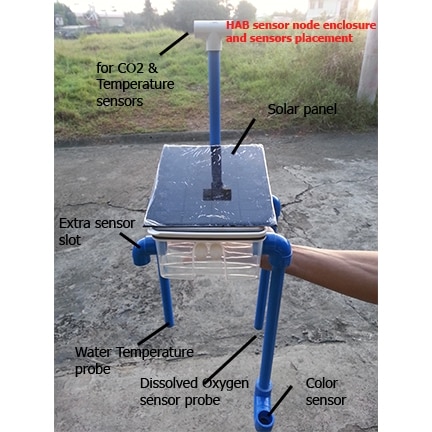


image


Additional photos of the sensor node enclosure.
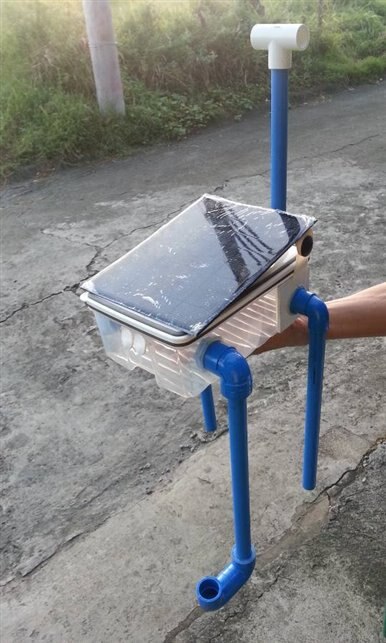
image    imageimage

Click this link Ryan Labutap to view my previous post on this project.

  • Sign in to reply

Top Comments

  • mcb1
    mcb1 over 11 years ago +2
    Ryan If you are having trouble with sealing the upper pipe, you could add a u section so that any water would have to travel upwards before entering. This would ensure that wind blown water is not resting…
  • jw0752
    jw0752 over 11 years ago +2
    Hi Ryan, It looks like you are handling the water challenges of your project very well. Will your raft be tethered in position so that the solar panel remains tilted towards the sun? If so, how will your…
  • mcb1
    mcb1 over 11 years ago in reply to rmlab +2
    Ryan Have a search for mooring hints/suggestions for yachts. They face similar issues where they are tied and subject to wind and current action as well as the tide. You may wish to know how much the tidal…
  • rmlab
    rmlab over 11 years ago in reply to jw0752

    Yes, it will be tethered facing north. I still have to check if it's the optimal direction.

    • Cancel
    • Vote Up 0 Vote Down
    • Sign in to reply
    • More
    • Cancel
  • jw0752
    jw0752 over 11 years ago

    Hi Ryan, It looks like you are handling the water challenges of your project very well. Will your raft be tethered in position so that the solar panel remains tilted towards the sun? If so, how will your tether accommodate the waves and tides? Mark makes some really good points with respect to the seals being in jeopardy if the down pipes can move. If you put rigid porous planes between the pipes you will lock the pipes into place and not create too much drag.

    John

    • Cancel
    • Vote Up +2 Vote Down
    • Sign in to reply
    • More
    • Cancel
  • mcb1
    mcb1 over 11 years ago in reply to rmlab
    corrosion on components

    This will be when moisture is present.

    You could try a double container, where the electronics is inside a small enclosure inside the container, and has the wires terminated with sockets/plugs.


    This would allow the humisorb/silicagel (those moisture absorbing beads) to be used inside the second container.

    It also prevents any field repairs from touching the controller and dripping salt water onto it.


    Whatever you decide, I would strongly suggest trying it before adding the electronics.

    There was a good article recently for a home built Kontiki (2nd reference) where a supposedly sealed LED caused leakage issues and would have destroyed the controller.


    Mark


    • Cancel
    • Vote Up +1 Vote Down
    • Sign in to reply
    • More
    • Cancel
  • rmlab
    rmlab over 11 years ago in reply to mcb1

    Thanks for the inputs Mark. Another concern playing in my mind is the corrosion on components which could be a possible effect of moisture. 

    • Cancel
    • Vote Up +1 Vote Down
    • Sign in to reply
    • More
    • Cancel
  • mcb1
    mcb1 over 11 years ago in reply to rmlab

    Ryan

    I think your raft idea will work.

    You may wish to ensure the fixing of your pipes is very secure.

    The drag from the water pushing and pulling on them will stress the joints where your seal is.


    One simple way of achiving/eliminating it is to tie/fix/join the pipes together with a strap of pastic/bamboo or similar, so that they cannot individually be pushed or pulled.


    Direct wave action will be one source of water, but spray that is driven by the wind is very likely to be another more problematic cause.


    The other problem that people forget about is the water being sucked in due to pressure differences.

    During the day the container will get warm/hot and the air pressure will increase, but during the night it will cool and decrease.

    This heating/cooling usually allows moist air (night) to ingress and becomes trapped inside.


    Some form of containment at the lowest point that can be drained on a regular basis is the best way to handle it, or have the whole thing positively pressurised with dry air.


    Mark

    • Cancel
    • Vote Up +1 Vote Down
    • Sign in to reply
    • More
    • Cancel
<>
element14 Community

element14 is the first online community specifically for engineers. Connect with your peers and get expert answers to your questions.

  • Members
  • Learn
  • Technologies
  • Challenges & Projects
  • Products
  • Store
  • About Us
  • Feedback & Support
  • FAQs
  • Terms of Use
  • Privacy Policy
  • Legal and Copyright Notices
  • Sitemap
  • Cookies

An Avnet Company © 2026 Premier Farnell Limited. All Rights Reserved.

Premier Farnell Ltd, registered in England and Wales (no 00876412), registered office: Farnell House, Forge Lane, Leeds LS12 2NE.

ICP 备案号 10220084.

Follow element14

  • X
  • Facebook
  • linkedin
  • YouTube