element14 Community
element14 Community
    Register Log In
  • Site
  • Search
  • Log In Register
  • Community Hub
    Community Hub
    • What's New on element14
    • Feedback and Support
    • Benefits of Membership
    • Personal Blogs
    • Members Area
    • Achievement Levels
  • Learn
    Learn
    • Ask an Expert
    • eBooks
    • element14 presents
    • Learning Center
    • Tech Spotlight
    • STEM Academy
    • Webinars, Training and Events
    • Learning Groups
  • Technologies
    Technologies
    • 3D Printing
    • FPGA
    • Industrial Automation
    • Internet of Things
    • Power & Energy
    • Sensors
    • Technology Groups
  • Challenges & Projects
    Challenges & Projects
    • Design Challenges
    • element14 presents Projects
    • Project14
    • Arduino Projects
    • Raspberry Pi Projects
    • Project Groups
  • Products
    Products
    • Arduino
    • Avnet & Tria Boards Community
    • Dev Tools
    • Manufacturers
    • Multicomp Pro
    • Product Groups
    • Raspberry Pi
    • RoadTests & Reviews
  • About Us
  • Store
    Store
    • Visit Your Store
    • Choose another store...
      • Europe
      •  Austria (German)
      •  Belgium (Dutch, French)
      •  Bulgaria (Bulgarian)
      •  Czech Republic (Czech)
      •  Denmark (Danish)
      •  Estonia (Estonian)
      •  Finland (Finnish)
      •  France (French)
      •  Germany (German)
      •  Hungary (Hungarian)
      •  Ireland
      •  Israel
      •  Italy (Italian)
      •  Latvia (Latvian)
      •  
      •  Lithuania (Lithuanian)
      •  Netherlands (Dutch)
      •  Norway (Norwegian)
      •  Poland (Polish)
      •  Portugal (Portuguese)
      •  Romania (Romanian)
      •  Russia (Russian)
      •  Slovakia (Slovak)
      •  Slovenia (Slovenian)
      •  Spain (Spanish)
      •  Sweden (Swedish)
      •  Switzerland(German, French)
      •  Turkey (Turkish)
      •  United Kingdom
      • Asia Pacific
      •  Australia
      •  China
      •  Hong Kong
      •  India
      • Japan
      •  Korea (Korean)
      •  Malaysia
      •  New Zealand
      •  Philippines
      •  Singapore
      •  Taiwan
      •  Thailand (Thai)
      • Vietnam
      • Americas
      •  Brazil (Portuguese)
      •  Canada
      •  Mexico (Spanish)
      •  United States
      Can't find the country/region you're looking for? Visit our export site or find a local distributor.
  • Translate
  • Profile
  • Settings
MusicTech
  • Challenges & Projects
  • Design Challenges
  • MusicTech
  • More
  • Cancel
MusicTech
Blog A Brief History of Effects Pedals, Part 1
  • Blog
  • Forum
  • Documents
  • Polls
  • Files
  • Mentions
  • Sub-Groups
  • Tags
  • More
  • Cancel
  • New
  • Share
  • More
  • Cancel
Group Actions
  • Group RSS
  • More
  • Cancel
Engagement
  • Author Author: bluescreen
  • Date Created: 23 Nov 2015 5:47 PM Date Created
  • Views 3594 views
  • Likes 12 likes
  • Comments 28 comments
Related
Recommended

A Brief History of Effects Pedals, Part 1

bluescreen
bluescreen
23 Nov 2015

This is the first in a series of articles which cover the evolution of music effects pedals. If you haven't already done so, join our new MusicTech design challenge and build the music effects pedal of tomorrow!


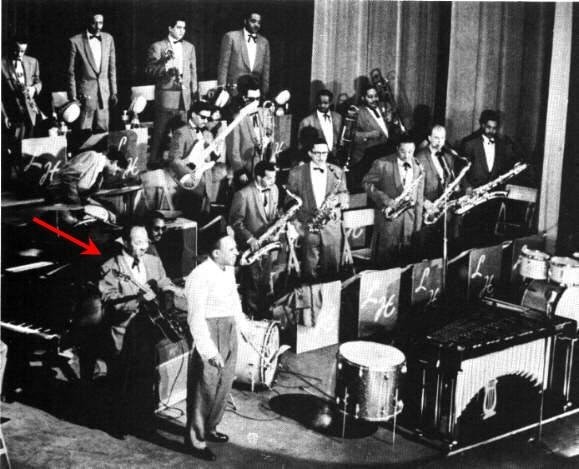
The problem was easy to state, but damnably difficult to solve: how to make guitars louder?


It was the 1930s, and musicians struggled to be heard when playing onstage with louder instrumentalists like drummers and horn players. The very shape of the acoustic guitar, including its soundboard and hollow body, had evolved over time to provide natural amplification to the notes struck by the player. But new forms of popular music in the 1930s—particularly big band and swing—thrilled audiences by featuring powerful brass sections. Guitarists struggled to be heard when playing onstage with brass players.
 

image

This guy had it rough


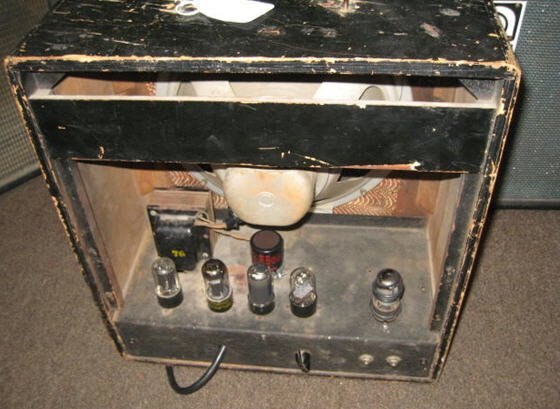
Playing in front of a microphone presented its own challenges, because it often gave rise to painful feedback loops. Starting in the late 1920s, manufacturers like the Stromberg-Voisinet company began to produce amplifiers for electrified string instruments. Magnetic coils placed beneath the strings captured their pitch when struck, converted it into an electronic signal, and conveyed it to an external amp to increase the volume of their instrument. These early amps used electrolytic capacitors and glass rectifier tubes, and solved the volume issue for many musicians.
 

image

Vintage Vega amplifier, circa 1930


But wait, I hear you protest. Isn't this supposed to be about music effects pedals? Why are we talking about amps?


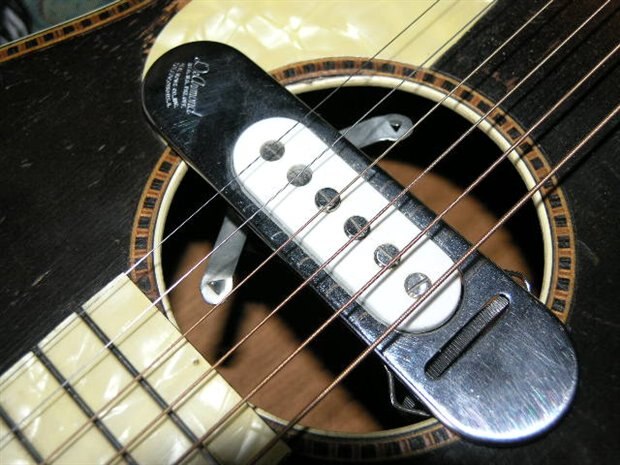
To understand the evolution of pedals, it helps to begin with amps, because when musicians discovered the accidental qualities amplification imparted to their sound, they began to seek these effects as an end in itself. Initially, guitarists were told to match the signal of their instruments with that of their amps to provide a clean increase of volume without adding much coloration or distortion to the instrument's sound. But by the 1940s guitarists were beginning to experiment with the magnetic coils (or "pickups") on their instruments to alter the sound being sent from their instruments. Buddy Guy and Elmore James were among those who sought to match the rawness of blues singers such as Howlin' Wolf and Muddy Waters by modifying the pickups on their instruments.
 

image

Elmore James soundhole pickup


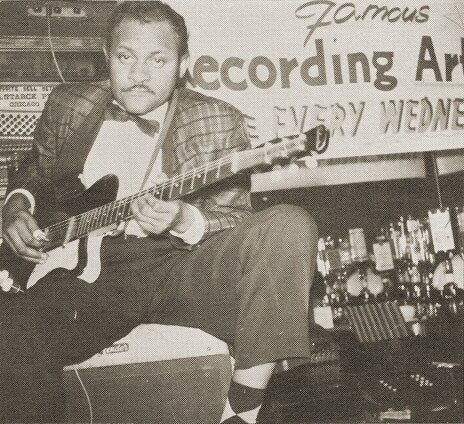
By the 1950s, a new wave of experimentation had began. Guitarists were deliberately overdriving their amps to produce new kinds of tones—tones impossible to produce in a non-electrified setting. Willie Johnson, Joe Hill Louis, and Chuck Berry all recorded songs using overdriven, distorted sounds. Describing the origins of his 1950s guitar sound, Pat Hare explained that he turned the volume knob on his amp "all the way to the right until the speaker was screaming."
 

image

Guitar pioneer Pat Hare


This was not what these devices had been built for. From the moment new technologies were introduced to help guitarists, they began hacking them to produce strange new sounds to take their playing to unimaginable places.


A defining moment arrived in the 1960s when Dave Davies, guitarist for The Kinks, produced a new type of distortion by hooking the already-distorted output of one amp into the input of another amp. This daisy-chaining produced a hitherto-unknown level of distortion which heralded the birth of hard rock in the 1960s.


image

Contemporary daisy-chaining. The instrument is directly connected to the Fender amp on the left, and this amp feeds directly into the Gibson amp on the right.


Then, in 1966, a frustrated guitarist left New York for London. His scant belongings testified to just how hard his life had been in America: a small bag of clothes, plastic hair curlers, acne medicine, and $40 were all he had to his name.


That, and his prized Fender Stratocaster electric guitar.


His name was James Marshall Hendrix, and within a few months he would change the face of music forever.

 

image

Jimi Hendrix's passport photo, 1966


Next: The birth of the effects pedal (coming soon)

  • Sign in to reply

Top Comments

  • Jan Cumps
    Jan Cumps over 10 years ago in reply to Jan Cumps +4
    The schematic is from Elektuur magazine 1985. I had to wait until my first paychecks before I could afford the parts for the build.
  • Jan Cumps
    Jan Cumps over 10 years ago in reply to bluescreen +4
    And this is all that's left of my skills after several years of neglect. www.youtube.com/watch
  • Jan Cumps
    Jan Cumps over 10 years ago in reply to D_Hersey +3
    Here's a guitar amp that I built in (I think) 1988. It's got a spring reverb inside. I'll check if I can open her up later today to have a look at the reverb.
  • D_Hersey
    D_Hersey over 9 years ago

    Santana and McLaughlin, IIRC were early adopters of MESA Boogie amps, which had a relatively controllable overdrive.  Jimi and The Beatles had military RADAR engineers assigned to them. Tourism was one of the few things the Brits had to sell after the war.


    The Fabs had separate eq for their echo.  They were early adopters of this and also bucket-brigade delay lines.

    • Cancel
    • Vote Up 0 Vote Down
    • Sign in to reply
    • More
    • Cancel
  • Former Member
    Former Member over 9 years ago

    Interesting article with important mistakes. The piece about Dave Davies' insertion of one amp between his guitar and another amp isn't illustrated by the illustration. The illustration ties together the INPUT of one amp to the other, Davies was supposed to have wired the OUTPUT of the first amp to the second--which would have overdriven that input as reported. For an article that uses this point so prominently, I am surprised the photo is incorrect. In fact, the term "Daisy Chain" may be the wrong one. Simply tying the inputs of two amplifiers together--the photo is from Telecaster forum, indicating how to play through two amps at once, a very common practice--is not novel.


    Also, the photo of the vintage amp that "used electrolytic capacitors and glass rectifier tubes, and solved the volume issue for many musicians." is a fine example of an amp from that era, but the electrolytic cap is a new one. The familiar "can electrolytic" should be shown in the photo if a period-correct illustration is called for.

    • Cancel
    • Vote Up 0 Vote Down
    • Sign in to reply
    • More
    • Cancel
  • SmilinVamp
    SmilinVamp over 9 years ago

    Very cool article!  Have a look at the UniVibe.... I'd love to read about it.  I tried making one once but could not find the "authentic" varistors...  (Univibe was used by Jimi a lot)

    The Wiki on it: https://en.wikipedia.org/wiki/Uni-Vibe

    • Cancel
    • Vote Up 0 Vote Down
    • Sign in to reply
    • More
    • Cancel
  • Former Member
    Former Member over 9 years ago

    Yes, keep this history about guitar effects going. It was pretty cool when a few years back I met an elderly English gentleman living in Canada who played bass and keyboards in skiffle bands as far back as the early 60's in the U.K. He was asked by some studio chums if he would like to play bass to help out this American chap who was in London and was trying to get some musicians to back him. He said he was fine thank you, but maybe they should give Noel a call. There goes history.


    For my personal interest in this subject, I used to build effects from magazine articlees (Popular Electronics, Radio Electronics) with mixed results and I built a Heathkit guitar amp kit with a spring reverb box and a tremolo circuit using a LDR (Light Dependent Resistor) driven by an oscillator that modulated the light source of the LDR. Fun times.

    • Cancel
    • Vote Up 0 Vote Down
    • Sign in to reply
    • More
    • Cancel
  • jonivanart
    jonivanart over 9 years ago

    Great article! maybe we should let the winner hook my guitar up to it??


    image

    :-)

    It does sound like a great challenge. Too bad I don't have enough knowledge on DSP's or the time to put into it.

    • Cancel
    • Vote Up +1 Vote Down
    • Sign in to reply
    • More
    • Cancel
>
element14 Community

element14 is the first online community specifically for engineers. Connect with your peers and get expert answers to your questions.

  • Members
  • Learn
  • Technologies
  • Challenges & Projects
  • Products
  • Store
  • About Us
  • Feedback & Support
  • FAQs
  • Terms of Use
  • Privacy Policy
  • Legal and Copyright Notices
  • Sitemap
  • Cookies

An Avnet Company © 2025 Premier Farnell Limited. All Rights Reserved.

Premier Farnell Ltd, registered in England and Wales (no 00876412), registered office: Farnell House, Forge Lane, Leeds LS12 2NE.

ICP 备案号 10220084.

Follow element14

  • X
  • Facebook
  • linkedin
  • YouTube