


I have been selected as one of the official participants in the My Project Is Trash challenge hosted by the Element14 community. This is my first post while I wait for the challenge kit, which is already on its way. I would like to take this opportunity to share my proposal and the path that led me to it. I hope you find it interesting and that it inspires a few ideas of your own.
For those who don't know me, I'm a Spanish developer with more than 40 years of experience and a background in industrial engineering, specializing in robotics, electronics, and automatic control systems. My professional career has mainly focused on software development and solutions for payment systems and access control.
I've always been curious about the maker world, and over the last decade I've occasionally participated in the Element14 community, sharing projects that combine microcontrollers, sensors and actuators, analog electronics, and FPGAs. You can find some of those projects in this summary: My element14community Story
My Motivation for Joining This Design Challenge
The main reason is simply to take a break from work and have some fun. I'm fortunate that my whole family usually gets involved in one way or another with these projects.
Recycling small household and office waste is also a topic that concerns me. I know this project is not going to solve the problem, but it may help illustrate some of the challenges involved in waste sorting and classification.
Evaluating Different Ideas
Before settling on a final proposal, I explored several ideas to determine which would be the most interesting, practical, and enjoyable to build.
Below is a summary of some of them, along with their first designs, presented in the same order in which they originally appeared. Every time I worked on one of these concepts, I was convinced I had found the winning idea, until I procrastinated and became distracted by a new one.
Looking back through my notes now, I realize I would still enjoy building all of them. I wouldn't rule out revisiting some of these ideas in the future.
In previous challenges, I used FreeCAD to create the first sketches of my prototypes. This time, I decided to use OpenSCAD, which allows me to create fully parametric designs through code.
Anyway, here are some of those ideas:
Electromechanical Eco-Pinball
I considered building a portable interactive game inside the Hammond enclosure, controlled through gestures using the IR Light Angle Sensor, small impacts detected by the 3-Axis MEMS Accelerometer, bumper switches based on the CamdenBoss CSM40500A Microswitch, and plenty of illuminated indicators using CamdenBoss Panel Mount Indicators.
The goal was to promote environmental awareness and proper waste sorting through gamification. Pinball machines are always fun, and I liked the idea of turning the Hammond enclosure into a miniature pinball machine.
Top view of the inclined pinball playfield.

Interior cross-section of the pinball.

Sorting Game
Following the pinball idea, the next design evolved into a sorting game built inside the enclosure itself. Players would sort different types of waste, represented by balls, using gestures detected by the ADI IR sensor.

Internal view showing the LEDs and CamdenBoss push buttons.

The next step was a refined version of this game.
Recycling Plant Cranes
After several iterations focused on educational games inside the enclosure, my attention shifted toward another aspect of waste sorting: the cranes used in recycling plants.
The idea was to build an electromechanical system capable of picking up small objects and moving them into different sorting areas, reproducing on a small scale some of the processes used in real industrial facilities.
My first design was a simple polar crane using two motors, with the switches acting as limit switches and homing sensors. It could be used either as a game or as an automatic sorting system.

Later, I explored a more visually appealing design based on cables and pulleys driven by stepper motors. The goal was to create a lightweight and relatively simple mechanism capable of positioning a gripper anywhere within the work area.
The first prototype used three motors, but I wasn't satisfied with the available workspace.

Adding a fourth motor increased the workspace, but positioning accuracy depended heavily on cable tension and system calibration, making both the control software and the mechanical construction more complex. I was also concerned about the complexity of the gripper itself.

My next idea was a Cartesian system with linear guides inspired by 3D printers and CNC machines.
This solution was much easier to control, but it exceeded the budget and was starting to drift away from my idea of what a "trash project" should be.

The overall concept remained the same: an educational electromechanical game showing how waste is handled and classified inside a recycling plant.
I kept getting stuck when designing the gripper mechanism. At some point, I realized I could avoid using a gripper altogether by letting gravity do the work. That triggered a small chain reaction in my brain, and the idea for my final proposal appeared: the Smart Tilting Bin.
Project Proposal: Smart Tilting Bin
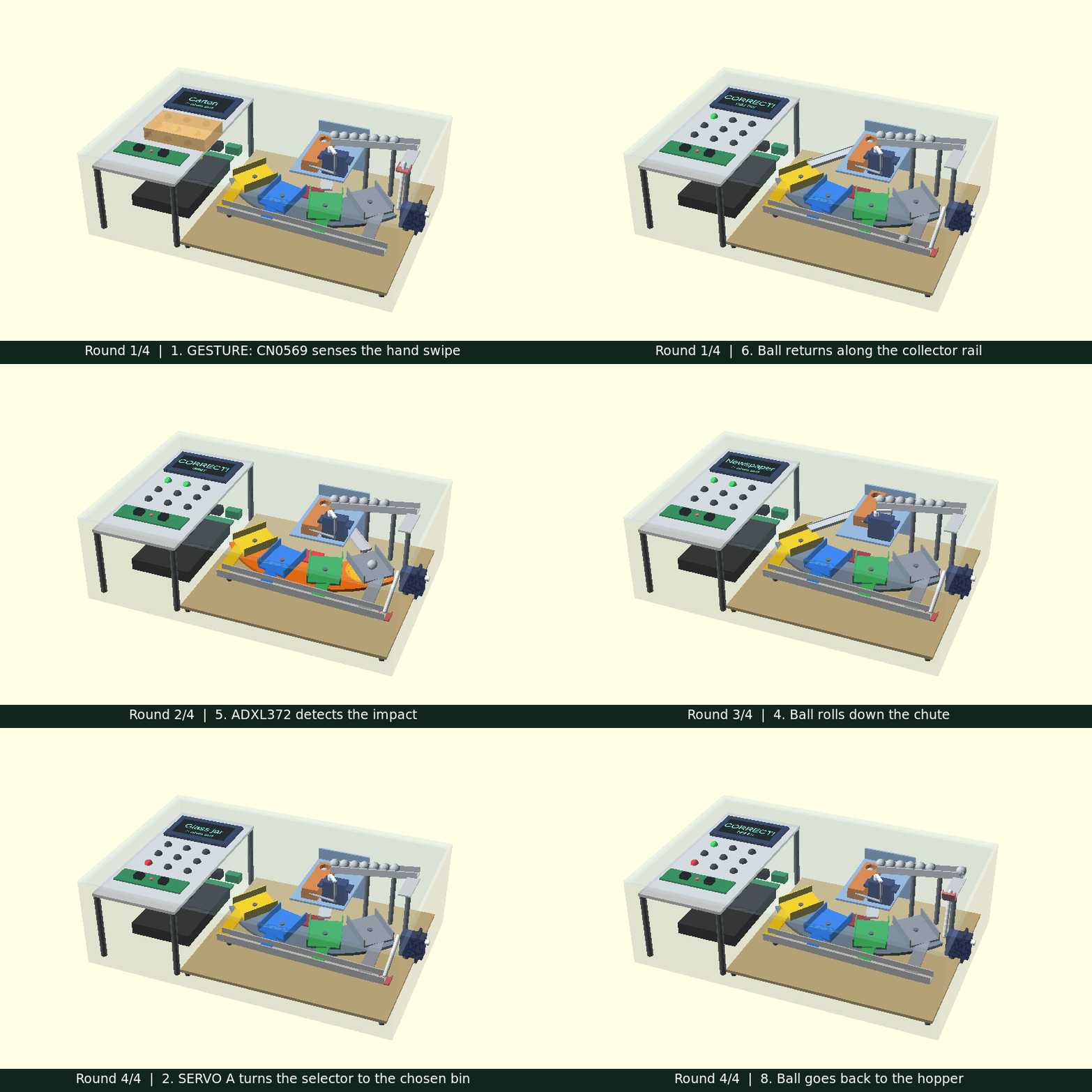
My proposal is a smart bin for small office waste, built mainly from reused household materials such as bowls, tubes, food containers, scrap wood, discarded cables, and bottle caps, combined with electronic components, sensor fusion techniques, and artificial intelligence.

Here's a brief overview of how it works:
1. Multimodal Detection
A camera mounted above the bin observes the object being inserted, while a microphone captures its impact sound and the ADI 3-Axis MEMS Accelerometer records a vibration signature to help resolve ambiguous cases.

2. The Mechanism
A circular concave tray with two cut-outs along its edge acts as a seesaw. It tilts by 45° and rotates by 90° to direct waste into four surrounding bins (packaging, paper, organic waste, and general waste), using only two small motors, including a stepper motor and a homing system based on a CamdenBoss CSM40500A Microswitch.

3. Active Learning Through Gesture Correction
If the AI confidence level is low, the user can simply wave a hand over an infrared gesture sensor (Analog Devices CN0569 IR Light Angle Sensor) to correct the classification. This immediately generates labelled training data for future improvements.

4. Game Mode
A display and several CamdenBoss Panel Mount Indicators provide a built-in guessing game, while an industrial-grade accelerometer protects the device against vandalism or excessively heavy objects.


5. Protection and Control
The AI processing hardware will be protected inside a Hammond 1554X2GYCL Polycarbonate Enclosure IP68, which will also house the electronics responsible for controlling and coordinating the mechanical system.

Wiring between sensors, actuators, and control electronics will use CamdenBoss CTBP93HD/4 and CTBP92HD/4 terminal blocks, making the system easier to assemble, test, and maintain.


Meet Tiltie
One last introduction: meet Tiltie, a magpie and the unofficial mascot of this project. Magpies have a reputation for being smart, curious, and a little mischievous, so the name felt like a good fit. Tiltie will be keeping an eye on the project as it progresses. And if time allows, Tiltie might even make a special appearance in a future update.

What's Next?
While waiting for the free kit to arrive, including evaluation boards and hardware from Analog Devices, Hammond, and CamdenBoss, I am finishing the CAD design and preparing the software environment on a Raspberry Pi CM4 and a Raspberry Pi Pico.
In my next updates, I'll unbox the kit, test the sensors, and start building the physical prototype.
Thanks for reading!

