element14 Community
element14 Community
    Register Log In
  • Site
  • Search
  • Log In Register
  • Community Hub
    Community Hub
    • What's New on element14
    • Feedback and Support
    • Benefits of Membership
    • Personal Blogs
    • Members Area
    • Achievement Levels
  • Learn
    Learn
    • Ask an Expert
    • eBooks
    • element14 presents
    • Learning Center
    • Tech Spotlight
    • STEM Academy
    • Webinars, Training and Events
    • Learning Groups
  • Technologies
    Technologies
    • 3D Printing
    • FPGA
    • Industrial Automation
    • Internet of Things
    • Power & Energy
    • Sensors
    • Technology Groups
  • Challenges & Projects
    Challenges & Projects
    • Design Challenges
    • element14 presents Projects
    • Project14
    • Arduino Projects
    • Raspberry Pi Projects
    • Project Groups
  • Products
    Products
    • Arduino
    • Avnet & Tria Boards Community
    • Dev Tools
    • Manufacturers
    • Multicomp Pro
    • Product Groups
    • Raspberry Pi
    • RoadTests & Reviews
  • About Us
    About the element14 Community
  • Store
    Store
    • Visit Your Store
    • Choose another store...
      • Europe
      •  Austria (German)
      •  Belgium (Dutch, French)
      •  Bulgaria (Bulgarian)
      •  Czech Republic (Czech)
      •  Denmark (Danish)
      •  Estonia (Estonian)
      •  Finland (Finnish)
      •  France (French)
      •  Germany (German)
      •  Hungary (Hungarian)
      •  Ireland
      •  Israel
      •  Italy (Italian)
      •  Latvia (Latvian)
      •  
      •  Lithuania (Lithuanian)
      •  Netherlands (Dutch)
      •  Norway (Norwegian)
      •  Poland (Polish)
      •  Portugal (Portuguese)
      •  Romania (Romanian)
      •  Russia (Russian)
      •  Slovakia (Slovak)
      •  Slovenia (Slovenian)
      •  Spain (Spanish)
      •  Sweden (Swedish)
      •  Switzerland(German, French)
      •  Turkey (Turkish)
      •  United Kingdom
      • Asia Pacific
      •  Australia
      •  China
      •  Hong Kong
      •  India
      •  Japan
      •  Korea (Korean)
      •  Malaysia
      •  New Zealand
      •  Philippines
      •  Singapore
      •  Taiwan
      •  Thailand (Thai)
      •  Vietnam
      • Americas
      •  Brazil (Portuguese)
      •  Canada
      •  Mexico (Spanish)
      •  United States
      Can't find the country/region you're looking for? Visit our export site or find a local distributor.
  • Translate
  • Profile
  • Settings
On the Line
  • Challenges & Projects
  • Design Challenges
  • On the Line
  • More
  • Cancel
On the Line
Forum Misaz’s Forum #2: Breadboarding Industrial Temp + Humidity Sensor
  • News
  • Projects
  • Forum
  • DC
  • Leaderboard
  • Files
  • Members
  • More
  • Cancel
  • New
Join On the Line to participate - click to join for free!
Actions
  • Share
  • More
  • Cancel
Forum Thread Details
  • Replies 1 reply
  • Subscribers 36 subscribers
  • Views 73 views
  • Users 0 members are here
Related

Misaz’s Forum #2: Breadboarding Industrial Temp + Humidity Sensor

misaz
misaz 21 days ago

Hi. I welcome you to my second forum post as part of my participation in On The Line Design Challenge. In this post, I will describe how I prepared Omega HX94 humidity + temperature sensor to enable experimenting with it on breadboard.

Preparing Cable

First step is preparing cable for connecting sensor. It could be definitely done in hacky way, but I tried less hacky way and actually used connector which was bundled in package and mounted it to ethernet cable.

Process is explained in printed manual which come with the sensor:

image

First step is separating connector by unscrewing tiny screw on side:

image

Then you can solder, wires to four contacts inside connector.
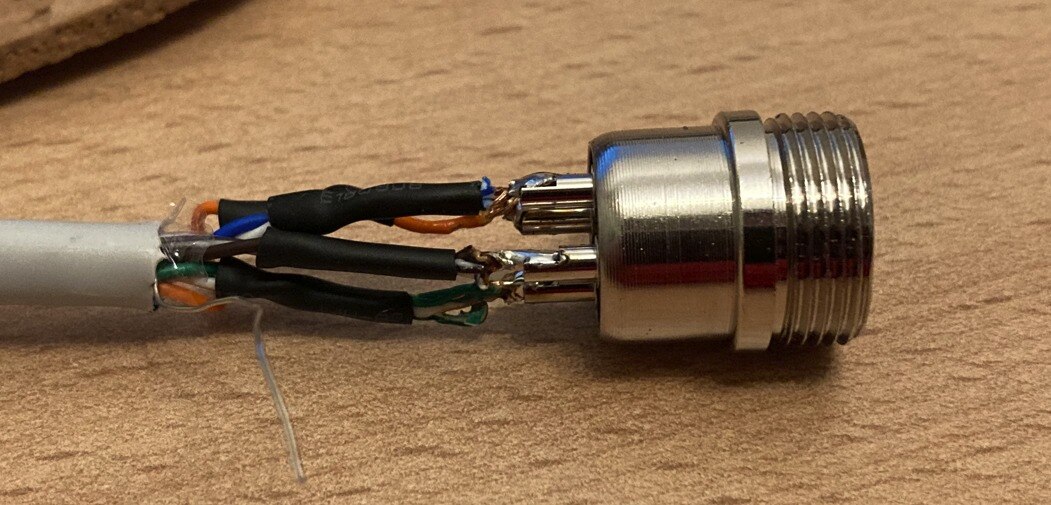
image

As you can see, I did not forget about heatshrink, however since contact are large, I need to heat them a lot and heartstring sooner then I needed.

Next step is pulling other part of connector from other side of cable:

image

Then you can push parts together and fit back small screw.

Another end I made breadboard friendly:

image

Across whole process, it is good idea to check for open connections and short circuits, but I was lucky this time. This is a result. Now my sensor is breadboarded:

image

It is sensor with analog output, so next time, I will try it with power supply and multimeter. These two are enough to obtain reading from it.

  • Sign in to reply
  • Cancel

Top Replies

  • shabaz
    shabaz 21 days ago +1
    Always a problem insulating the conductors in small connectors! One way is to replace the heatshrink with rubber tubing (there is a 3-prong tool that expands the rubber sleeve) and put it on each conductor…
  • shabaz
    shabaz 21 days ago

    Always a problem insulating the conductors in small connectors!

    One way is to replace the heatshrink with rubber tubing (there is a 3-prong tool that expands the rubber sleeve) and put it on each conductor's insulator, then solder as normal, then slide it over (can lubricate to do that if needed).

    The more unorthodox method I like is to instead use little pieces of polyamide tape, and tweezers to wrap it around each conductor individually, after soldering. Takes up very little space, so the connector shells go on easily afterwards.

    • Cancel
    • Vote Up +1 Vote Down
    • Sign in to reply
    • Cancel
element14 Community

element14 is the first online community specifically for engineers. Connect with your peers and get expert answers to your questions.

  • Members
  • Learn
  • Technologies
  • Challenges & Projects
  • Products
  • Store
  • About Us
  • Feedback & Support
  • FAQs
  • Terms of Use
  • Privacy Policy
  • Legal and Copyright Notices
  • Sitemap
  • Cookies

An Avnet Company © 2026 Premier Farnell Limited. All Rights Reserved.

Premier Farnell Ltd, registered in England and Wales (no 00876412), registered office: Farnell House, Forge Lane, Leeds LS12 2NE.

Follow element14

  • X
  • Facebook
  • linkedin
  • YouTube