

Multi-layer ceramic capacitors (MLCCs) have been used in electronic products for decades. Used in smartphones to PCs to electric vehicles, MLCC use has been so ubiquitous that in 2017 component manufacturers were discovering the demand for them was beginning to outpace their ability to supply them. Things came to a head in 2018 when an industry-wide MLCC shortage was in full swing and limiting production cycles of some products. Although some think the shortage will be resolved by 2020, there is still concern that MLCC shortages will occur in the future.
There are different ways you can design around MLCCs if you are unable to get them. Find an MLCC substitute. Use a larger capacitance in an available package if it doesn't require much board redesign. Use lesser-valued capacitors in parallel. Use a different capacitor technology. The element14 Design Challenge team decided to test the last alternative and created a competition called, Experimenting with Polymer Capacitors. We had 8 challengers complete the challenge. But there was only a single grand prize: a DSOX1102GDSOX1102G Keysight Digital Oscilloscope. The competition is complete and the entries are in. The judges read all the challengers' blog and chose a winner.
The Grand Prize Goes To ...
I think judging a competition like Experimenting with Polymer Capacitors is a challenge in and of itself. It was a unique challenge for element14. Typically, we use development boards to create the kit for the competition. But this time the kit consisted of 16 different valued polymer capacitors from our sponsor, The specified item was not found.All the challengers presented different ways to conduct their polymer capacitor experiments. Each emphasized different characteristics of polymer capacitors. Some designed their own circuits. Some used reference designs. Some used different types of test equipment. But all of them provided a learning experience for the entire element14 community.
The Grand Prize winner of the Experimenting with Polymer Capacitors Design Challenge is fmilburn.
He wrote three official blogs, experimenting with different ways of measuring ESR and wrapping up with another experiment on adding bulk capacitance to a buck converter (TPSM84A21 10A SWIFT Power Module ) and comparing the Output Ripple (mV) with and without the bulk capacitance. His experiments were well documented with videos, screenshots, graphics, charts, tables -- everything one expects in an experimental report. to read his project blogs: Experimenting with Polymer Capacitors
The Finisher Prizes Go To...
As I stated previously, Experimenting with Polymer Capacitors was a different kind of design competition, probably because the goal wasn't necessarily to design something new. Rather, the goal was to "A hands-on competition that allows you to experiment, test, breadboard, or just play around with Polymer Capacitors." But it required a different skill set and a good amount of expertise in circuit design and board level electronics. We received 20 applications, which was higher than I expected. And we sent polymer capacitor kits + the Peak ESR70 capacitor tester to nine of the applicants. In no special order, here are the Challengers who finished the challenge and will receive a finisher's Prize.
Douglas Wong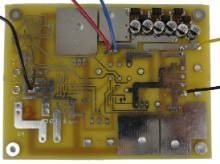 (dougw): he designed a charge pump circuit and a simple power oscillator to drive it, and compared the results of using MLCCs vs. Polymer Capacitors. He demonstrated that the output ripple and efficiency of the polymer cap charge pump was better than the MLCC version. He shot several videos demonstrating his experiments. I recommend anyone who wants to learn a lot about these components to read his blog. It's a great education! to read his project blog: Experimenting with Polymer Capacitors
F. Yao (fyaocn): when I read his application, I found it unexpected and unique; he was going to experiment with polymer capacitors in an instrumentation amplifier. But his experiments were more than that. He outlined the "big picture" of how to study a single type of electronic component. He described his experiments this way: "From basic parameter measuring to circuit design, PCB design, and final build. And finally, how a demo circuit can lead to one potential REAL APPLICATION prototype build with an Arduino Board." His experiments are rich in screenshots and provide a great tutorial experience.
Miguel Pineiro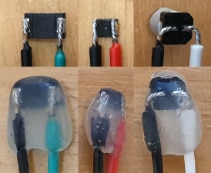 (neuromodulator): one of the characteristics of polymer capacitors in general is that are more stable than MLCCs over a wide temperature range, showing virtually no capacitance drift over temperature. To explore this characteristic, he conducted some experiments on capacitance temperature dependence. Specifically, how temperature affects the capacitance of the different capacitors by performing a temperature sweep from ambient temperature to ~80oC, and then back to ambient temperature. with hot glue. He used a hotplate magnetic stirrer to heat water and avoid a temperature gradient buildup (as the water is stirred through a coupled magnet). Temperature was measured with a thermistor and a NI MyDAQ, which is an inexpensive DAQ that comes with a built-in DMM. Capacitance, current and voltage were measured concurrently with a Keithley DMM6500. Beyond experimenting with capacitance temperature dependance, he also performed experiments on leakage current and dielectric absorption. I was most intrigued by his testing and I had wished this design competition was longer so I could see him more deeply experiment with these characteristics. Maybe next time. to read his project blogs: Experimenting with Polymer Capacitors
Ralph Yamamoto (ralphjy): he compared the performance of a polymer aluminum electrolytic capacitor and a standard wet aluminum electrolytic capacitor as the output filter of a buck converter (LM2596). Specifically, evaluate the performance of the existing circuit and then replace the 220mF aluminum electrolytic output filter capacitor with an equivalent polymer capacitor and compare the results. What was most interesting about this experiment is that he observed some instability in the feedback control loop. When he referred to the LM2596, he found the following note: "...if the selected capacitor's ESR is extremely low, there is a possibility of an unstable feedback loop, resultying in an poscillation at the output." I found his experiment interesting and a learning experience. To read his project blogs: Experimenting with Polymer Capacitors
Rod.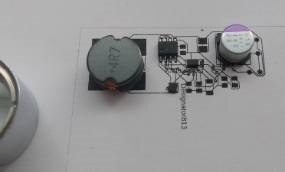 (14rhb): he wrote a whopping 6 blogs for this competition! His goal was to see how low in profile the new generation of polymer capacitors would allow, hence the project title. He went above and beyond by starting from scratch in designing a new power supplying, laying it out, and building it. Quite a lot of work! In the end, he designed a power supply using Texas Instruments Webench online tool. He tried out a new PCB technique, and this design and physical build worked. He was able to solder the 0402 and minute NexFET 2mm x 2mm device. To read his project blogs: Experimenting with Polymer Capacitors
R. Scott Coppersmith (rsc ): he built a simple regulator circuit, with and without polymer capacitors. He did it again because the first version wasn't regulating as he expected. So, he built it again in the spirit of experimentation. He built a second set of circuits using MC78L05ACPMC78L05ACP regulators in a T092 package. When I checked the outputs with no load (each powered separately), he found 1.9mv of noise on the non-poly cap circuit, and a 26mv 2.5khz oscillation with the poly caps. His next step is to place a load on the regulators... To read his project blogs: Experimenting with Polymer Capacitors
Very Compact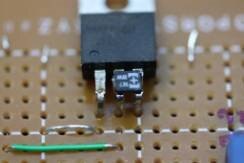 (COMPACT): I'd describe his experiments as testing out polymer capacitors on vintage computers. He used a Microbee computer (1980-ish Z80 based computer for schools and hobbyists). When he powered up a microbee for this challenge he found that there was unwanted ripple on its video output. He posed this question, can we remove this noise using polymer capacitors or by other means? He concluded that polymer capacitors are suitable for vintage designs but are best used as a direct replacement for old components that have lost their original properties or to replace components that pose a fire hazard. Slight improvements can be achieved from the superior ESR and ESL properties. The available values are generally too large for effective high speed noise reduction but this is no problem for newer designs that incorporate suitably designed power planes and controlled impedances. To read his project blogs: Experimenting with Polymer Capacitors
The Future: The Next Experimenting with ... Design Challenge
Top Comments