element14 Community
element14 Community
    Register Log In
  • Site
  • Search
  • Log In Register
  • Community Hub
    Community Hub
    • What's New on element14
    • Feedback and Support
    • Benefits of Membership
    • Personal Blogs
    • Members Area
    • Achievement Levels
  • Learn
    Learn
    • Ask an Expert
    • eBooks
    • element14 presents
    • Learning Center
    • Tech Spotlight
    • STEM Academy
    • Webinars, Training and Events
    • Learning Groups
  • Technologies
    Technologies
    • 3D Printing
    • FPGA
    • Industrial Automation
    • Internet of Things
    • Power & Energy
    • Sensors
    • Technology Groups
  • Challenges & Projects
    Challenges & Projects
    • Design Challenges
    • element14 presents Projects
    • Project14
    • Arduino Projects
    • Raspberry Pi Projects
    • Project Groups
  • Products
    Products
    • Arduino
    • Avnet & Tria Boards Community
    • Dev Tools
    • Manufacturers
    • Multicomp Pro
    • Product Groups
    • Raspberry Pi
    • RoadTests & Reviews
  • About Us
  • Store
    Store
    • Visit Your Store
    • Choose another store...
      • Europe
      •  Austria (German)
      •  Belgium (Dutch, French)
      •  Bulgaria (Bulgarian)
      •  Czech Republic (Czech)
      •  Denmark (Danish)
      •  Estonia (Estonian)
      •  Finland (Finnish)
      •  France (French)
      •  Germany (German)
      •  Hungary (Hungarian)
      •  Ireland
      •  Israel
      •  Italy (Italian)
      •  Latvia (Latvian)
      •  
      •  Lithuania (Lithuanian)
      •  Netherlands (Dutch)
      •  Norway (Norwegian)
      •  Poland (Polish)
      •  Portugal (Portuguese)
      •  Romania (Romanian)
      •  Russia (Russian)
      •  Slovakia (Slovak)
      •  Slovenia (Slovenian)
      •  Spain (Spanish)
      •  Sweden (Swedish)
      •  Switzerland(German, French)
      •  Turkey (Turkish)
      •  United Kingdom
      • Asia Pacific
      •  Australia
      •  China
      •  Hong Kong
      •  India
      •  Korea (Korean)
      •  Malaysia
      •  New Zealand
      •  Philippines
      •  Singapore
      •  Taiwan
      •  Thailand (Thai)
      • Americas
      •  Brazil (Portuguese)
      •  Canada
      •  Mexico (Spanish)
      •  United States
      Can't find the country/region you're looking for? Visit our export site or find a local distributor.
  • Translate
  • Profile
  • Settings
Save The Bees Design Challenge
  • Challenges & Projects
  • Design Challenges
  • Save The Bees Design Challenge
  • More
  • Cancel
Save The Bees Design Challenge
Blog BeeAInspector Bee - Blog 2: Nest building
  • Blog
  • Forum
  • Documents
  • Leaderboard
  • Polls
  • Files
  • Members
  • Mentions
  • Sub-Groups
  • Tags
  • More
  • Cancel
  • New
Join Save The Bees Design Challenge to participate - click to join for free!
  • Share
  • More
  • Cancel
Group Actions
  • Group RSS
  • More
  • Cancel
Engagement
  • Author Author: FollowTheWizard
  • Date Created: 26 Feb 2023 10:56 AM Date Created
  • Views 761 views
  • Likes 10 likes
  • Comments 5 comments
  • save the bees
  • wild bees
Related
Recommended

BeeAInspector Bee - Blog 2: Nest building

FollowTheWizard
FollowTheWizard
26 Feb 2023

BeeAInspector Bee

Blog 2: Nest building


Hi all, welcome to our second blog for the Save the Bees Challenge.


Today we will describe how to build the wild bee research nests that we will be using for the challenge. For this bee nest design we want to acknowledge everyone at the project NutriB2, Macrobees and collaborators who designed and tested these nests in the past. The materials we use are:


  • Drainage PVC Tubes (300 mm diameter): We use these tubes as a container.
  • Bamboo reeds: We get long bamboo reeds with a variety of diameters. The ones we get in Germany are from the following brand: https://www.naturschutzcenter.de/schilf. Sometimes also in construction supermarkets one can get panels of bamboo reeds attached to each other. If the diameter is not too small, those will also work.
  • Oscillator cutting machine: After trying with many machines, this is the one that we preferred, as it leaves the least sprints and broken pieces of bamboo. On the downside, you need to cut one by one the reeds with this device.
  • Cable binder
  • Optional: a metal mesh

Procedure:

  1. Cut the PVC tubes in trapezoids with about 30 cm length on the top and 20 cm length at the bottom. The longer area will act as a roof preventing water from coming in and soaking the reeds.
  2. At the bottom make cuts perpendicular to the entry point, one on each side, so that any stagnated water will flow out after the rain and the reeds will dry easier.
  3. Cut the bamboo reeds in pieces of 18 cm length with the oscillation machine. Try to avoid using the ones with diameters too big (more than 10 mm) or too small (less than 2 mm). When cutting the reeds, try to do so in a way that one side is closed by the natural segment of the bamboo reed. This will prevent that bees can begin a nest from both sides. Be aware of splinters and try to smooth the borders with sandpaper when possible.
  4. Put the tube upside down and fill it with reeds until they are very tight that none of them can be moved easy. Optional: use a string around the reeds as you place them, to help keep them in place. Stay clear from superglue or other adhesives that could contain toxic materials.
  5. Look for a nice spot for your nest. It should be relatively high (ideally 1 to 3 m from the ground), to help avoid ants infestations. It should be sunny but not directly in the sun specially in very hot and dry weathers. It should not be too much exposed to the wind, if possible to be avoided, to ease the flight of the bees. There should be plenty of flowers and water in the surroundings, to ensure they don’t need to go too far for food and drink. The nest doesn’t need to be completely dry all the time, but protection from direct rain is beneficial and good air circulation, to avoid excess humidity and fungi/moss proliferation.
  6. Hang your nests using cable binder or any other tool you can think of. Some people use nails, although be aware that this may break the reeds inside and make it more difficult to exchange them if needed.
  7. Optional: Protect your nest from birds with a metal mesh, surrounding the nest and covering the exits, with holes big enough that a bee will pass without problem, but not the beak of a hungry bird looking for larvae.


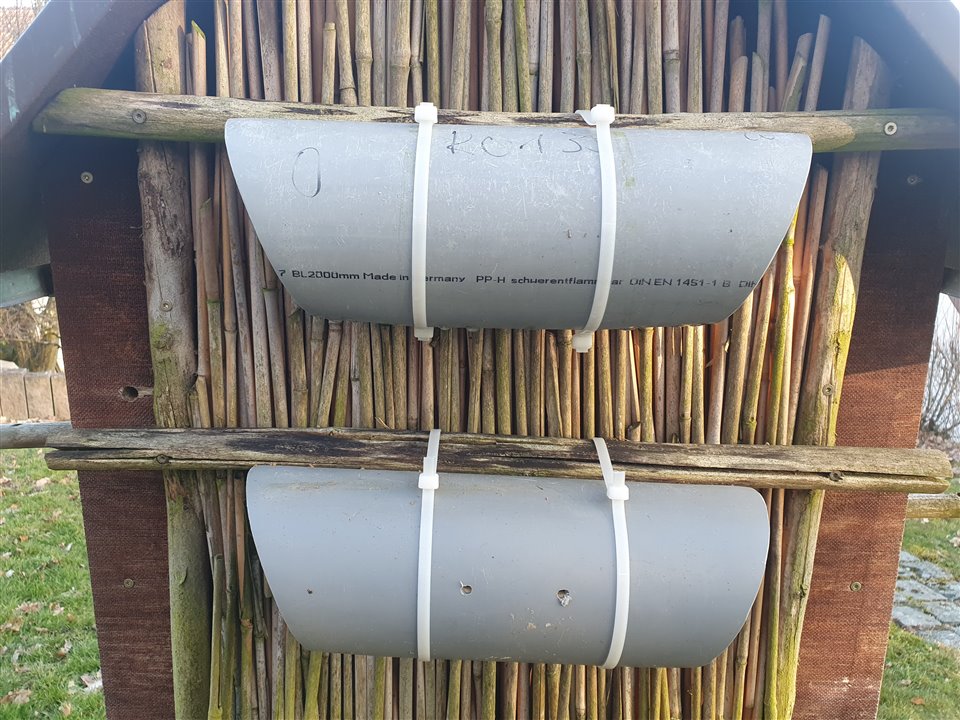
The final research nest looks like this:
image

Figure 1: Final nests hanging in their places.


We currently have 2 nests in our garden, with reeds that were occupied since last year around June, which means they are overwintering now and we can expect them to come out in end of March to May.

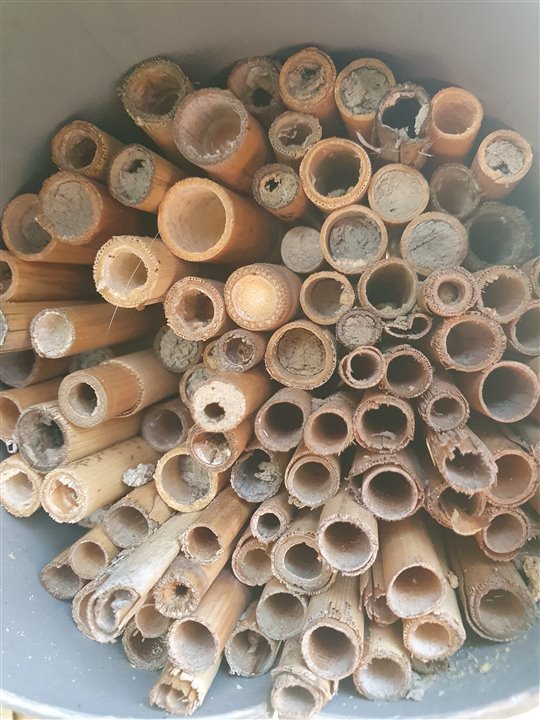
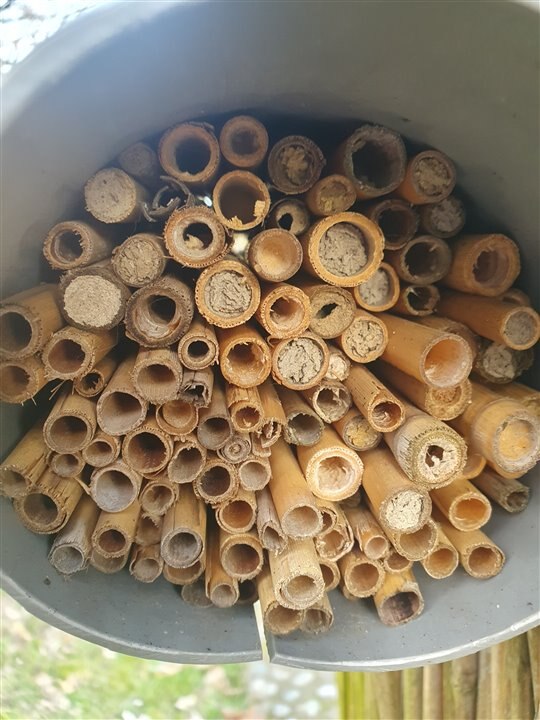
From the side you can distinguish the reeds that are filled from those that are not filled, by the soil closing. Most of them will be Osmia species which close the nests using that element.
 imageimage

Figure 2: Side from the nest, showing closed and open reeds.

One of our questions is whether we can train an algorithm to interpret the images taken with the provided camera-kit, to identify the proportion of reeds closed or open. Even if we would not be on time to test this with flying bees (given the time constraints of the challenge), we could use already available pictures of the nest to test our algorithm alone.


There will be at least two additional challenges with the camera:

  • to mount it on the side of the nest: with sufficient time we would try a 3D printing solution to build up a mount.
  • to adjust zoom to get an area of the nest side that is representative of the proportion of filled/empty reeds in the whole nest: for this we need the device and to test it at different zoom/distances from the nest. Only then we can tell if a few reeds can be representative of what is happening in the non-visible parts of the nest.


We still have not received the kit, so we are a bit worried about timing. We also have a big trip in March and won’t be able to assemble much during that time. Hopefully the deadline will be passed to April or even May, given the 2 month delay in the kit send-off.

We will start working soon on the algorithm and maybe have something to show on that in the next blog.

Cheers

Phil and Ale


  • Sign in to reply
  • dougw
    dougw over 2 years ago

    Great construction of a useful bee nest. Where I originally come from it would be easier to get a large diameter Bamboo "pipe" than PVC pipe,

    • Cancel
    • Vote Up 0 Vote Down
    • Sign in to reply
    • More
    • Cancel
  • FollowTheWizard
    FollowTheWizard over 2 years ago in reply to beacon_dave

    great idea! Maybe they would perceive it as more natural, like the bee hotel wood

    • Cancel
    • Vote Up 0 Vote Down
    • Sign in to reply
    • More
    • Cancel
  • beacon_dave
    beacon_dave over 2 years ago in reply to FollowTheWizard

    I was wondering if it would be worth covering the outside of the PVC pipe in reeds or bark or similar as well to make it look more natural.

    Perhaps could try one with a covering/background and one without and see if there is more activity detected with one or the other.

    • Cancel
    • Vote Up 0 Vote Down
    • Sign in to reply
    • More
    • Cancel
  • FollowTheWizard
    FollowTheWizard over 2 years ago in reply to beacon_dave

    Hey! Yes, that is a typo. Its supposed to say "bee", maybe we can edit it.

    Raising the reeds would also work.

    As for the background reeds, I think so! As we also have seen tiny bees entering those long reeds in the back.

    • Cancel
    • Vote Up 0 Vote Down
    • Sign in to reply
    • More
    • Cancel
  • beacon_dave
    beacon_dave over 2 years ago

    Looking good so far.

    These reeds are definitely a lot longer than your average 'bee hotel'.

    Is that supposed to say 'bee' or 'big bee' ?:

    image

    I guess if you raised the lower reeds off the bottom of the PVC pipe it would also help prevent them from sitting in any collected rainwater.

    Do you think that the reeds you have behind the nest help attract the bees to the nesting site ? 

    • Cancel
    • Vote Up 0 Vote Down
    • Sign in to reply
    • More
    • Cancel
element14 Community

element14 is the first online community specifically for engineers. Connect with your peers and get expert answers to your questions.

  • Members
  • Learn
  • Technologies
  • Challenges & Projects
  • Products
  • Store
  • About Us
  • Feedback & Support
  • FAQs
  • Terms of Use
  • Privacy Policy
  • Legal and Copyright Notices
  • Sitemap
  • Cookies

An Avnet Company © 2025 Premier Farnell Limited. All Rights Reserved.

Premier Farnell Ltd, registered in England and Wales (no 00876412), registered office: Farnell House, Forge Lane, Leeds LS12 2NE.

ICP 备案号 10220084.

Follow element14

  • X
  • Facebook
  • linkedin
  • YouTube