


For my Health Guard project, selecting the right microcontroller was an important part of the development process. I explored several platforms, including Arduino, ESP32 development boards, and Raspberry Pi Pico, and carefully considered their capabilities, cost, and suitability for my application. After evaluating these options, I finally chose the ESP32 Cheap Yellow Display (CYD) for practical and technical reasons. This board combines a powerful ESP32 microcontroller with a built-in 2.8-inch TFT color display, making it an ideal choice for my project. Since Health Guard is designed to monitor vital health parameters, I need a display that can present real-time measurements clearly and intuitively. The CYD allows me to display body temperature, pulse rate, and blood oxygen saturation (SpO₂), while also plotting a live electrocardiogram (ECG) waveform on the same screen. Integrating the microcontroller and display into a single, affordable board reduces hardware complexity, minimizes wiring, and saves space. Most importantly, it provides a practical, cost-effective platform for developing a compact health-monitoring device without requiring a separate display module or additional display-driving hardware.
The ESP32 Cheap Yellow Display (CYD) offers sufficient I/O connectivity for my Health Guard project. It provides GPIO pins that I can configure for I²C communication to connect two sensors for measuring vital health parameters. In addition, I can connect the ECG module using one analog input to acquire the ECG signal and two GPIO pins to monitor the module’s lead-off detection signals. This combination of interfaces allows me to integrate all three sensor modules with the ESP32 while using the built-in 2.8-inch TFT display to present real-time measurements and ECG waveforms. I will carefully assign the GPIO pins to avoid conflicts with the display, touch controller, and other onboard peripherals.
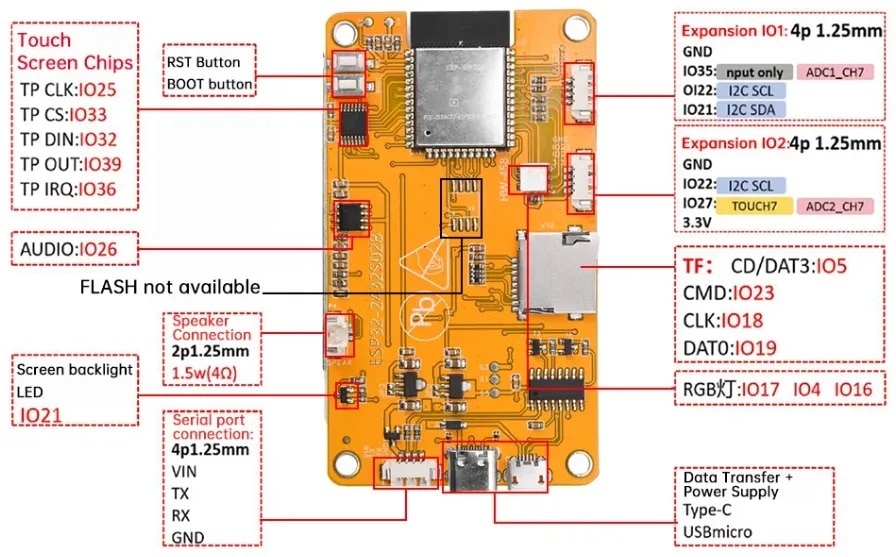
For powering my Health Guard project, I selected an 18650 Li-ion rechargeable battery combined with a 5V UPS module. The battery provides a compact and rechargeable power source, while the UPS module boosts the battery’s nominal 3.7V output to a regulated 5V supply that can power the ESP32 CYD board through its 5V input. The module also incorporates battery-charging functionality, allowing me to recharge the battery without removing it from the device. This integrated power solution simplifies the overall design, reduces additional circuitry, and makes Health Guard more portable and convenient for everyday use.
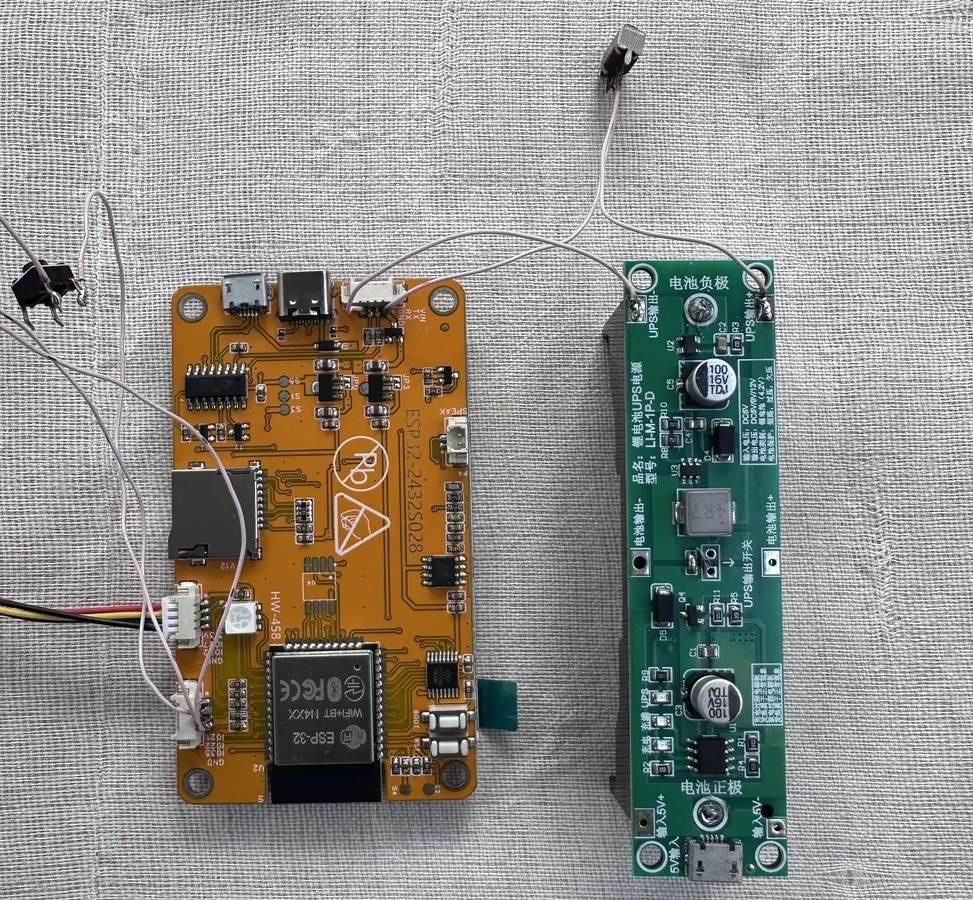
I added a sliding power switch to turn the Health Guard device on and off conveniently. I connected the switch, 5V UPS power module, and ESP32 CYD board using thin jumper wires and soldered the connections to establish the power circuit. This arrangement provides a simple and compact wiring solution, allowing me to control the device’s power without disconnecting the battery.