


This Forum post outlines the architecture and the strategic logic driving the system’s coordination.
Design Lineage
The foundation of this design is rooted in the Adaptive Environmental Monitoring project. By leveraging that established architecture, the Adaptive Sentinel expands from purely environmental tracking into a proactive security framework, maintaining the core principles of modularity and edge-based intelligence.
Basic Design: The Architectural Framework
The system is structured around a robust hub-to-node topology, designed for high reliability and low-latency response:
- Centralized Coordination: At the heart of the ecosystem is the Arduino UNO Q. It serves as the primary hub, orchestrating the network, aggregating telemetry, and managing high-level logic. The use of containerized Bricks will be helpful in carrying out these tasks without compromising the core system's stability.
- Deployment of Edge Nodes: To provide a direct interface for localized relays and sensors, I intend to position edge nodes based on FeatherWing in designated building zones, acting as the primary frontline for data collection.
- System Layout & Logic: The operational flow is decentralized yet unified. Edge nodes monitor local environments and transmit critical telemetry to the Arduino UNO Q hub for centralized aggregation and automated response.
- Connectivity Strategy: I intend to establish a robust UART infrastructure to guarantee stability during the primary rollout. This wired setup will serve as a performance benchmark, providing a structured path for transitioning to wireless protocols after the integration has been thoroughly confirmed.
- Sensor Integration:Sensor Strategic Integration: I intend to strategically select and integrate kit-supplied sensors to maximize the hardware’s efficacy in detecting security breaches and maintaining environmental awareness.
Visualizing the Hub-to-Node Topology
The following Basic Design Diagram details the mapping of FeatherWing edge nodes across various zones. By utilizing the Arduino UNO Q as the central coordinator, the architecture remains scalable.
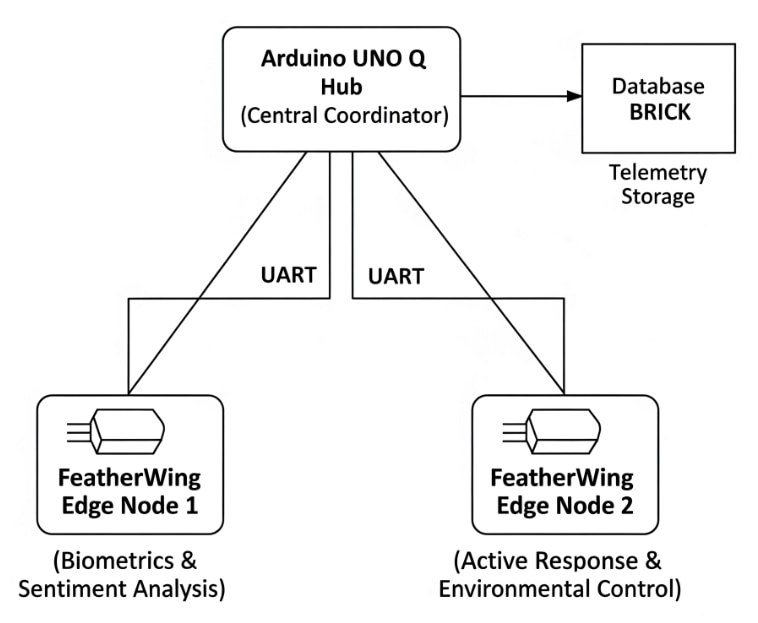
Hub-to-Node Connectivity Design: This system utilizes a robust hub-to-node topology centered on an Arduino UNO Q coordinator, managing modular FeatherWing edge nodes for localized intelligence. The initial rollout employs a stable UART connectivity strategy. The edge nodes are deployed in two primary functional configurations: Edge Node 1 for Biometrics & Sentiment Analysis, and Edge Node 2 for Active Response & Environmental Control.
HUB Node Architecture: Built on the Arduino UNO Q, the central hub functions as the primary network coordinator, aggregating telemetry from FeatherWing edge nodes. This architecture leverages a dual-processor system where the MPU handles high-level orchestration, intensive data logging, and serving the Web UI, while the MCU manages deterministic low-level communication protocols. Furthermore, the system utilizes a specialized Database BRICK to ensure the reliable storage of all telemetry data streamed from the distributed edge nodes.
Edge Node Architecture: Edge nodes are implemented as modular expansion subsystems. The current deployment strategy utilizes the following functional configurations for localized intelligence.
Edge Node 1 (Biometrics & Sentiment Analysis): This node focuses on human-centric data, monitoring biometric signatures and localized sentiment to assess security states based on occupant presence and behavior.
Edge Node 2 (Active Response & Environmental Control): Serving as the primary execution layer, this node manages physical relays and automated control systems to mitigate identified threats or adjust climate variables in real-time.
The "Request for Help"
Before I finalize the Project Blog and lock in the implementation, I am reaching out to the community. Prior to finalizing the Project Blog and committing to this implementation, I am seeking community insights. I invite you to "identify any loopholes" or logical flaws in my current approach.
Specifically, I am interested in your thoughts on whether the transition from UART to wireless is technically sound and if there are hidden bottlenecks in the hub-to-node telemetry aggregation. My goal is to uncover any technical gaps in the orchestration of this security intelligence system before moving to final deployment.
I value your expertise and look forward to the feedback.


