


In this blog post, I will cover my lighting system design and implementation.
Available Lighting choices:
Through my research, I have determined that there are four basic types of artificial lighting used for indoor plant cultivation. These are
- Fluorescent - Most commonly used for used for propagation, vegetative growth, and over-wintering.
- High-Intensity Discharge (HID) - Most commonly used for general purpose indoor cultivation.
- Plasma - Most commonly used for general purpose indoor cultivation.
- Light Emitting Diode (LED) - Most recently developed grow light technology. Commonly used as supplemental lighting along with natural and other artificial grow lighting. Also used alone for general purpose indoor cultivation and bloom promotion.
Chosen lighting:In my system, I have chosen to supplement natural sunlight with LED lighting for these reasons.
- Cost. Natural lighting is free and can be used effectively if plants can be arranged near windows, skylights or in greenhouses. Both the cost to purchase and operate LED lighting is much lower than for any of the other types of artificial lighting. LED grow lights have been in development and testing, and used in production environments, for many years now and have proven to be very successful under the right conditions. A large part of my decision to use LED lighting, and the specific product I chose, is simply due to the initial purchase price. As I am working within a relatively tight budget for this project, the initial cost had to be the main deciding factor.
- Space requirements. Natural sunlight requires no additional space. LED grow lights can be installed in a very small footprint. The lights I have chosen provide a total lighting surface area of approximately 650 square centimeters. The system is arranged vertically and the actual dimensions are approx. 1m tall by 6.5cm wide. This will provide supplemental lighting for 6 to 7 vertically stacked planting areas, sections within a single planting container, at any given time. This equates to 6 or 7 to 12 or 14 actual plants. The footprint of the system is approx. 460 square centimeters. As one of the main criteria of the challenge is vertically oriented cultivation, which equates to reduced footprint, I think my system meets that criteria quite well.
Overview of my lighting system:
I will be using natural sunlight supplemented with LED grow lighting. The cultivation unit will be placed in front of a window that will receive relatively direct sunlight during most of the daylight hours. The vertically oriented LED lighting will be placed on the opposite side of the cultivation unit from the window. As the cultivation unit is rotated continuously throughout the day plants will receive both direct natural sunlight and artificial lighting. Meaning all plants will receive either sunlight or artificial light during the entire daylight hours period. During dark hours, the cultivation unit will be rotated periodically to provide pre-determined periods of artificial lighting. Over an approx. 12 hour period of dark each stack of planting areas should receive an additional two hours of artificial lighting as well as some additional time where they receive defuse artificial lighting. I think I could increase the dark hours light received by introducing reflective materials placed opposite the artificial lighting. However, this would have to be manually removed and put in place in the morning and evening. As I am trying to keep the system as automated as possible, I will not do this unless deemed absolutely necessary. Also, if I can work out how to read ambient light from the sensor-puck via an RPi then I can base the lighting schedule on the change in morning and evening ambient light.
LED lighting system details:
As my LED lighting is only being used to supplement natural sunlight, the quality, power nd spectral output, of the LED light may not be as critical as when using artificial lighting exclusively. It is difficult to know the exact output power and spectral output of an artificial lighting system if it is not, truthfully, provided by the manufacturer. To do this requires some relatively specialized and expensive equipment that I do not have access to. So below is my best estimate using the information provided by the manufacturer and data I have gathered in testing.
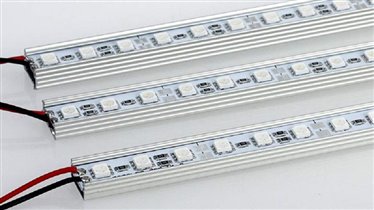
Configuration: The physical configuration of the LED arrays I'm using is strips of 36 total (27 Red and 9 Blue) LEDs. Each strip is 0.5m in length and approx. 1.3cm in width. They are sold in kits of 5 strips for $35 per kit. I am using two kits. See the picture below.
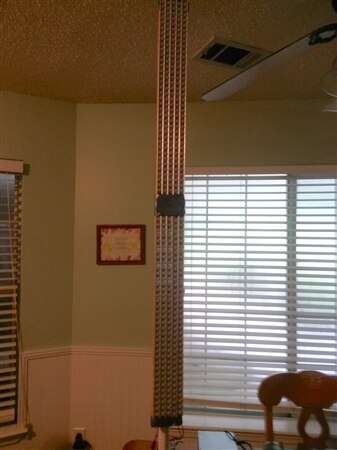
I have mounted the strips on a 9.5mm x 6.5cm x 1m plywood backing strip. Each kit is mounted five across. Then I've attached the plywood backing pieces to PVC pipe with the two kits being mounted one above the other using a PVC coupler. See the picture below. I am using an old modified guitar stand to support the entire structure. It turned out to be quite stable and adjustable. See pictures below.
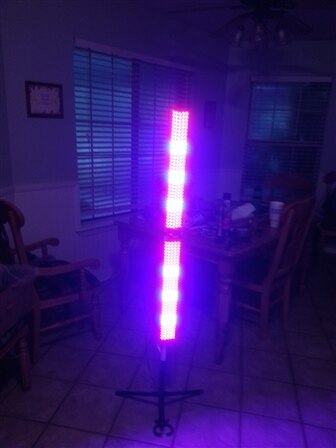
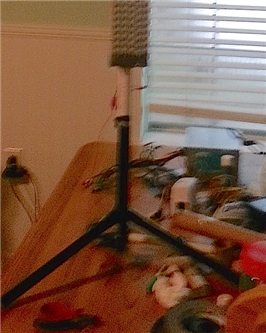
Power output: Using a simple multimeter I have determined that my LED light array draws a total of approx. 5A @ 12VDC. So the input power is 60W. The manufacturer claims a power factor of 97%. Since the concept of power factor doesn't apply to DC circuits, as the have no reactance, then the term power factor doesn't really apply. So I'm assuming they are referring to power efficiency, or that input power which is actually seen in the output of the circuit. I don't know this for sure. So I believe the total output power of the array should be approx. 58W.
Currently, the light strips are connected such that each corresponding top and bottom strip is in series while the five sets of two are in parallel. I could probably get a little more power out by connecting all strips in parallel. But the series/parallel combination turned out to be very convenient and I believe I have enough power output for the application.
Spectral output: The lights I have chosen do not produce the absolute optimal spectral content. They are made up of only two colors (wavelengths). These being Red @ 660nm and Blue @ 445nm. Red light promotes photosynthesis, which are beneficial while plants are growing and flowering. While blue light promotes the synthesis of Chlorophyll and Carotenoid, which are benneficial for promoting the leaf growth.
In a subsequent blog I intend to go into more detail concerning the cultivation requirements including lighting and nutrient requirements. In this blog I simply wanted to present the design and implementation details for my chosen lighting system.
As always, happy vertical farming and good luck to all the challengers.
Cheers,
Rick
Top Comments
-

DAB
-
Cancel
-
Vote Up
+1
Vote Down
-
-
Sign in to reply
-
More
-
Cancel
Comment-

DAB
-
Cancel
-
Vote Up
+1
Vote Down
-
-
Sign in to reply
-
More
-
Cancel
Children