


Hi everybody,
Last blog, I wrote about our pH situation. The next topic I will topic about is the design of the system itself; specifically water circulation. This is a huge topic for this project, and I will have to split it up into two sections to properly introduce our new design changes. The first design was nice, but of course came with a few issues. I believe talking about this new design will set a good picture for you all to have while we move forward.
The Mini Plant Water Circulation Design Problem:
The Mini Plant that I built earlier this year was considered a success in the short term, but had long term water circulation problems. The Mini Plant managed to grow enough food for a few sauces and salads; however, the system was constantly unstable. The plants were constantly stressed by disease or lack of nutrients, and the fish were constantly being stressed by change in water level. All factors contributed by proper circulation.
The main disease we dealt with was called verticillium wilt, better known as root rot. Root rot only occurs when the plant's roots don’t get enough oxygen. Lack of oxygen to the roots normally happens when the plant is constantly submerged. The water circulation of our first Mini Plant was happening too fast for the system; not enough time for the plant's roots to breathe. There is not a set amount of time to how long the roots need aeration, but probably enough time for the roots to dry up a bit.

The water circulation of our first system filled our grow-bed too quickly because of the pump rate and size of the tank; the fish tank being a 18.5 gallon tank, and the grow bed was a 7 gallon tank. I had a variable pump that pumped water from the fish tank to the grow bed. I am uncertain of the actual flow rate because it was a variable flow rate pump. Also something to consider is that the pump has a limited height that water can pump to. I worked with what I had, and set the flow rate to a point where the system would trigger the bell siphon (siphon and further plumbing will be a subject of the next blog) The best flow rate that triggered the siphon created a flood and drain rate between two to one minute. This means, the plant's roots were submerged every minute or two; creating a perfect environment for the bacteria that causes root rot. Root rot not only affected the plants but had a strong impact on the fish, especially since the fish tank water level was never constant.
The fish underwent stress from the unstable water levels which then introduced chemical spikes in the fish tank. The size of the fish tank was 18.5 gallons of water. The grow bed was 7 gallons. The reason that I had a fish tank with a larger volume is because when the water is pumped up to the grow bed, there is less water in the fish tank. This leaves the fish in a stressful situation where their water level is reduced. The bigger fish tank allowed for there to be enough water pumped to the grow bed, and keep the fish from too much stress. However, when the water was lowest in the fish tank, the chemistry in the water sometimes spiked. Especially, when some of the plants were dying from root rot, the water ammonia levels would spike. Sometimes it would be too much for the fish, so some died. This was solved by filling the tank with bottled water, but we knew this was a problem the next version of the Mini Plant should not have to deal with on a daily basis.
Solution:
The solution to root rot that we will propose will be with a better calculated plumbing in the next design. We will model the system using Simulink, to calculate the flow rate required to have a flood and drain rate of about ten to twenty minutes, while still triggering the bell siphon. Like I said, the bell siphon calculations will come next blog. The system will be designed with more care, and the more I work on the Simulink system, the more in detail I can get for you all.
The solution to keeping the fish tank water levels constant, is to implement a sump tank. Sump tanks are no new technology, and work as the tank with variable water levels. The idea is to have the pump in the sump tank, pump up to the grow bed, drain down to the other additional grow areas we will add, down to the fish tank. The fish tank will have a level drain system. The level drain system will just be an outlet that is always open, to allow the water to flow back down to sump. Adding a sump tank will not only solve the problem of constant water level, but also allow us to add more grow space without changing the design of the whole system. This means, the sump tank will allow us to make our system modular.
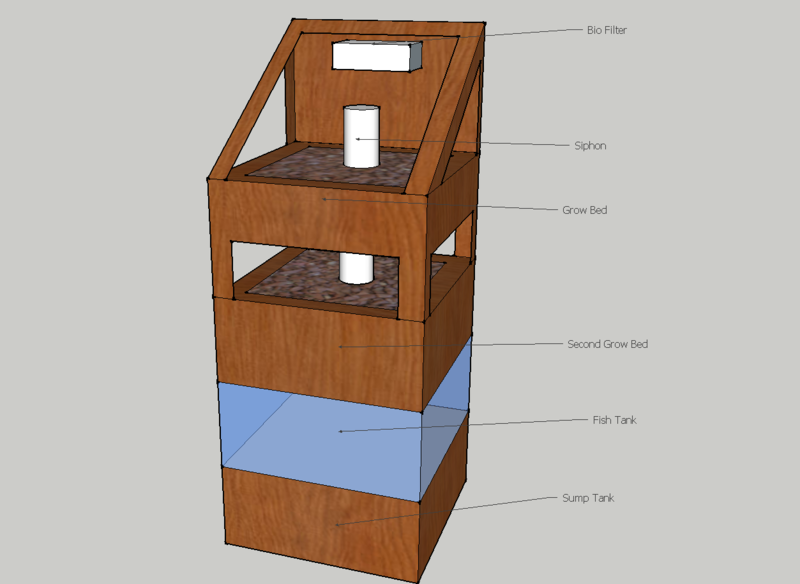
Below is the design of the second version of the Mini Plant. Labeled are all the important sections of the design. The water cycle begins with the sump tank, which is where the pump will be located. The pump will pump the water to the bio filter. I haven't spoken much about the bio filter, but the purpose of the bio filter is to provide more surface area for the bacteria to grow. The water then falls to the grow bed. Once the grow bed fills up to a certain level, the siphon sucks all the water down to the second grow bed, which can either be a deep water culture (DWC) or another grow bed. Then again the water drains to the fish tank, then back to the sump tank.
Future Work:
Like I said, this plan took a few days, and I will require a few more days to dig deep into the modeling and analysis of this system. Meanwhile, we are still continuing work on the electronics side. The electronics will be a topic of another blog.
If you guys have any questions or suggestions, please let us know, and we will take it into consideration. Thanks to Rick Reynolds, we are getting a clearer picture of our final electronic package design and our capabilities.