


Introduction:
In order to support growing populations in metropolitan areas with little horizontal space, food production may have to move vertically in the future. This fundamental shift provides many design challenges, and the cost of space will require an extremely efficient process in order to compete economically with food produced on traditional farms. Water, energy, nutrient, and space usage must be carefully measured, controlled, and utilized to its maximum potential.
For indoor vertical farms, there is a clear advantage to using hydroponics instead of soil based agriculture. Hydroponics systems use water more efficiently, don't require soil to be hauled up many stories, attract fewer pests, and the nutritional needs of the plants can be controlled more precisely. All of these factors lead to greater production potential in a smaller space.
These are many of the reasons I have adopted hydroponics for much of my gardening both indoors and out. The main disadvantages of growing hydroponically is that it is more difficult to get set up initially, it takes a lot of time and attention to keep growing optimally, and crop failure can occur very quickly if the nutrient solution isn't maintained properly. I am hoping to develop some solutions to these problems through participation in this contest.
Project Overview
I have seen many automated hydroponics and aquaponics systems online, but most of these solutions are focused on only one stage of plant growth. I plan to produce a system that is monitored and controlled to provide optimal growing conditions throughout the plants life. To demonstrate this, I will create a system to control and monitor several of the most important features for successfully growing leafy greens and herbs from seed to harvest in an indoor hydroponics system. This will consist of four sections: water treatment, germination, seedling/microgreens, and nft channels. I will focus on measuring energy, water, nutrient, and other material use while controlling the nutrient solution, temperature, and lighting. I am particularly interested in the cost of such a system and if small scale production would be economically feasible.
If time and budget permits, I will also include fruiting plants such as tomatoes, peppers, or cucumbers. The different requirements of these plants during the fruiting stage means that they would require a different section for optimal growth.
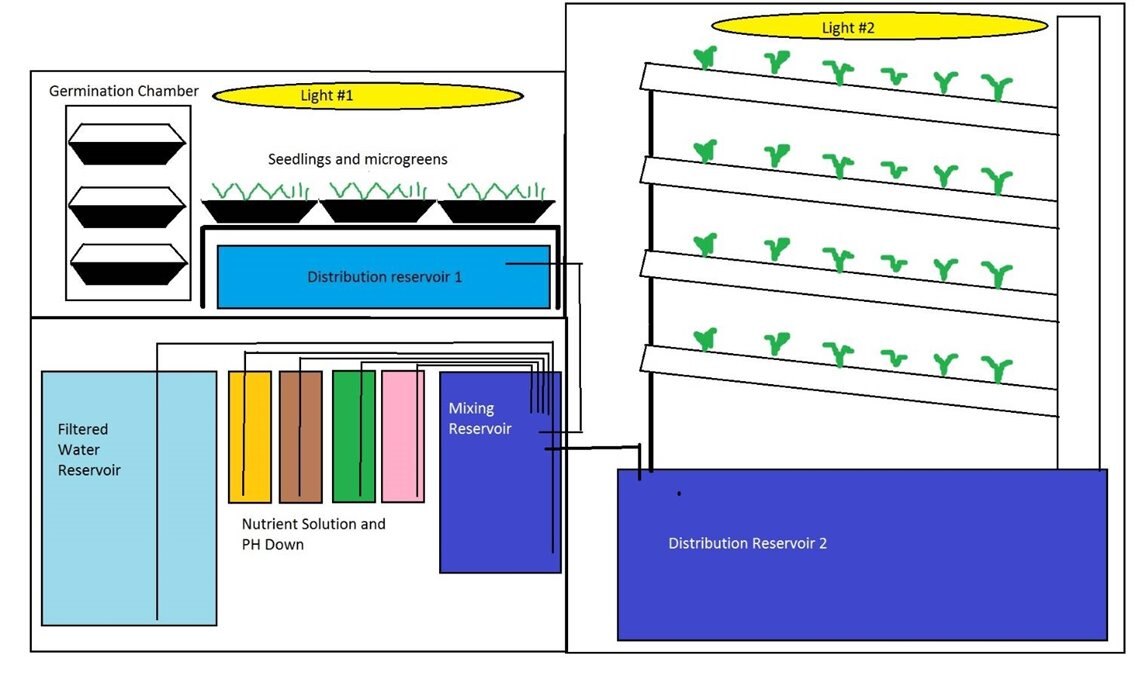
Water Treatment and Hydroponic Solution Creation
One of the most important parts of a hydroponic growing system is the solution used to feed the plants. Creating and maintaining this solution can also be the most time consuming. The first part of my system will consist of four reservoirs. The first will contain filtered water that is refilled manually (potentially automated if time and cost permits) whenever it gets low.
When a new batch of hydroponic solution must be created, water will be pumped from the first reservoir to the second. An ultrasonic distance sensor will be placed at the top of the second reservoir in order to measure the amount of water added. Four peristalic pumps will be used to add the appropriate amount of PH down and a three part nutrient solution according to a predetermined recipe.
Finally, the solution will be pumped into one of two distribution reservoirs for delivery to the plants. These reservoirs will hold the solution that is recirculated through the two growth areas. They will each contain an ultrasonic distance sensor to measure the water level as well as a submersible pump with tubing that distributes the water to the plants. The pump will be controlled through a relay to ensure that the plants are receiving the correct amount of water.
Germination
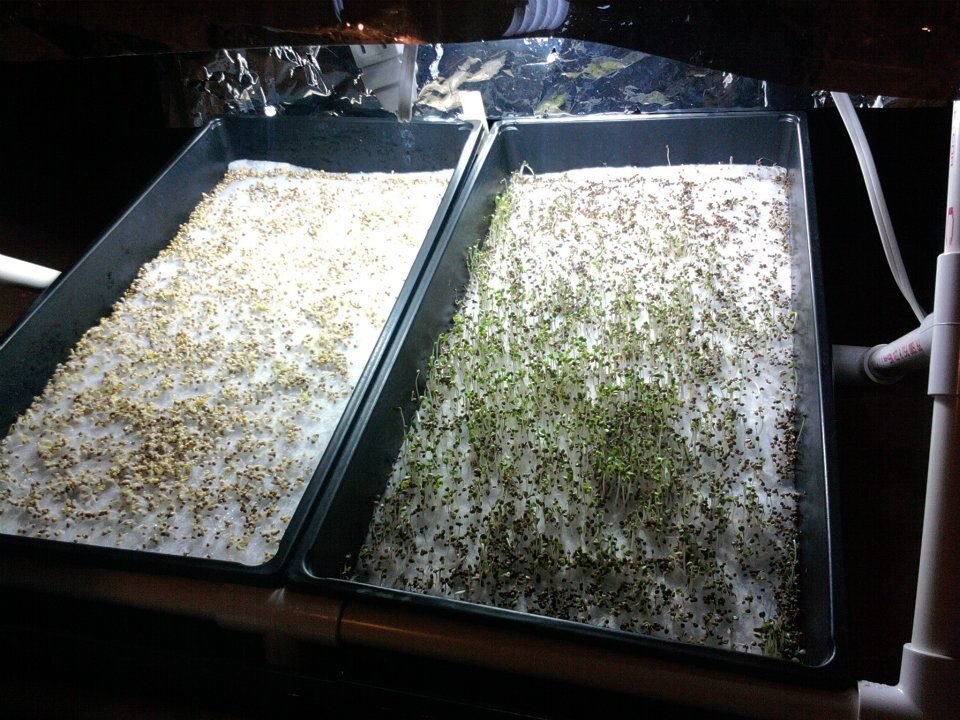
Seeds for green and herbs will be started in rockwool or another suitable growing medium. Microgreen seeds will be broadcast onto a synthetic growing medium. They will spend their first 2-5 days in 10” x 20” nursery trays that are kept between 70F and 80F with no light and >80% humidity.
Seedling and Microgreen Growing Area
Once the seeds have sprouted, they will be moved to the There will be three or more trays in this section. Two will be growing microgreens, and the others will contain the seedlings. These trays will be fed a nutrient solution that has a low concentration of nutrients. It will be pumped to the plants 2-4 times per day for 5-15 minutes each time.
This section will be maintained between 65 F and 80 F.

NFT Channels
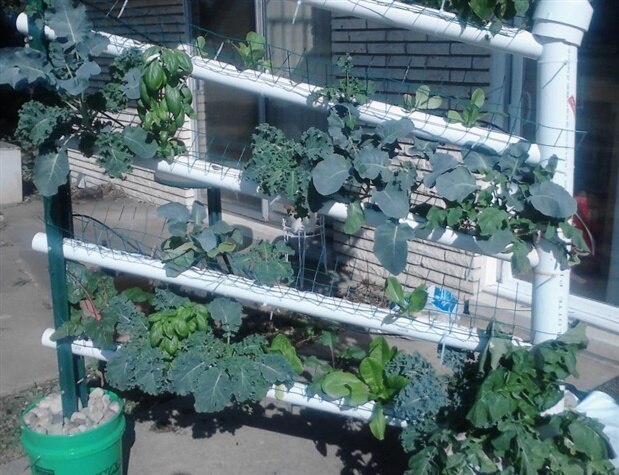
NFT channels will be created from 2” PVC pipe with holes cut in the top. Once seedlings have reached sufficient maturity, they will be moved from the seedling trays to the NFT channels. Here they will receive a much more potent nutrient solution that is constantly flowing around their roots.
Greens like lettuce, kale, swiss chard, and basil will be grown to maturity in the NFT channels. One channel will be populated at a time, and when the plants in the channel have been harvested, it will be cleaned and filled with new plants from the seedling area
This section will be maintained between 60 F and 90 F. Below is an example of a prototype outdoor hydroponics system I built a few years ago. This section will be similar to the system below.
Hardware and Software Implementation
The main purpose of this project is to automate as much of the system as possible (within time and financial constraints) while also very accurately monitoring water, power, and nutrient usage. To do this I will use one of the provided EZR32WG Wireless Starter Kit for my control system. One of the radio boards from the starter kit will be used as the controller for the hydroponics system. A daughter board will be created to interface the radio board with all of the relays, sensors, and other I/O required for the system The other will be used as a gateway to connect to a BeagleBone Black running OpenHAB for data storage and remote user interface. I will certainly find uses for the rest of the kit as well, but at the moment I am not entirely sure what I will use it for. That to me is the most exciting part of this challenge. I get to experiment with a new development kit while finding solutions to some common problems in one of my favorite hobbies! What more could you ask for?!
In my next blog I will present a more detailed plan of the components I am currently thinking about using for my design. I will also share my current setup with OpenHAB, BeagleBone Black, and 915MHz Moteinos that will be modified for this project.
Top Comments