element14 Community
element14 Community
    Register Log In
  • Site
  • Search
  • Log In Register
  • Community Hub
    Community Hub
    • What's New on element14
    • Feedback and Support
    • Benefits of Membership
    • Personal Blogs
    • Members Area
    • Achievement Levels
  • Learn
    Learn
    • Ask an Expert
    • eBooks
    • element14 presents
    • Learning Center
    • Tech Spotlight
    • STEM Academy
    • Webinars, Training and Events
    • Learning Groups
  • Technologies
    Technologies
    • 3D Printing
    • FPGA
    • Industrial Automation
    • Internet of Things
    • Power & Energy
    • Sensors
    • Technology Groups
  • Challenges & Projects
    Challenges & Projects
    • Design Challenges
    • element14 presents Projects
    • Project14
    • Arduino Projects
    • Raspberry Pi Projects
    • Project Groups
  • Products
    Products
    • Arduino
    • Avnet & Tria Boards Community
    • Dev Tools
    • Manufacturers
    • Multicomp Pro
    • Product Groups
    • Raspberry Pi
    • RoadTests & Reviews
  • About Us
  • Store
    Store
    • Visit Your Store
    • Choose another store...
      • Europe
      •  Austria (German)
      •  Belgium (Dutch, French)
      •  Bulgaria (Bulgarian)
      •  Czech Republic (Czech)
      •  Denmark (Danish)
      •  Estonia (Estonian)
      •  Finland (Finnish)
      •  France (French)
      •  Germany (German)
      •  Hungary (Hungarian)
      •  Ireland
      •  Israel
      •  Italy (Italian)
      •  Latvia (Latvian)
      •  
      •  Lithuania (Lithuanian)
      •  Netherlands (Dutch)
      •  Norway (Norwegian)
      •  Poland (Polish)
      •  Portugal (Portuguese)
      •  Romania (Romanian)
      •  Russia (Russian)
      •  Slovakia (Slovak)
      •  Slovenia (Slovenian)
      •  Spain (Spanish)
      •  Sweden (Swedish)
      •  Switzerland(German, French)
      •  Turkey (Turkish)
      •  United Kingdom
      • Asia Pacific
      •  Australia
      •  China
      •  Hong Kong
      •  India
      • Japan
      •  Korea (Korean)
      •  Malaysia
      •  New Zealand
      •  Philippines
      •  Singapore
      •  Taiwan
      •  Thailand (Thai)
      • Vietnam
      • Americas
      •  Brazil (Portuguese)
      •  Canada
      •  Mexico (Spanish)
      •  United States
      Can't find the country/region you're looking for? Visit our export site or find a local distributor.
  • Translate
  • Profile
  • Settings
element14's The Ben Heck Show
  • Challenges & Projects
  • element14 presents
  • element14's The Ben Heck Show
  • More
  • Cancel
element14's The Ben Heck Show
Forum Challenge: Equatorial Mount for Astrophotography (Computer Controlled?)
  • Blog
  • Forum
  • Documents
  • Polls
  • Files
  • Members
  • Mentions
  • Sub-Groups
  • Tags
  • More
  • Cancel
  • New
Join element14's The Ben Heck Show to participate - click to join for free!
Actions
  • Share
  • More
  • Cancel
Forum Thread Details
  • Replies 14 replies
  • Subscribers 33 subscribers
  • Views 1383 views
  • Users 0 members are here
  • build_challenge
  • ben_heck
  • show_idea
Related

Challenge: Equatorial Mount for Astrophotography (Computer Controlled?)

Former Member
Former Member over 12 years ago

Hey Ben,

I would love to see you take on the challenge of building a equatorial mount to help ametuer astrophotographers take long-exposure photographs of planets, stars and other deep-space objects such as Galaxy's and Nebulae.

For those who don't know what an 'equatorial mount' is, it is a motorized tripod-mount-thing to cancel the effect of the earths rotation during the exposure time of a DSLR camera with telephoto lens and/or telescope.

Adding computer control could further improve the design by assisting the focusing and positioning of stars etc.

I realize this is a step up from your time lapse trolley imagebut if a challenge like this what to be solved, it would benefit a lot of astrophotographers like myself.

Thanks a lot for your time. (And for making an awesome channel on electronic DIY projects)

Liam


EDIT: Picture and Caption Below, Few Grammatical and caption updates
 

image

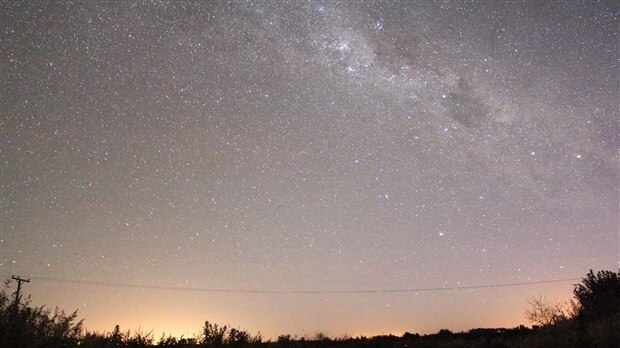
Picture (Above): A Picture taken from a fixed tripod of the night sky. Exposure time:30 seconds. If you look closely, you will notice that the stars are slightly elongated; this is motion blur due to the earths rotation, having a equatorial mount wont only eliminate these spoils in the photographs, but will also allow for longer exposure times, and a deeper, clearer view into space. The two orange lights on the horizon are (from left to right), a city 30 minutes away and a town 10 minutes away.

  • Sign in to reply
  • Cancel

Top Replies

  • Former Member
    Former Member over 12 years ago +1
    Assumption One: Understands the term "Declination",in re:Northern and Southern Hemispheres Assumption Two: Understands the difference between Right Ascension(R.A.) and Left Ascension(LA). Assumption Three…
  • Former Member
    Former Member over 12 years ago in reply to Former Member +1
    Wow that's awesome! You'll never believe that I am 16 and building an equatorial mount then . If I (and Ben possibly) were to build a computer controlled mount, is there any other movements we could factor…
  • Former Member
    Former Member over 12 years ago in reply to benheck +1
    Cost is relative to the value of the equipment being used and whether this is to be a lifetime avocation or a teenager's whim. I have a portable;trailer-mounted observatory,that I built from my own plans…
  • Former Member
    Former Member over 12 years ago

    Assumption One:     Understands the term "Declination",in re:Northern and Southern Hemispheres

    Assumption Two:     Understands the difference between Right Ascension(R.A.) and Left Ascension(LA).

    Assumption Three:  Understands the difference between magnetic North and celestial North(Polaris) OR magnetic South and celestial South

    Assumption Four:    Understands the difference between Earth Time(GMT) and Celestial Time(Sidereal)

    Assumption Five:     Interpolation of the data produced from the above four assumptions and ability to form algorithms in mid-level programming code.


    Background:          In 1971,at ripe age of 16 years,I built my first motorized equatorial mount. I had built a 22" Schmidt-Cassegran, the year before and was ready to upgrade from a crappy azimuth mount?  As I entered university that autumn,one of my first classes was: Intro to Astronomy.  Big deal? I built my first telescope(4.5 inch Newtonian) when I was eight! Back then,I used a synchronous motor on 60 HZ power.  I machined bronze planetary gears to 60:60:24 ratios operating at 1RPM;i.e.a clock motor. One motor per axe. These motors were counter-balanced to minimize weight distortion on the motors and gear boxes. I used lead for its Δmass/weight. WOW! Have things changed in 40+ years? Hey,wait a minute...what happened to my hair?! Why is it so white?? Whatever happened to the WHO?


    I do have fixes for this problem for the 21st century propeller heads...if many are interested,I can give the current fix and/or provide solution archives of the other problems shown in the Ben Heck Photo(such as the light pollution) and apparent chromatic aberration typical of DSRL images.

    • Cancel
    • Vote Up +1 Vote Down
    • Sign in to reply
    • Cancel
  • benheck
    benheck over 12 years ago

    So a computer controlled rotation module to rotate the camera against the rotation of the Earth, to keep the stars fixed?


    How much does an existing solution cost?

    • Cancel
    • Vote Up 0 Vote Down
    • Sign in to reply
    • Cancel
  • Former Member
    Former Member over 12 years ago in reply to benheck

    Exactly. You could probally add computer control so it could fix onto comets and other things that move around. I think commercial solutions prices range around $1000. But a guy by the name of 'Hash' managed to build a simple one for $200 (http://petapixel.com/2013/08/10/buidling-a-diy-barn-door-tracking-mount-for-long-exposure-astrophotography/). I don't think adding computer control would be too hard with an arduino with the serial port. The only real issue is finding software compatible with the whole set up.

    • Cancel
    • Vote Up 0 Vote Down
    • Sign in to reply
    • Cancel
  • Former Member
    Former Member over 12 years ago in reply to Former Member

    Wow that's awesome! You'll never believe that I am 16 and building an equatorial mount then image. If I (and Ben possibly) were to build a computer controlled mount, is there any other movements we could factor into the design (maybe comets, other galaxies etc). Thank you for the terminology, as you could guess I'm rather new to this but I'm doing my research right after this . with the difference of times between the stars and earth, will that effect the timing of the mount or just the location/locating of stars? What type of telescope would you recommend for astrophotography of planets etc.

    I will say with the photo I provided that the light pollution was kinda intentional however the chromatic abbreviation was a mistake (a. Forgot about it. B didn't realize it actually effected the image).

    I would definitely be interested in the solutions and fixes .

    Thank you for your input, I'm sure your expertise will help with Bens/my project.

    Liam

    image <- by the way, his smiley face refuses to be deleted.

    • Cancel
    • Vote Up +1 Vote Down
    • Sign in to reply
    • Cancel
  • Former Member
    Former Member over 12 years ago in reply to benheck

    Cost is relative to the value of the equipment being used and whether this is to be a lifetime avocation or a teenager's whim. I have a portable;trailer-mounted observatory,that I built from my own plans,that cost me $267,884USD+$6K annum to maintain. The first motorised equatorial mount,with my GrandPap strong hand behind me ROFLOL,cost $617,way back in 1966! We machined every part on a 50-year old South Bend,Inc. lathe GrandPap bought from the foundry two years before;when he retired. That lathe is now in my shop as a CNC metal monster,now over a century old?

    How much does it cost to design a Proto-Board,using EagleCad,to control two stepper motors? The motor on the y-axis moves at one rotation per 24 hours sidereal time. Also, the motor on the x-axis moves at one degree of arc per minute,i.e. 1RPHour sidereal time. Factors to be considered but not limited to:

    1. Weight of photographic+telescopic equipment
    2. Weight of counterbalance.
    3. Diameter and metal type of the axle to remain rigid underload with minimal deviation
    4. Strength of Superstructure to support all the above;et al.
    • Cancel
    • Vote Up +1 Vote Down
    • Sign in to reply
    • Cancel
  • rodreig89kishore
    rodreig89kishore over 12 years ago

    Can someone give me some tools and directions to start with I am broke right now.

    And need to work myself  a nice unit

    I can take broken parts and fix them too image
    So I am willing to learn and prosper and Enjoy.
    And return the favour image

    • Cancel
    • Vote Up 0 Vote Down
    • Sign in to reply
    • Cancel
  • Former Member
    Former Member over 12 years ago in reply to rodreig89kishore

    Hi P.Kishore Kumar,

    I going to assume you were talking about a equatorial mount. The simplest and cheapest design is called a barn door. It is essentially a hinged door that opens slowly by the turning of a worm gear. You will need a motor and a timer circuit to keep the camera nice and sturdy, especially for long distance photographs (i.e. other planets). Just remember that a few thousanths of a degree could spoil your photograph (apparently).

    -from my research so far

    Liam

    • Cancel
    • Vote Up 0 Vote Down
    • Sign in to reply
    • Cancel
  • Former Member
    Former Member over 12 years ago in reply to Former Member

    Just check out this guys $200 version.

    http://petapixel.com/2013/08/10/buidling-a-diy-barn-door-tracking-mount-for-long-exposure-astrophotography/

    • Cancel
    • Vote Up 0 Vote Down
    • Sign in to reply
    • Cancel
  • kas.lewis
    kas.lewis over 12 years ago

    There is software called Stellarium that I believe you could hook up to a controller. I once looked into it but not into much detail, ,maybe you can use that to send the rotation control signal and the you can process that and send it to your motors to get the required rotation. Would love to hear if you can get this to work would make star photography so much easier and cheaper than using a prebuilt solution.


    Hope that helps

    • Cancel
    • Vote Up 0 Vote Down
    • Sign in to reply
    • Cancel
  • Former Member
    Former Member over 12 years ago in reply to Former Member

    I've checked out the aforementioned "Barn-door-tracking-mount";this is not an equatorial mount,however? I repeat,as mentioned in previous posts,Equatorial Mounts work on two axes;90° of arc-relative to each axis;i.e. at right angles. Usually the y-axis is tilted from the neutral plane(0,0,0) to your actual latitudinal co-ordinate(0,0,z);I'm in the process of converting my old hand drafts into CAD sketches, so the younger generations can understand what I'm talking about?

    • Cancel
    • Vote Up 0 Vote Down
    • Sign in to reply
    • Cancel
>
element14 Community

element14 is the first online community specifically for engineers. Connect with your peers and get expert answers to your questions.

  • Members
  • Learn
  • Technologies
  • Challenges & Projects
  • Products
  • Store
  • About Us
  • Feedback & Support
  • FAQs
  • Terms of Use
  • Privacy Policy
  • Legal and Copyright Notices
  • Sitemap
  • Cookies

An Avnet Company © 2026 Premier Farnell Limited. All Rights Reserved.

Premier Farnell Ltd, registered in England and Wales (no 00876412), registered office: Farnell House, Forge Lane, Leeds LS12 2NE.

ICP 备案号 10220084.

Follow element14

  • X
  • Facebook
  • linkedin
  • YouTube