

This project explores what human vision might feel like if it worked like that of a prey animal, using a Raspberry Pi 5 and dual wide‑angle NoIR cameras to recreate side‑mounted eyes in real time. By stitching two camera feeds together and testing the result through FPV goggles, Clem shows how peripheral awareness increases while depth perception and coordination quickly fall apart, turning simple tasks into a genuine challenge. The result is a technically simple but mentally demanding experiment in perception, you can find the episode and supporting files below.
We Have Our Eyes on This Project
What would the world look like if human vision worked the way it does for prey animals? Not metaphorically, not philosophically, but physically, if the eyes were mounted on the sides of the head instead of facing forward. That deceptively simple question is the foundation of Clem’s latest experiment, a project that blends biology, perception science, and hands-on electronics into an experience that is as uncomfortable as it is illuminating.

Predators, Prey, and Perspective
Eye placement is not an aesthetic accident of evolution; it is a survival strategy. Predators, humans included, have forward-facing eyes that prioritise depth perception and focus. Prey animals such as rabbits or deer trade that precision for awareness, gaining an enormous field of view at the cost of frontal clarity. Clem’s project sets out to explore that trade-off directly, asking not just what prey animals see, but how it feels to operate with such a radically different visual system.
Rather than resorting to anything biologically questionable, the project takes a decidedly non-gory approach. Cameras, computing, and some carefully considered image processing do the heavy lifting, allowing a human brain to be dropped, temporarily, into a prey-like visual configuration.

The Hardware Foundation
At the centre of the build is a Raspberry Pi 5, chosen not just because it supports two camera connectors, but because it has enough processing headroom to handle real-time video manipulation. Two wide-angle NoIR camera modules act as surrogate eyes, each mounted to the side rather than the front, deliberately exaggerating peripheral vision. Wide lenses are essential here, as prey animals typically enjoy a much broader field of view than humans ever do.
The cameras feed directly into the Raspberry Pi, which outputs video either to a conventional HDMI display during development or to a pair of FPV goggles for the full experience. Power delivery and cabling are intentionally simple, with the focus kept firmly on perception rather than polish.

From Two Eyes to One View
The technical heart of the project lies in how the two camera feeds are combined. Rather than attempting any complex depth reconstruction, the system relies on simple interpolation, mirroring how the brain blends overlapping visual information from each eye. As Clem explains, this same process is why humans do not normally see their own nose, even though it sits squarely within the field of view.
This philosophy is reflected in the Python code driving the system. Frames are captured simultaneously from both cameras, normalised into a common colour format, and optionally rotated to account for physical mounting. The real trick happens in the fusion stage:
def brain_fusion(left, right, fusion_width):
    h, w, c = left.shape
    combined_width = w*2 - fusion_width
    combined = np.zeros((h, combined_width, c), dtype=np.uint8)
The overlap region, the “fusion width”, acts as a crude stand-in for binocular blending. By adjusting it, Clem can tune how much the two images bleed into one another, directly influencing how disorienting the result becomes.

Displays, Limitations, and Workarounds
Getting the video where it needs to go turns out to be one of the project’s more interesting challenges. The FPV goggles expect composite video, while the development setup relies on HDMI. Unfortunately, the Raspberry Pi cannot drive both simultaneously. Enabling composite output disables HDMI entirely.
The workaround is a very maker-style solution: network streaming. The Raspberry Pi runs a lightweight web server inside the vision script, streaming the processed video over the local network. A second computer simply opens the stream in a browser and records the screen. It is inelegant, but effective, and it preserves the integrity of the experiment.
This same streaming infrastructure hints at future flexibility. Once the video exists as a network stream, it can be viewed, recorded, or even post-processed elsewhere without touching the core vision code.

Strapping It On: The Human Test
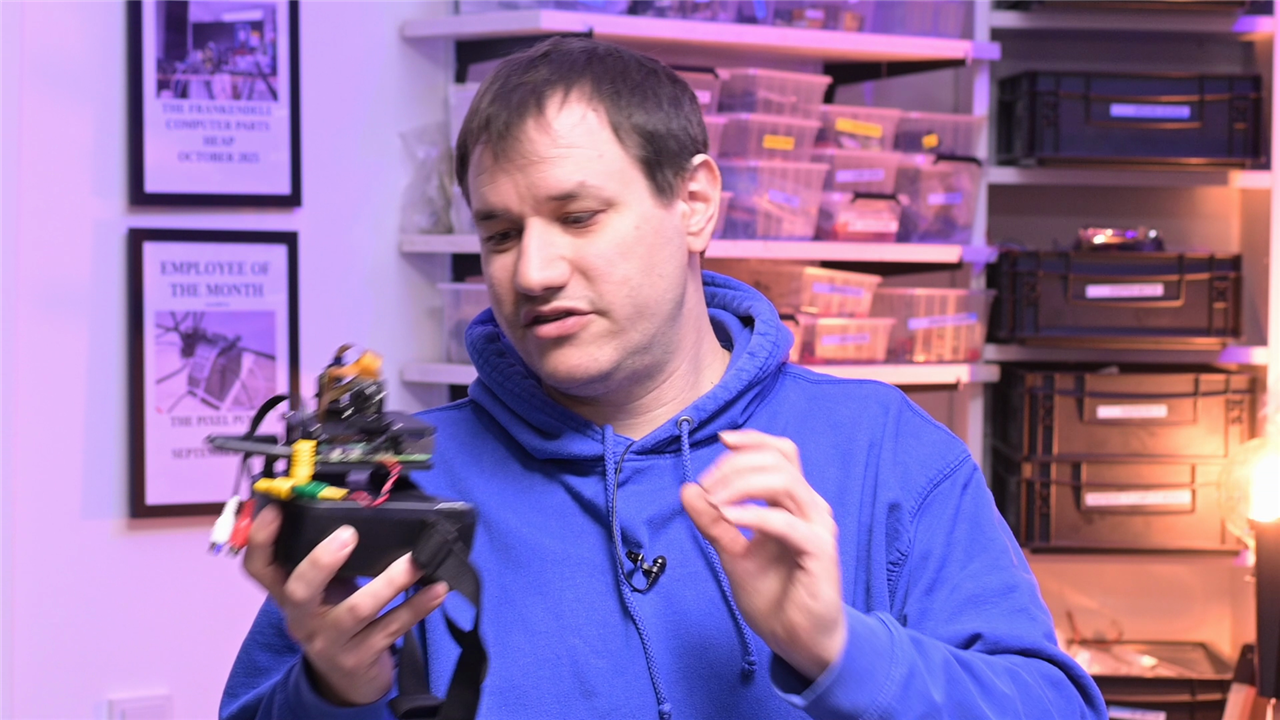
With the system assembled, the real experiment begins. The cameras and Raspberry Pi are mounted directly onto the FPV goggles, with 3D-printed parts doing little more than holding everything in place and keeping cables out of the way. Ironically, the abundance of cables quickly becomes irrelevant: with eyes effectively on the sides of the head, anything directly in front simply fades from awareness.
The first test configuration places the cameras at a more animal-like angle, around 70 degrees. In this mode, everyday tasks become difficult but not impossible. Measuring the voltage of a AAA battery, writing the value down, and packing everything away can be done, albeit slowly and with exaggerated head movements. The brain begins to adapt, treating this strange stitched panorama as a new normal.
Push the cameras out to a full 90 degrees, however, and the experience deteriorates rapidly. Frontal vision all but disappears. Tasks rely almost entirely on touch. Even reading a multimeter display becomes a struggle. The discomfort escalates from simple disorientation to genuine nausea, accompanied by headaches that linger long after the goggles come off.
Beyond the discomfort, the experiment reveals something subtle about animal behaviour. Zig-zagging prey movements, often dismissed as panic, suddenly make sense. With side-mounted vision, maintaining visual contact with a threat means constant changes in direction. What looks erratic from the outside is, in fact, a logical response to a very different sensory input.
Equally revealing is how quickly the human brain attempts to adapt. Given enough time, it is clear that operating with side-mounted vision is possible. It is just profoundly unpleasant for a brain evolved to expect depth and focus straight ahead.
Is It Worth Building?
As a practical tool, the answer is simple: no. The system is not useful, comfortable, or efficient. But that is entirely beside the point. The real value lies in the experience. This project turns an abstract biological concept into something immediate and visceral, forcing a direct confrontation with how deeply perception shapes behaviour.
For anyone interested in human vision, animal biology, or the limits of adaptation, Clem’s side-eyed experiment is a reminder that sometimes the most meaningful projects are the ones that exist purely to be felt, not perfected.
Supporting Files and Links
Bill of Materials
| Product Name | Manufacturer | Quantity | Buy Kit |
|---|---|---|---|
| RPI5-4GB-SINGLE | Raspberry Pi | 1 | Buy Now |
| Raspberry Pi Wide NoIR Camera Module3, 11.9MP, Wide Lens, 2.75mm Focal Length, Raspberry Pi Computer | Raspberry Pi | 2 | Buy Now |
| Power Supply, USB-C, 5.1 V, 5 A, Black, EU Plug | Raspberry Pi | 1 | Buy Now |
| Raspberry Pi Accessory, Raspberry Pi 4 Model B HDMI Cable, Micro HDMI To HDMI, 2m, Black | Raspberry Pi | 1 | Buy Now |
| Product Name | |||
| FPV goggles with AV input | |||


