

Clem's latest workbench upgrade brings together a programmable power supply, precision bench multimeter, electronic load and arbitrary waveform generator to create a fully automated measurement platform. By writing custom Python libraries for each instrument and connecting everything over Ethernet, he can run repeatable test routines that validate power-supply accuracy, characterise voltage drop, measure cable resistance, simulate real-world loads and even explore signal injection and ripple analysis.
Alongside the automation upgrades, he also installs a dual-arm fume extraction system, expands his collection of test leads, and adds a non-invasive AC/DC current probe that makes current measurements easier without breaking into a circuit. If you've ever wanted to move beyond manual measurements and build a smarter, data-driven electronics bench, this project offers a practical look at what's possible with a handful of programmable instruments and some carefully written code - you can find links to the Python libraries, and supporting resources below along with the episode!
Time to Work Smarter, not Harder!
Following the previous workbench upgrade, which focused on organisation, infrastructure, and day-to-day usability, Clem's latest round of improvements takes a different direction. This time, the emphasis is on automation, repeatability, and measurement accuracy. By combining programmable test equipment with custom software, the bench evolves from a collection of instruments into a coordinated testing environment capable of generating reliable data with minimal manual intervention.
As with previous upgrades, the equipment was selected by Clem according to his own requirements. The goal was not simply to add more instruments, but to create a system that could answer practical engineering questions automatically, repeatedly, and with greater precision than would be possible through manual measurements alone.
A Better Approach to Fume Extraction
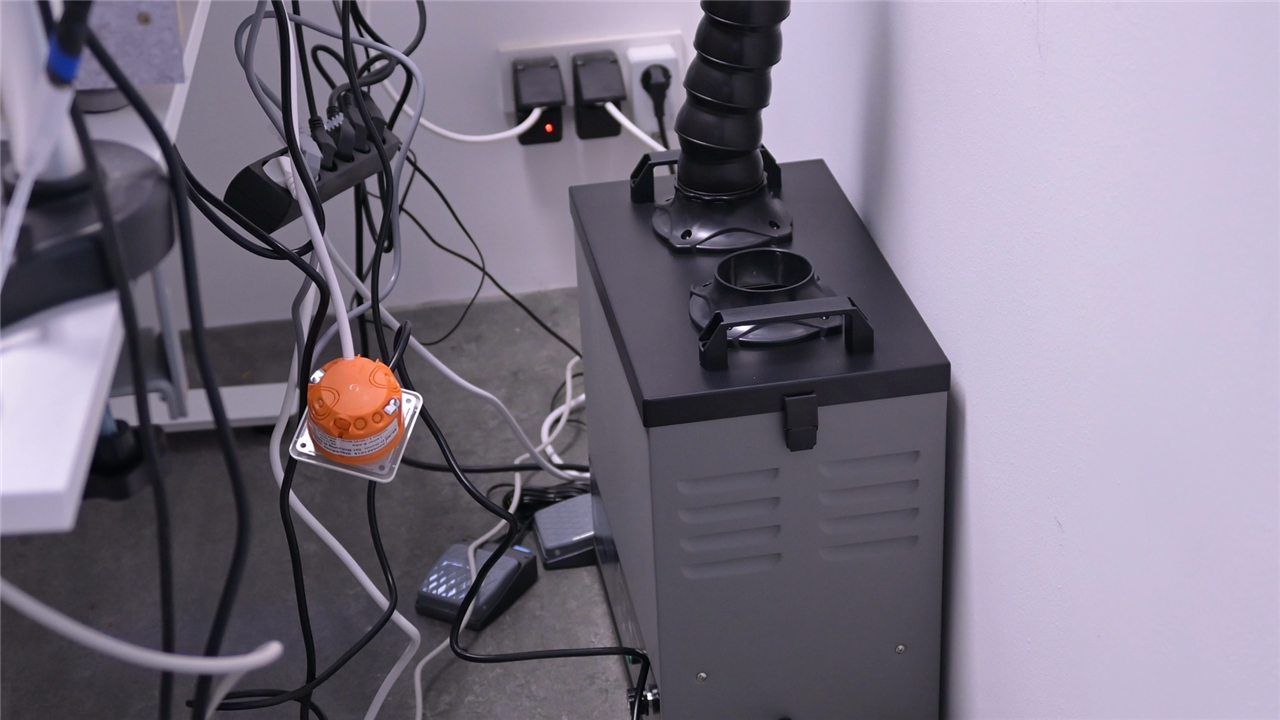
One of the more visible upgrades came directly from community feedback. During the previous workbench tour, viewers questioned whether the existing DIY extraction setup provided adequate protection for prolonged soldering sessions. Rather than making incremental changes, Clem decided to install a dedicated dual-arm fume extraction unit. The system incorporates pre-filtration, HEPA filtration, and activated carbon filtering within a self-contained package.
The upgrade complements the original extraction arrangement rather than replacing it entirely. Both systems have been integrated into the existing remote-controlled switching setup, allowing them to operate simultaneously whenever soldering work begins.
"The community's nagging got me to upgrade the fume extraction system."
In use, the dual extraction arms provide considerably more flexibility than the previous fixed arrangement, allowing airflow to be positioned directly where fumes are generated. While the original extraction system continues to contribute overall airflow, the dedicated extractor offers the advantage of being portable and self-contained, making it useful in situations where permanent ducting is impractical. After testing both approaches side-by-side, Clem concluded that the dedicated extractor provided superior filtration and positioning flexibility while still integrating neatly into the existing workshop infrastructure.
Expanding the Power and Measurement Stack
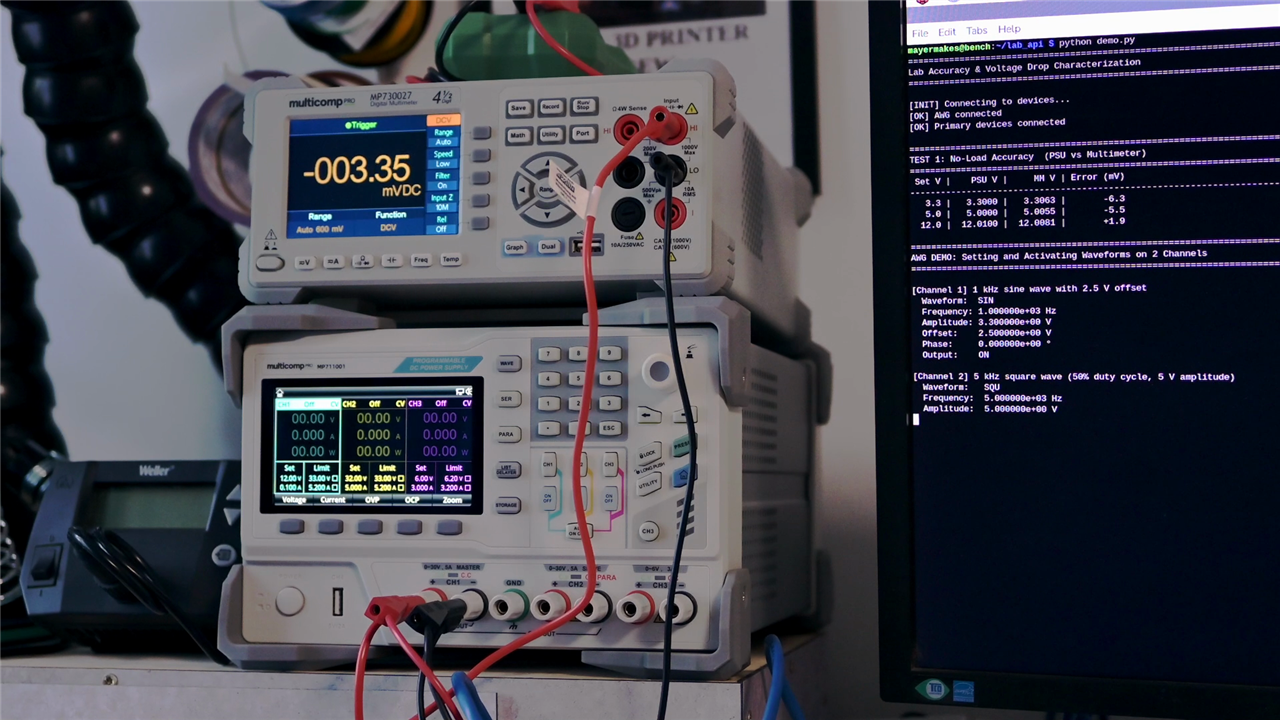
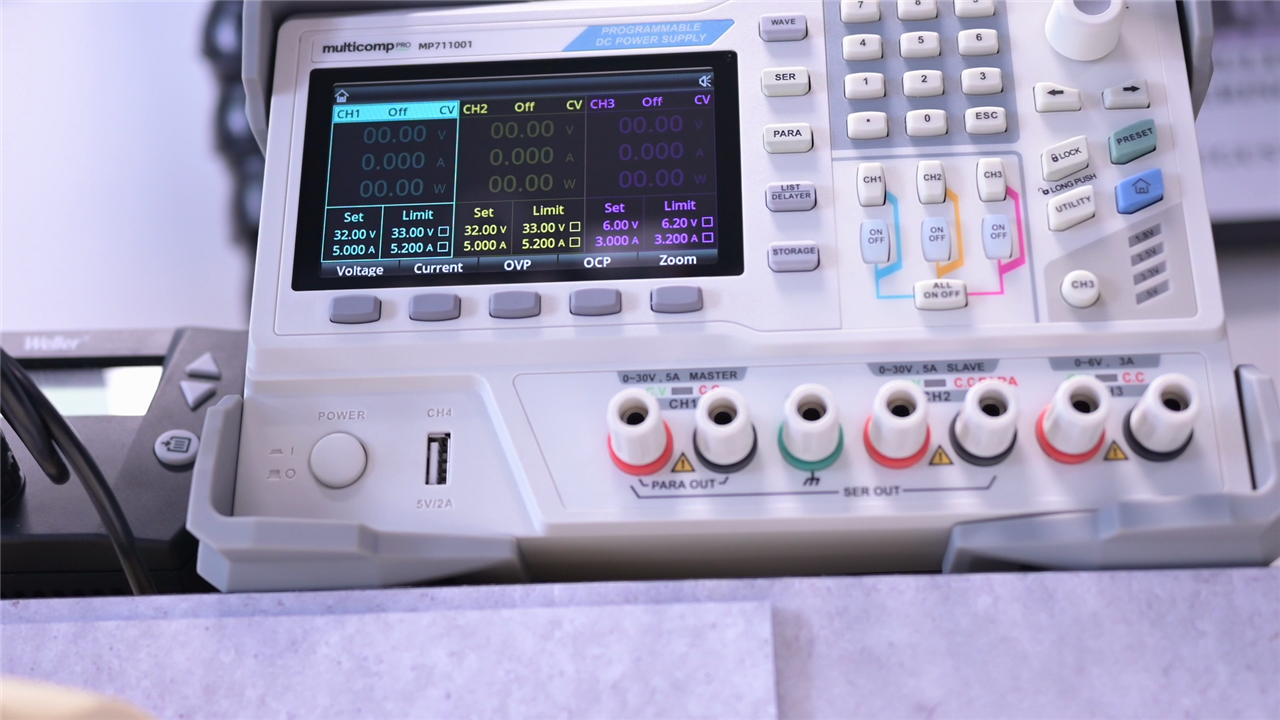
Although Clem remains a fan of his existing bench power supply, particularly because of its simplicity and speed of use, the new upgrade focuses on capabilities beyond simply delivering power. The centrepiece of the new measurement stack is a programmable four-output bench supply featuring two 0-30 V, 5 A channels alongside a dedicated low-voltage precision channel and an independently controlled USB output. The additional channels dramatically increase flexibility when powering more complex projects.
The power supply is supported by a programmable bench digital multimeter, a programmable DC electronic load, and an arbitrary waveform generator. Together they create a complete measurement platform capable of sourcing power, applying controlled loads, performing precision measurements, and generating test signals.
The installed equipment includes:
- MP711001 programmable four-output power supply
- MP730027 bench digital multimeter
- MP710771 programmable DC electronic load
- MP750513 arbitrary waveform generator
All instruments support remote connectivity via Ethernet, USB, and even RS232, allowing them to be integrated into automated workflows rather than operated exclusively through their front panels.
"I've got a serious new bench upgrade."
One detail Clem found particularly useful is that the bench multimeter can act as a trusted measurement reference rather than relying solely on values reported internally by the power supply.
"I can have a reliable voltage and current measurement over this precision instrument and don't have to rely on the output that the power supply tells me it does."
This allows the instruments to effectively validate one another and provides a higher level of confidence when collecting measurement data.
Why Add a Programmable DC Load?
For many electronics projects, power consumption testing often starts with a collection of power resistors. While effective, resistors provide only a single fixed load characteristic. The programmable electronic load removes these limitations.
In addition to conventional constant-current and constant-voltage operation, the instrument supports constant-power and constant-resistance modes. More importantly, it also provides dynamic versions of those operating modes. This allows entire load profiles to be generated automatically, enabling simulation of changing operating conditions that would be difficult to reproduce manually.
"These modes don't end with constant ones. They are also dynamic ones."
The unit also includes battery testing functionality and remote sense inputs, providing significantly more capability than a collection of passive load resistors ever could. For engineers developing motor controllers, battery-powered electronics, or power conversion systems, the ability to simulate loads that are not physically present becomes particularly valuable.
"I don't have to guess anymore how my things will perform. I can already know before I even buy the parts."

Measurement Capabilities Created by Combining the Instruments
The real strength of the setup emerges when all four instruments operate together. Rather than performing isolated measurements, Clem can now build repeatable test scenarios that coordinate the power supply, multimeter, electronic load, and waveform generator simultaneously.
The automated environment supports:
- Voltage accuracy verification between power supply output and precision DMM measurements
- Load regulation testing across multiple voltage rails
- Power-delivery characterisation under varying current demands
- Cable resistance measurement using controlled voltage-drop testing
- Contact resistance identification
- Error mapping across operating ranges
- Signal injection and disturbance testing
- Dynamic load simulation
- Filter and ripple analysis
- Battery and motor behaviour emulation
One particularly useful capability involves measuring voltage drops through cables and connectors and deriving the associated resistance automatically. The software evaluates the relationship between load current and voltage drop to estimate the combined resistance of wiring and connections.
Within the test framework, the calculation is performed directly from sweep data:
r_cable = (d1 - d0) / 1000 / (i1 - i0)
That simple calculation transforms a series of load measurements into a quantified resistance value, making it easy to compare wiring arrangements and identify poor connections.
Automating Everything with Python and A Unified Lab API and Demonstration Framework
Although all of the instruments include their own interfaces and software, Clem quickly realised that remembering the behaviour of several unrelated front-panel interfaces was not the most productive way to work.
"I'd better use them programmatically over the network and have them do my bidding just via some code."
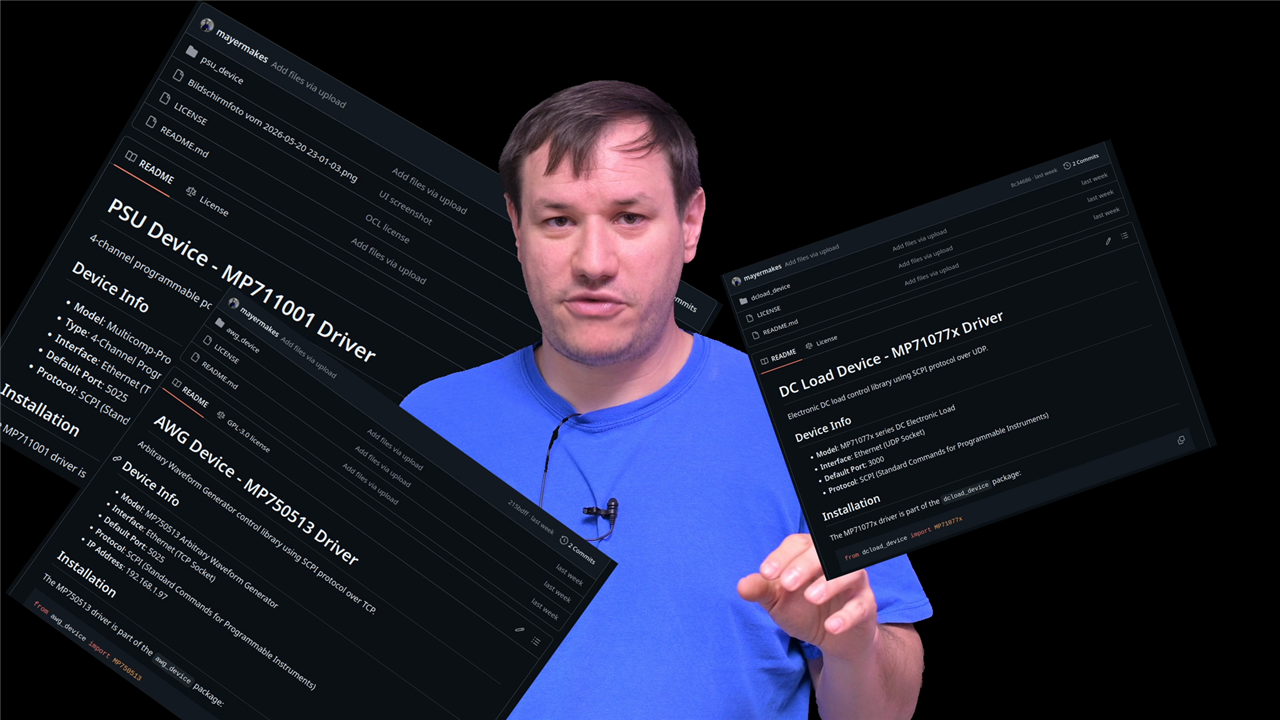
The solution was to create a collection of Python libraries that expose a consistent programming interface across all of the devices.
The project ultimately became more involved than expected.
"There were some quirks with some of the devices, especially the load gave me a difficult time."
While the digital multimeter proved relatively straightforward to integrate, other instruments required additional investigation before stable communication could be achieved. The resulting drivers focus on reliability and predictable operation. Each device is abstracted behind its own class, providing a clean interface for controlling power supplies, multimeters, electronic loads, and waveform generators.
The codebase even includes a dedicated diagnostic utility for investigating SCPI communications with the arbitrary waveform generator. This tool systematically tests alternative command variations when communicating with the instrument, helping identify protocol differences and implementation quirks that often appear when automating laboratory equipment. After developing individual device drivers, Clem wrapped everything inside a higher-level laboratory API.
The demonstration application performs several automated validation exercises that would be time-consuming to execute manually.
The workflow includes:
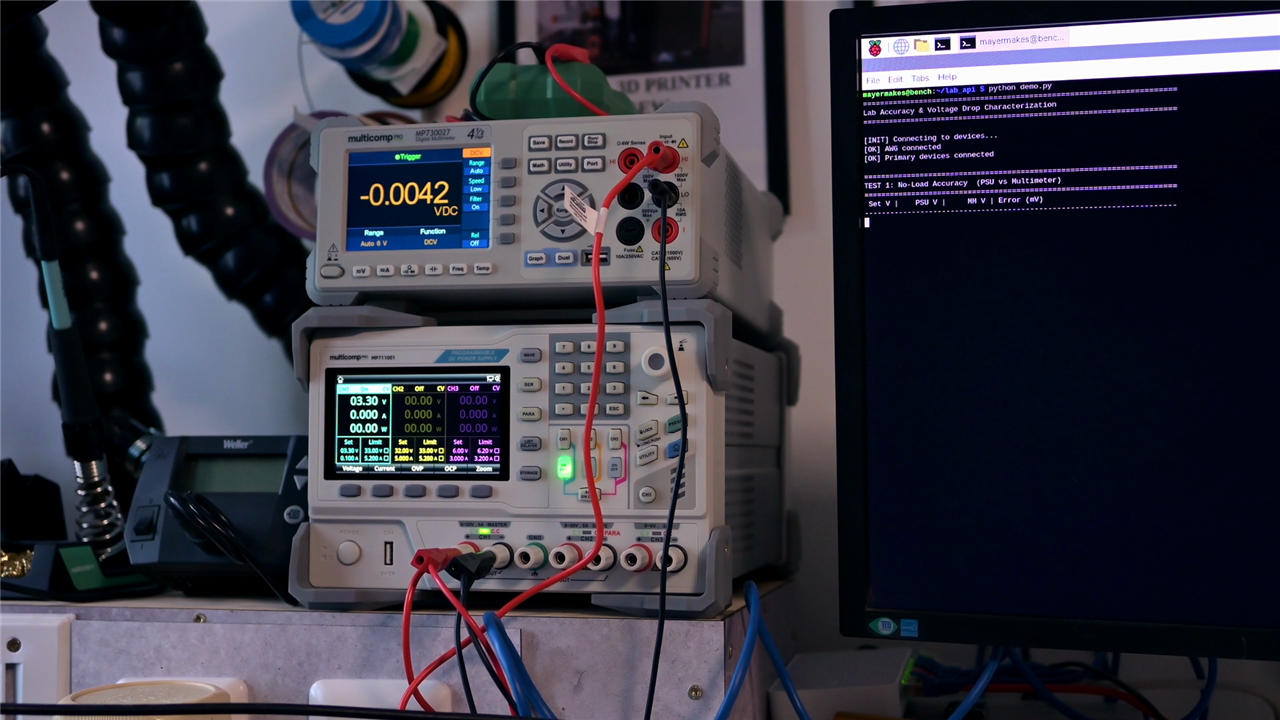
- No-load accuracy validation at multiple output voltages
- Voltage-drop characterisation under increasing load current
- Power-supply regulation testing across 3.3 V, 5 V and 12 V rails
- Constant-resistance load testing
- Arbitrary waveform generator control and activation
The script automatically applies voltages, changes load conditions, waits for outputs to settle, collects readings from multiple instruments, calculates deviations, and records the results. Rather than simply taking a single measurement, the framework sweeps through operating ranges to build a much more complete understanding of system behaviour.
"I can automate that and just go through all the possible scenarios and then see how much the error in measurement is."
Because every instrument is connected via Ethernet, the measurements can be run from anywhere on the network.
"For sensitive measurements I can even leave the room and run them from outside and still look at all the data in real time."
This becomes useful whenever environmental effects could disturb measurements or when long-duration tests need to be left unattended.
Expanding into Signal Integrity and Ripple Analysis and Non-Invasive Current Measurement
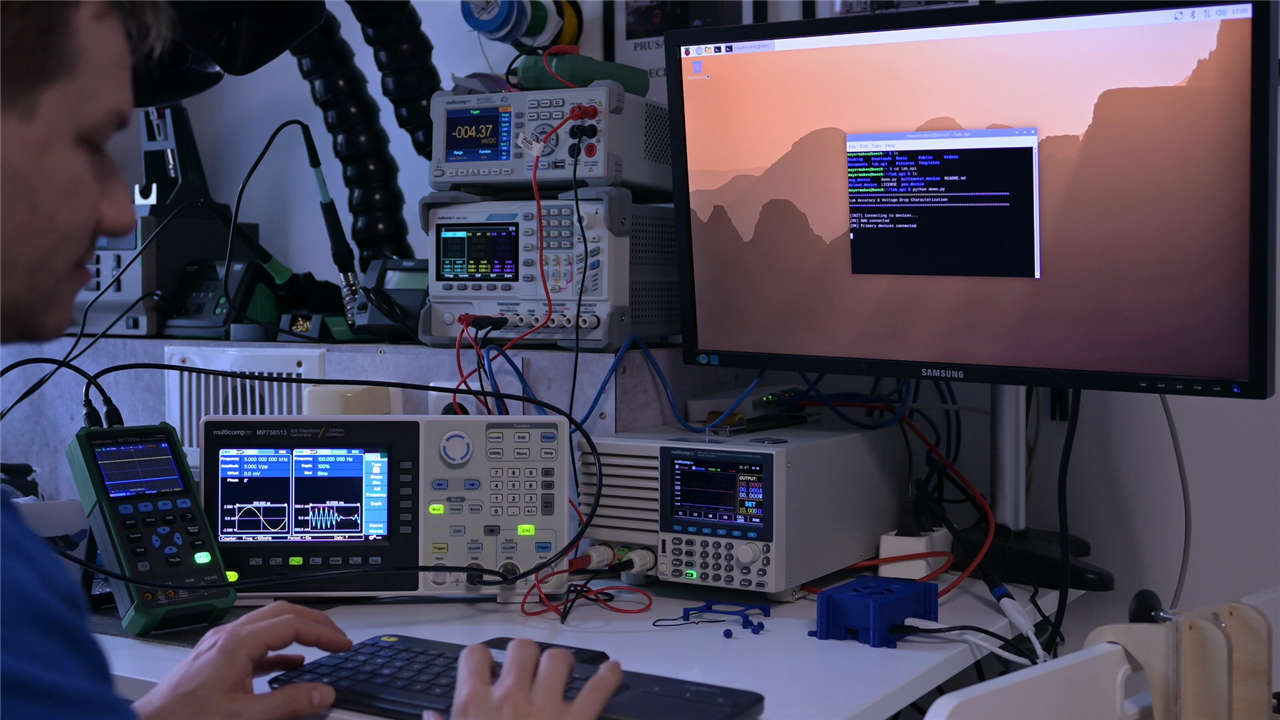
The arbitrary waveform generator opens the door to testing scenarios beyond simple DC measurements. Although Clem described the waveform generator library as still being a work in progress, the intent is already clear. The instrument can inject controlled signals into circuits and, when combined with the current probe and oscilloscope, create a surprisingly capable signal analysis platform.
"We even can see how much of ripple that we could inject into a power path would at the end get filtered out."
This allows evaluation of filters, power-distribution networks, and noise-sensitive circuits across different frequencies, voltages, and load conditions.
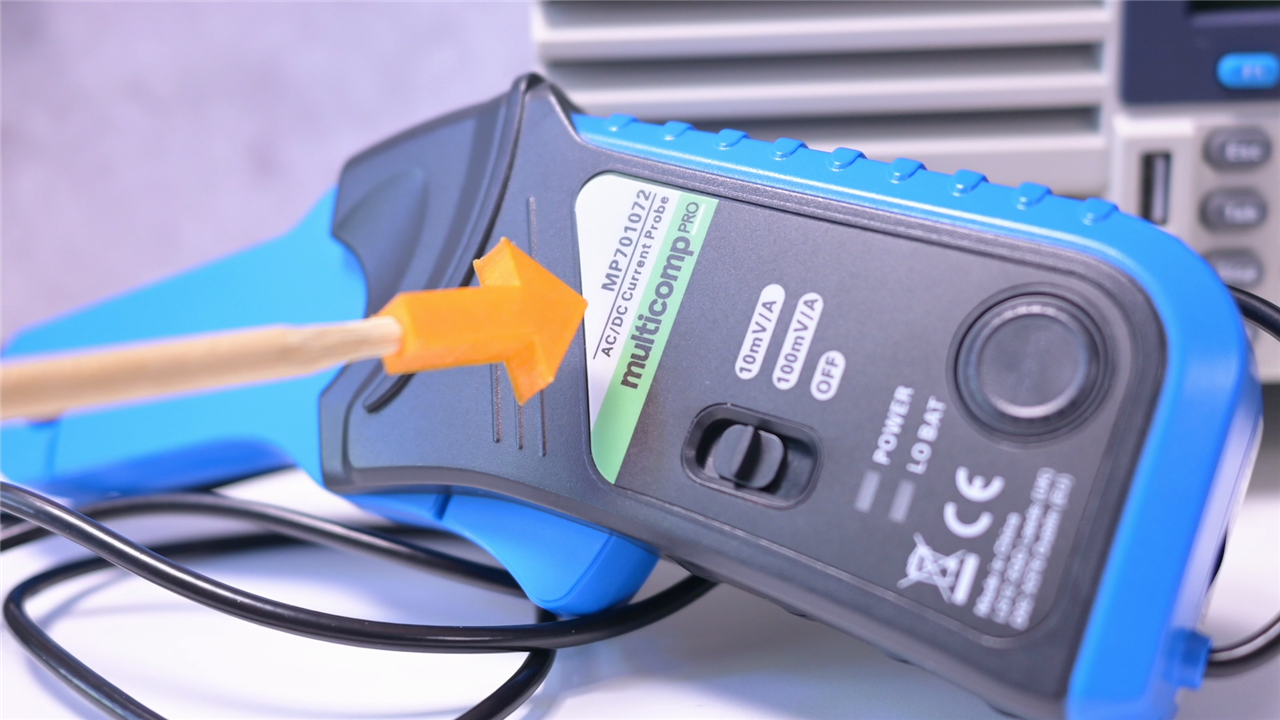
It also points towards future development of the software platform as additional instrumentation becomes integrated into the automated environment. Another small but surprisingly useful addition is an active AC/DC current probe.
Unlike traditional current measurements that require inserting a meter into the circuit, the clamp allows current to be monitored without disconnecting or modifying wiring.
The probe provides a voltage output proportional to the measured current, making it suitable for direct connection to either a multimeter or an oscilloscope.
Selectable output scaling allows engineers to trade sensitivity for measurement range, depending on the application.
"I don't have to break up the circuit anymore."
While not intended to replace precision inline measurements, the probe dramatically simplifies troubleshooting and verification tasks where convenience is more important than ultimate accuracy.
From Hobby Workbench to Automated Test Environment
Viewed individually, none of these upgrades are particularly dramatic. A better extractor, a programmable power supply, an electronic load, a current probe, some test leads, and a few hundred lines of Python code are all commonplace tools. Taken together, however, they fundamentally change how the bench can be used.
The workbench is no longer simply a place where measurements are taken manually. It has become a programmable measurement platform capable of validating power systems, characterising components, simulating hardware that is not physically available, and performing repeatable tests automatically.
As Clem summarised after bringing the instruments and software together:
"That's quite a lot of capability that we just added with a few simple upgrades and a bit of code."
Supporting Links and Files
Bill of Materials / Parts Used
| Product Name | Manufacturer | Quantity | Buy Kit |
|---|---|---|---|
| DC Electronic Load, Multicomp Pro DC Electronic Loads, 300 W, Programmable, 0 V, 150 V, 40 A | multicomp pro | 1 | Buy Now |
| Bench Power Supply, USB Power Output, Programmable, 4 Output, 0 V, 32 V, 0 A, 5 A | multicomp pro | 1 | Buy Now |
| Test Lead Set, Hook Clip, Hook Clip, 60 V, 6 A, Grey, 500 mm | multicomp pro | 1 | Buy Now |
| Current Probe, BNC Plug, Current Clamp, 65 A, 20 mA, Multimeters & Oscilloscopes | multicomp pro | 1 | Buy Now |
| Fume Extractor, 320 m³/h, 240 VAC, 200 W, EU, UK, Dual Channel | multicomp pro | 1 | Buy Now |
| Test Lead Set, Banana Plug Stackable, Alligator Clip, Banana Plug, Hook Clip, 1 kV, 5 A | multicomp pro | 1 | Buy Now |
| TEST LEAD, RED, 1.524M, 1.2KV, 12A | multicomp pro | 1 | Buy Now |
| TEST LEAD, BLK, 1.016M, 1.2KV, 12A | multicomp pro | 1 | Buy Now |


