element14 Community
element14 Community
    Register Log In
  • Site
  • Search
  • Log In Register
  • Community Hub
    Community Hub
    • What's New on element14
    • Feedback and Support
    • Benefits of Membership
    • Personal Blogs
    • Members Area
    • Achievement Levels
  • Learn
    Learn
    • Ask an Expert
    • eBooks
    • element14 presents
    • Learning Center
    • Tech Spotlight
    • STEM Academy
    • Webinars, Training and Events
    • Learning Groups
  • Technologies
    Technologies
    • 3D Printing
    • FPGA
    • Industrial Automation
    • Internet of Things
    • Power & Energy
    • Sensors
    • Technology Groups
  • Challenges & Projects
    Challenges & Projects
    • Design Challenges
    • element14 presents Projects
    • Project14
    • Arduino Projects
    • Raspberry Pi Projects
    • Project Groups
  • Products
    Products
    • Arduino
    • Avnet & Tria Boards Community
    • Dev Tools
    • Manufacturers
    • Multicomp Pro
    • Product Groups
    • Raspberry Pi
    • RoadTests & Reviews
  • About Us
    About the element14 Community
  • Store
    Store
    • Visit Your Store
    • Choose another store...
      • Europe
      •  Austria (German)
      •  Belgium (Dutch, French)
      •  Bulgaria (Bulgarian)
      •  Czech Republic (Czech)
      •  Denmark (Danish)
      •  Estonia (Estonian)
      •  Finland (Finnish)
      •  France (French)
      •  Germany (German)
      •  Hungary (Hungarian)
      •  Ireland
      •  Israel
      •  Italy (Italian)
      •  Latvia (Latvian)
      •  
      •  Lithuania (Lithuanian)
      •  Netherlands (Dutch)
      •  Norway (Norwegian)
      •  Poland (Polish)
      •  Portugal (Portuguese)
      •  Romania (Romanian)
      •  Russia (Russian)
      •  Slovakia (Slovak)
      •  Slovenia (Slovenian)
      •  Spain (Spanish)
      •  Sweden (Swedish)
      •  Switzerland(German, French)
      •  Turkey (Turkish)
      •  United Kingdom
      • Asia Pacific
      •  Australia
      •  China
      •  Hong Kong
      •  India
      •  Japan
      •  Korea (Korean)
      •  Malaysia
      •  New Zealand
      •  Philippines
      •  Singapore
      •  Taiwan
      •  Thailand (Thai)
      •  Vietnam
      • Americas
      •  Brazil (Portuguese)
      •  Canada
      •  Mexico (Spanish)
      •  United States
      Can't find the country/region you're looking for? Visit our export site or find a local distributor.
  • Translate
  • Profile
  • Settings
WorkBench Wednesdays
  • Challenges & Projects
  • element14 presents
  • WorkBench Wednesdays
  • More
  • Cancel
WorkBench Wednesdays
Blog Quick: what's your best desoldering braid/wick tip or trick?
  • Blog
  • Forum
  • Documents
  • Quiz
  • Events
  • Polls
  • Files
  • Members
  • Mentions
  • Sub-Groups
  • Tags
  • More
  • Cancel
  • New
Join WorkBench Wednesdays to participate - click to join for free!
  • Share
  • More
  • Cancel
Group Actions
  • Group RSS
  • More
  • Cancel
Engagement
  • Author Author: baldengineer
  • Date Created: 1 Feb 2021 4:59 AM Date Created
  • Views 9711 views
  • Likes 14 likes
  • Comments 49 comments
  • soldering
  • solder wick
  • desolder
  • desoldering braid
Related
Recommended

Quick: what's your best desoldering braid/wick tip or trick?

baldengineer
baldengineer
1 Feb 2021

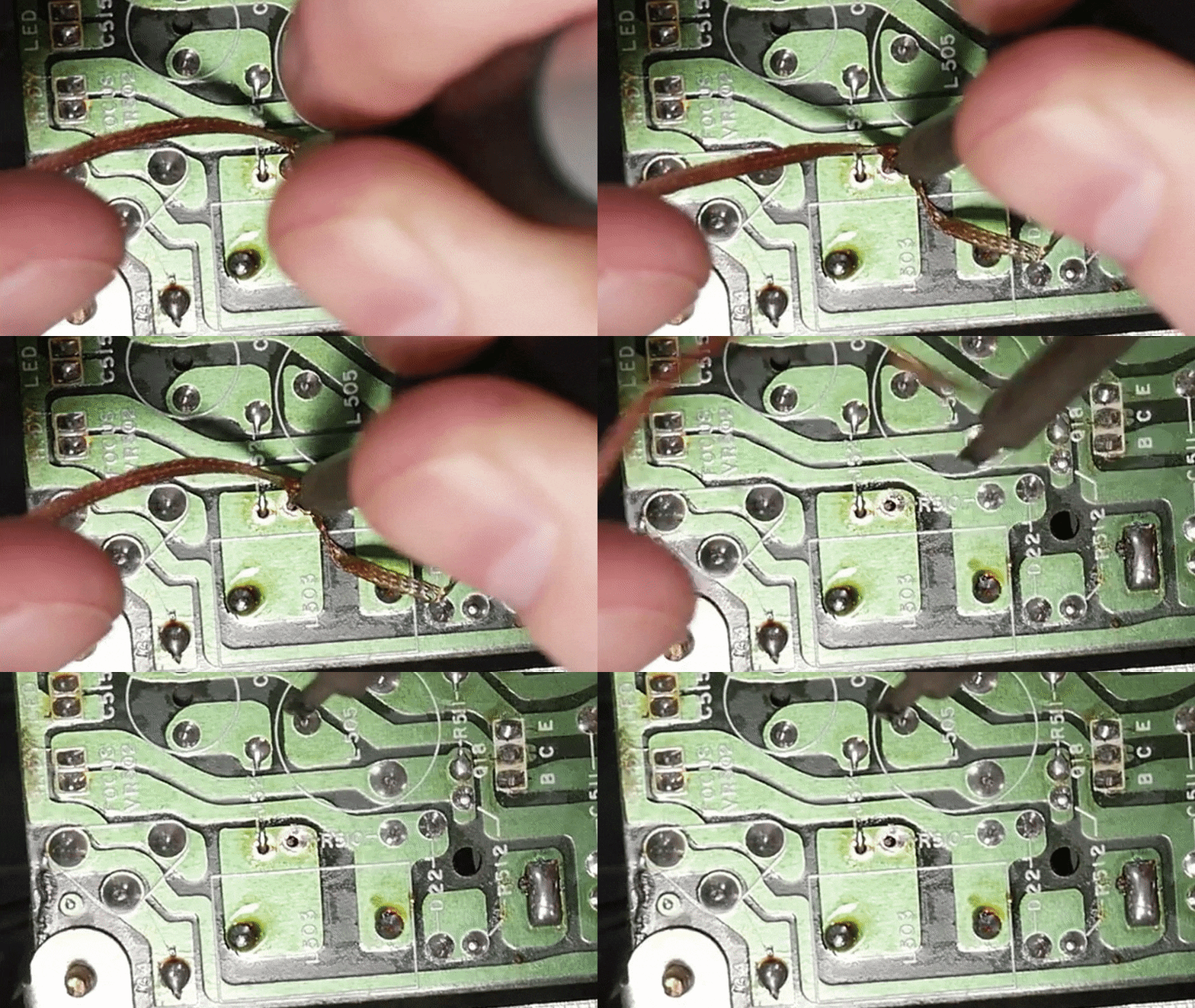
image

Since last March 2020, I have been live-streaming three days a week. My streams are all electronics related but include retro computer repairs, soldering kits, Arduino coding, explaining measurements, and other electronics stuff. Several of the recent Workbench Wednesdays episodes have been a result of a live stream. Another outcome from these streams is that my soldering skill has increased significantly. Not just because I am practicing more, but because constantly being watched and critiqued creates motivational awareness!


The other day, someone commented that I am a "solder wick magician." Of the things I get called online, I consider that one a compliment. Though, unlike the other names, it may not be entirely deserved. At least, I don't think so. However, as the animated GIF above shows, I occasionally get an excellent wicking action when using desoldering braid.


There are only a few tips and tricks that I (think I) actually know. So, I thought I'd ask the community about yours. Getting started, here is something obvious to me now, but people usually get the ah-ha look on their faces when I show them. Unless the wick is brand new, I'll dab it with a flux pen before using it. I find flux on the joint I'm trying to remove, plus the extra flux that wicks into the braid, is very effective. (And a great way to use up old braid.)


What are some tips or tricks you have when using desoldering braid (or wick)?


  • Sign in to reply

Top Comments

  • Fred27
    Fred27 over 5 years ago +9
    I was also going to suggest using more flux, but it seems everyone's on the same page with that one. I have a "shoe polish" style tin of flux that I must have got free with something from China. I drag…
  • Andrew J
    Andrew J over 5 years ago +7
    For through hole components, don't bend the leads underneath the board to hold them in place on the top side. That "can" make it more difficult to desolder in the future if needed and the part never stays…
  • wolfgangfriedrich
    wolfgangfriedrich over 5 years ago +7
    Use more flux, always....
  • jw0752
    jw0752 over 5 years ago in reply to jw0752

    I don't know if anyone else has situations to repair boards like this but if anyone is interested I have a series of pictures that show how I use solder wick to reinstall a fuse clip where the original pad is completely gone. I would probably start a separate thread so as not to divert James' thread any further than I have already.


    John

    • Cancel
    • Vote Up +3 Vote Down
    • Sign in to reply
    • More
    • Cancel
  • jw0752
    jw0752 over 5 years ago in reply to baldengineer

    About as much as cursing helps with burned fingers.

    • Cancel
    • Vote Up +2 Vote Down
    • Sign in to reply
    • More
    • Cancel
  • jw0752
    jw0752 over 5 years ago

    Sorry I didn't get into this conversation earlier but i had a bunch of work fall in my lap and I have not been able to keep up with the forum for the last several days. I almost never use solder wick for its intended purpose. In my work on damaged circuit boards it is used primarily  as a replacement for burned power traces. I will cut out the portion of the circuit board that has been carbonized by arcing and heat, I will construct a bridge using the solder wick from a good portion of the board to the other side and  then I will fill the hole in the board with epoxy. In some cases where the burn is localized and centered on a via I will start the wick on one side of the board and come through the board at the burn using the solder wick as a via to increase the surface area of contact with the lead that belongs in the previously burned hole. The solder wick than continues on the other side of the board to a good solid connection. Where the wick reconnects with the original traces of the board I will scrape the masking off the original trace that is about 4 times as long as the trace is wide so that once again the conductivity of the bond between the wick and the trace is as high as possible. Fluxing the scraped traces helps to make a good solder joint.


    One of the weak spots on many power handling boards are the fuse clips. If the board is relying on vias to pads on the other side of the board for good conductivity these are frequently damaged when the fuse clip oxidizes, heats up, and damages the board. I have found in situations where the board isn't too badly carbonized that I can use the solder wick to come from the pad on the underside, through one hole, across the new fuse clip like a belt and down the second pin hole and back to the pad. This necessitates enlarging the original holes slightly. The copper of the wick and the increased contact area afforded by the belting makes this a very good fix.


    John

    • Cancel
    • Vote Up +5 Vote Down
    • Sign in to reply
    • More
    • Cancel
  • baldengineer
    baldengineer over 5 years ago in reply to jw0752

    jw0752  wrote:

    but keep position of the driver in mind as a slip can also produce a puncture and lots of blood.

    Does solder wick help with cleaning up the blood? j/k

    • Cancel
    • Vote Up +1 Vote Down
    • Sign in to reply
    • More
    • Cancel
  • jw0752
    jw0752 over 5 years ago in reply to Andrew J

    I like to salvage components from old boards and while the ones with the bent over pins add an additional step they can be overcome. The trick is to take a small screw driver and straighten the pins before you use the desoldering gun. Surprisingly the metal of the pins is strong enough to be lifted through the cold soft solder. Once the pins are raised to an upward position the solder can be sucked away. I use a fairly hot 380 degree F desoldering gun as this gives enough heat to penetrate to both sides of the board. Further I rotate the position of the hollow tip around, with the pin at the center. This moves the pin slightly in the hole and allows the air flow into the vacuum to get all around the pin.  After the part is removed I use a flat bladed needle nose pliers to flatten the leads further and make them reusable. One word of caution though. The pin raising procedure works best with a small sharp screw driver but keep position of the driver in mind as a slip can also produce a puncture and lots of blood.


    John

    • Cancel
    • Vote Up +5 Vote Down
    • Sign in to reply
    • More
    • Cancel
<>
element14 Community

element14 is the first online community specifically for engineers. Connect with your peers and get expert answers to your questions.

  • Members
  • Learn
  • Technologies
  • Challenges & Projects
  • Products
  • Store
  • About Us
  • Feedback & Support
  • FAQs
  • Terms of Use
  • Privacy Policy
  • Legal and Copyright Notices
  • Sitemap
  • Cookies

An Avnet Company © 2026 Premier Farnell Limited. All Rights Reserved.

Premier Farnell Ltd, registered in England and Wales (no 00876412), registered office: Farnell House, Forge Lane, Leeds LS12 2NE.

Follow element14

  • X
  • Facebook
  • linkedin
  • YouTube