
element14 Community
element14 Community
    Register Log In
  • Site
  • Search
  • Log In Register
  • Community Hub
    Community Hub
    • What's New on element14
    • Feedback and Support
    • Benefits of Membership
    • Personal Blogs
    • Members Area
    • Achievement Levels
  • Learn
    Learn
    • Ask an Expert
    • eBooks
    • element14 presents
    • Learning Center
    • Tech Spotlight
    • STEM Academy
    • Webinars, Training and Events
    • Learning Groups
  • Technologies
    Technologies
    • 3D Printing
    • FPGA
    • Industrial Automation
    • Internet of Things
    • Power & Energy
    • Sensors
    • Technology Groups
  • Challenges & Projects
    Challenges & Projects
    • Design Challenges
    • element14 presents Projects
    • Project14
    • Arduino Projects
    • Raspberry Pi Projects
    • Project Groups
  • Products
    Products
    • Arduino
    • Avnet & Tria Boards Community
    • Dev Tools
    • Manufacturers
    • Multicomp Pro
    • Product Groups
    • Raspberry Pi
    • RoadTests & Reviews
  • About Us
    About the element14 Community
  • Store
    Store
    • Visit Your Store
    • Choose another store...
      • Europe
      •  Austria (German)
      •  Belgium (Dutch, French)
      •  Bulgaria (Bulgarian)
      •  Czech Republic (Czech)
      •  Denmark (Danish)
      •  Estonia (Estonian)
      •  Finland (Finnish)
      •  France (French)
      •  Germany (German)
      •  Hungary (Hungarian)
      •  Ireland
      •  Israel
      •  Italy (Italian)
      •  Latvia (Latvian)
      •  
      •  Lithuania (Lithuanian)
      •  Netherlands (Dutch)
      •  Norway (Norwegian)
      •  Poland (Polish)
      •  Portugal (Portuguese)
      •  Romania (Romanian)
      •  Russia (Russian)
      •  Slovakia (Slovak)
      •  Slovenia (Slovenian)
      •  Spain (Spanish)
      •  Sweden (Swedish)
      •  Switzerland(German, French)
      •  Turkey (Turkish)
      •  United Kingdom
      • Asia Pacific
      •  Australia
      •  China
      •  Hong Kong
      •  India
      •  Japan
      •  Korea (Korean)
      •  Malaysia
      •  New Zealand
      •  Philippines
      •  Singapore
      •  Taiwan
      •  Thailand (Thai)
      •  Vietnam
      • Americas
      •  Brazil (Portuguese)
      •  Canada
      •  Mexico (Spanish)
      •  United States
      Can't find the country/region you're looking for? Visit our export site or find a local distributor.
  • Translate
  • Profile
  • Settings
Recycle & Retrofit
  • Challenges & Projects
  • Project14
  • Recycle & Retrofit
  • More
  • Cancel
Recycle & Retrofit
Blog Convert a PC PS to a Bench Power Supply
  • Blog
  • Forum
  • Documents
  • Events
  • Polls
  • Files
  • Members
  • Mentions
  • Sub-Groups
  • Tags
  • More
  • Cancel
  • New
Join Recycle & Retrofit to participate - click to join for free!
  • Share
  • More
  • Cancel
Group Actions
  • Group RSS
  • More
  • Cancel
Engagement
  • Author Author: dougw
  • Date Created: 18 Oct 2020 9:16 AM Date Created
  • Views 8902 views
  • Likes 20 likes
  • Comments 35 comments
  • doug wong
  • bench supply
  • recycleretrofitch
  • pcps
  • pc power supply
Related
Recommended

Convert a PC PS to a Bench Power Supply

dougw
dougw
18 Oct 2020
image

Recycle & Retrofit

Enter Your Electronics & Design Project for a chance to win a $200 shopping cart!

Submit an EntrySubmit an Entry  Back to homepage image
Project14 Home
Monthly Themes
Monthly Theme Poll


I have a collection of old PCs from various scavenging activities. Somehow I just couldn't seem to pass up opportunities to acquire "free" PCs. They are probably all working, but I don't actually have a use for them as computers. I have "intended" for a long time to scavenge whatever might be repurposed off some of these computers - disk drives, power supplies, heat sinks, etc. But even for those items, I don't have a pressing need. I did make several attempts to design a conversion to create a bench power supply from the PC power supplies, because in the past I always seemed to need more power supplies, and they can be pretty expensive to buy.

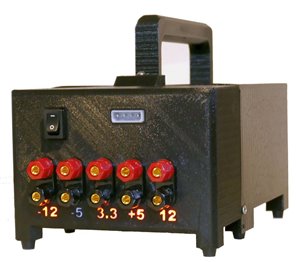
I bought connectors and binding posts and even designed a couple of versions of PCB to get started. However I always stalled when trying to come up with a reasonable (cheap) way to package the bench supply. This Projec14 Upcycling theme is a good excuse to finally put a complete supply together.
image

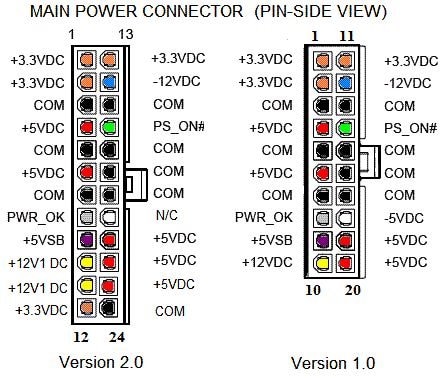
These old PC power supplies have a bunch of output power connectors and the main connector comes in a couple of variants.
image

Note that the V2 connectors have all the same pins in the same places as the V1 connector so they are backward compatible, except the V2 power supplies are less likely to have a -5 V output.

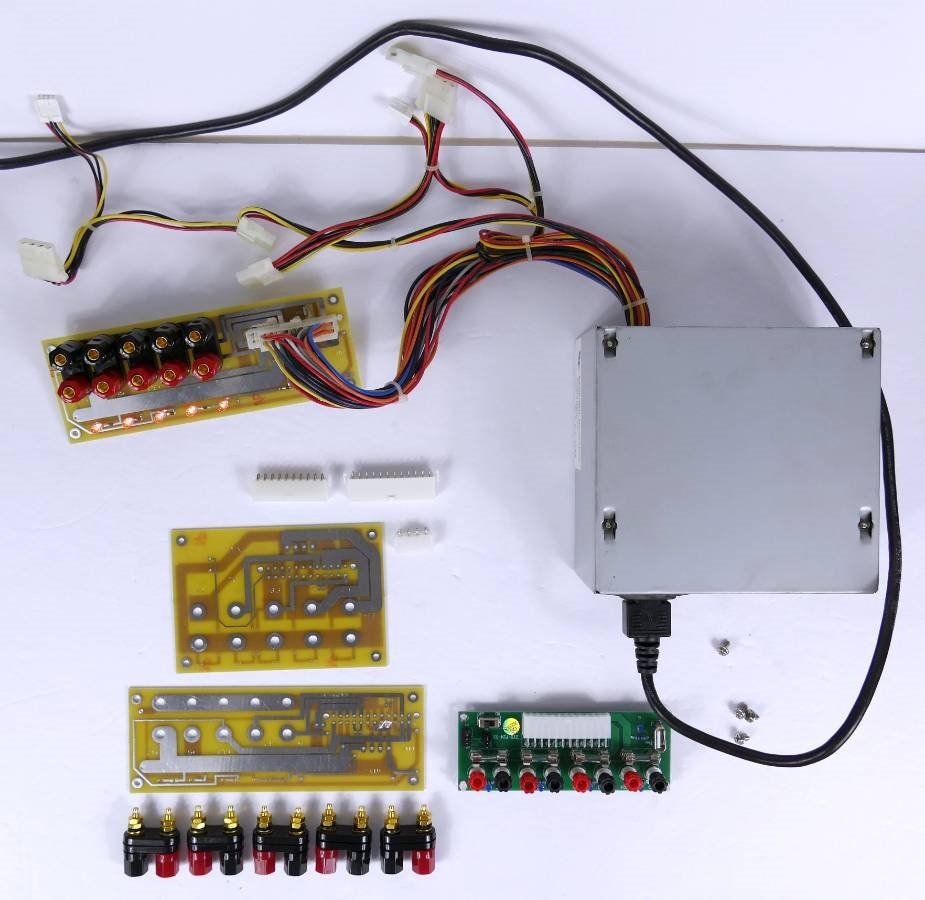
Additionally, some of these power supplies need a load before they will regulate properly. The supply in the picture below is like this so I have provision for a load resistor on my PCBs.

I bought both types of connector, just in case, but the bigger one will always work, if plugged in at the right end.

I also bought a cheap commercial version (also shown in the picture below - the green card), but its tiny binding posts are at a non-standard spacing and cannot accommodate banana plugs.
image

Note that this particular power supply uses a V1 connector and it has a -5V output. (The LEDs from left to right indicate +12, +5, + 3.3, -12, -5)

The larger card (that is powered up in the above picture) was the first one I designed - when I had a different idea about how to package it.

The smaller card takes no more room than the power supply front face, so this is what I used in the build.

The supply I used in the build (different from the one pictured above) has a V2 connector and it does not need load resistors to regulate properly, but it has no -5 output.

Here is a video showing how these parts fit in the case I designed:

You don't have permission to edit metadata of this video.
Edit media
x
image
Upload Preview
image

I still have enough parts to build at least 2 more complete bench supplies plus more supplies and partial kits of parts, if I can find the time or if a need arises.

These supplies do take up space, but not as much as the full PC box they came out of.

I am happy that I didn't need to order parts (because I bought them years ago) and I am happy that I can at least mostly cross this project off my backlog/bucket list of projects.

It turned out to be quite a bit more work than I had envisioned way back, but I am happy with the final look of the supply, given all the awkward constraints it needed to accommodate.

I could have picked a more photogenic color, but black was what was in the printer.

In the end it does look like a bench supply with a nice handle and it has high quality binding posts.

Update:

I traced the power switch issue to a faulty switch and fixed it:

You don't have permission to edit metadata of this video.
Edit media
x
image
Upload Preview
image


A question arose in the comments below about how much power the 5VSB (5V stand by) pin could supply. I extracted another PC supply from yet another old PC to test it.

I connected my little load box which can switch in a load of up to four 10 ohm resistors in parallel and measure the voltage and current...

The 5VSB could supply 0.5 amps more or less okay, but 2 resistors (= 5 ohms) brought the voltage down below 3V...at which point the meter didn't have enough voltage to work.

imageimage

No load = 5.01V                                                      10 ohm load -> 4.39V, 0.46A

My power supply doesn't do anything with this pin.


Relevant links:

Project14 | Recycle & Retrofit: Reduce Waste in Style By Upcycling Vintage Electronics!

A later project to convert a PC Power Supply

  • Sign in to reply

Top Comments

  • Gough Lui
    Gough Lui over 5 years ago +7
    Something to be wary of is that if you don't have any over-current protection, the ATX spec allows up to ~20A to be drawn before tripping a short circuit protection which is enough current to make thinner…
  • DAB
    DAB over 5 years ago +6
    Great build Douglas. DAB
  • dougw
    dougw over 5 years ago in reply to genebren +6
    I was thinking about doing this before I had a 3D printer - just somehow hack saw and bash the sheet metal PC case into a power supply shape. I am sure it would have been pretty ugly.
  • dougw
    dougw over 5 years ago in reply to ajcc

    The handle was made to be comfortable for my hands.

    Most handles in the world seem to try to be the minimum size they can get away with, which I find generally uncomfortable - not enough room for all fingers or knuckles and so skinny they dig in painfully, especially on something this heavy.

    • Cancel
    • Vote Up +1 Vote Down
    • Sign in to reply
    • More
    • Cancel
  • dougw
    dougw over 5 years ago in reply to Gough Lui

    Most of my PC supplies were built in the last century.

    • Cancel
    • Vote Up +1 Vote Down
    • Sign in to reply
    • More
    • Cancel
  • Gough Lui
    Gough Lui over 5 years ago in reply to ajcc

    It's highly dependent on the supply. I've got some older ATX supplies rated as low as 1.5A on the 5VSB line. As they age, with degraded capacitors especially on the cheap/generic units, it wouldn't surprise me if the output was a bit low. The line definitely droops while approaching full load. Originally the 5VSB functionality was mainly to power the soft-off power management IC which controls the power button and provide some power to the onboard RTC which would take load off the CR2032 cell when mains was available.


    Newer supplies usually are rated 2.5A to 3A on the 5VSB line - this is because more modern computers have increased functionality that depends on the 5VSB to operate. This includes refreshing the RAM banks when you're in S3/Suspend to RAM mode, powering the LAN/WLAN chipsets for WoL/WoWL functionality, powering modems for Wake-on-Ring (not a thing anymore) and supplying current to USB ports which are configured to be powered off 5VSB (e.g. for charging while the system is off).


    There is still the chance to overload the 5VSB line under certain configurations - I found that out the hard way when I destroyed the rectifying Schottky diode on a power supply by inadvertently leaving a USB bus-powered hard drive attached to a port powered by 5VSB and suspended the computer. It was the load that "overloaded" the supply (as it was WoL/S3 at the time with other loads attached too) and even though the specs usually say that the supply should shut down prior to any harm occurring, instead I got a burning smell and by the time I tracked it down, it was already toast.


    - Gough

    • Cancel
    • Vote Up +4 Vote Down
    • Sign in to reply
    • More
    • Cancel
  • ajcc
    ajcc over 5 years ago in reply to dougw

    That's far from the recommended 2 A, thanks for checking that. Wikipedia says USB should be within 5.00+0.25-0.60 Volt, so it's even less than half an amp image

    • Cancel
    • Vote Up +2 Vote Down
    • Sign in to reply
    • More
    • Cancel
  • dougw
    dougw over 5 years ago in reply to ajcc

    The 5VSB couldn't supply 2A - see update above.

    • Cancel
    • Vote Up +3 Vote Down
    • Sign in to reply
    • More
    • Cancel
<>
element14 Community

element14 is the first online community specifically for engineers. Connect with your peers and get expert answers to your questions.

  • Members
  • Learn
  • Technologies
  • Challenges & Projects
  • Products
  • Store
  • About Us
  • Feedback & Support
  • FAQs
  • Terms of Use
  • Privacy Policy
  • Legal and Copyright Notices
  • Sitemap
  • Cookies

An Avnet Company © 2026 Premier Farnell Limited. All Rights Reserved.

Premier Farnell Ltd, registered in England and Wales (no 00876412), registered office: Farnell House, Forge Lane, Leeds LS12 2NE.

ICP 备案号 10220084.

Follow element14

  • X
  • Facebook
  • linkedin
  • YouTube