element14 Community
element14 Community
    Register Log In
  • Site
  • Search
  • Log In Register
  • Community Hub
    Community Hub
    • What's New on element14
    • Feedback and Support
    • Benefits of Membership
    • Personal Blogs
    • Members Area
    • Achievement Levels
  • Learn
    Learn
    • Ask an Expert
    • eBooks
    • element14 presents
    • Learning Center
    • Tech Spotlight
    • STEM Academy
    • Webinars, Training and Events
    • Learning Groups
  • Technologies
    Technologies
    • 3D Printing
    • FPGA
    • Industrial Automation
    • Internet of Things
    • Power & Energy
    • Sensors
    • Technology Groups
  • Challenges & Projects
    Challenges & Projects
    • Design Challenges
    • element14 presents Projects
    • Project14
    • Arduino Projects
    • Raspberry Pi Projects
    • Project Groups
  • Products
    Products
    • Arduino
    • Avnet & Tria Boards Community
    • Dev Tools
    • Manufacturers
    • Multicomp Pro
    • Product Groups
    • Raspberry Pi
    • RoadTests & Reviews
  • About Us
  • Store
    Store
    • Visit Your Store
    • Choose another store...
      • Europe
      •  Austria (German)
      •  Belgium (Dutch, French)
      •  Bulgaria (Bulgarian)
      •  Czech Republic (Czech)
      •  Denmark (Danish)
      •  Estonia (Estonian)
      •  Finland (Finnish)
      •  France (French)
      •  Germany (German)
      •  Hungary (Hungarian)
      •  Ireland
      •  Israel
      •  Italy (Italian)
      •  Latvia (Latvian)
      •  
      •  Lithuania (Lithuanian)
      •  Netherlands (Dutch)
      •  Norway (Norwegian)
      •  Poland (Polish)
      •  Portugal (Portuguese)
      •  Romania (Romanian)
      •  Russia (Russian)
      •  Slovakia (Slovak)
      •  Slovenia (Slovenian)
      •  Spain (Spanish)
      •  Sweden (Swedish)
      •  Switzerland(German, French)
      •  Turkey (Turkish)
      •  United Kingdom
      • Asia Pacific
      •  Australia
      •  China
      •  Hong Kong
      •  India
      • Japan
      •  Korea (Korean)
      •  Malaysia
      •  New Zealand
      •  Philippines
      •  Singapore
      •  Taiwan
      •  Thailand (Thai)
      • Vietnam
      • Americas
      •  Brazil (Portuguese)
      •  Canada
      •  Mexico (Spanish)
      •  United States
      Can't find the country/region you're looking for? Visit our export site or find a local distributor.
  • Translate
  • Profile
  • Settings
STEM Academy
  • Learn
  • Learning Center
  • STEM Academy
  • More
  • Cancel
STEM Academy
Blog Simple Science Experiment with the Raspberry Pi
  • Blog
  • Forum
  • Documents
  • Events
  • Polls
  • Files
  • Members
  • Mentions
  • Sub-Groups
  • Tags
  • More
  • Cancel
  • New
Join STEM Academy to participate - click to join for free!
  • Share
  • More
  • Cancel
Group Actions
  • Group RSS
  • More
  • Cancel
Engagement
  • Author Author: mikedavis
  • Date Created: 2 Sep 2014 6:13 PM Date Created
  • Views 2478 views
  • Likes 1 like
  • Comments 8 comments
  • science
  • temperature
  • raspberrypi
  • probe
  • fair
  • sensor
  • stem space
Related
Recommended

Simple Science Experiment with the Raspberry Pi

mikedavis
mikedavis
2 Sep 2014

Since I got my first Raspberry Pi, I have been struggling to find a simple science experiment that I could do around the house.  I wanted to do something interesting, that used something I was familiar with.  It also had to involve temperature since that was the only probe I owned at the time.


I have a glass beaker mug that I got from a conference.  I don't remember the conference, but that was a highly coveted piece of swag from the exhibition floor, and I felt that I was luck to have it.  As cool as it looks, it is the worst mug I own.  Drinking coffee from that mug is like a drinking contest; it cools down so fast!  So I decided to see what coffee mug acts as the best insulator.


This has all of the core components of a classic science fair project.

  • Observation:  My coffee gets cold too quickly in this mug.
  • Hypothesis:  I bet other mugs might be better.
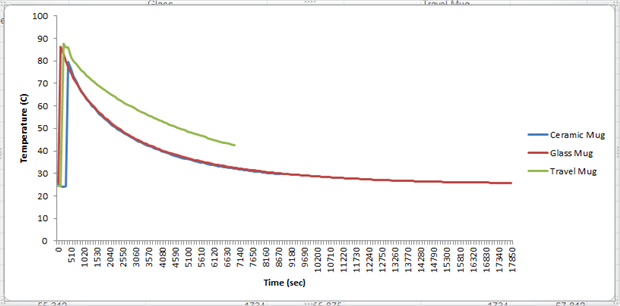
  • Experiment:  I can measure the temperature of water as it cools down over a long period of time using a temperature probe.
    • Heat 300mL of water (the beaker mug has graduation marks, so it isn't totally worthless) for 2 minutes in the microwave.
    • Pour the hot water into the mug of choice.
    • Stick in the temperature probe.
    • Watch the temperature drop as it cools down.
  • Conclusion:  None yet, but my travel mug seems to be doing the best.
 

image

I am a little surprised by this.  I thought my ceramic mugs were better than my glass mug.  According to this, there is little to no difference.


I also leads me to other questions:

  • Are there other better ceramic mugs in my house.
  • Will a lid help?
  • What about a travel mug without a lid?
  • What is the optimal drinking temperature - the best mug should be there the longest?


It took most of Labor Day to collect this data, and I did most of it while I was doing other things.  I have posted on the temperature probe before.  Again, because the RPi is a dedicated computer, I can dedicate it to watching temperatures for a long time, and do some calculations with it.


I wish I were young enough to enter it in the Science Fair!

  • Sign in to reply

Top Comments

  • jw0752
    jw0752 over 11 years ago +1
    This is a very good experiment and a good science application of the temperature probe and the Raspberry Pi. You can't however go back and use it as a school science experiment. Fortunately, now you have…
  • shabaz
    shabaz over 11 years ago +1
    These kinds of experiments are always the most fun,since one learns a lot not just about the desired experiment itself, but also about the methods used to perform the tests, like what probes are good,…
  • michaelwylie
    michaelwylie over 11 years ago +1
    I think you should try to determine the heat transfer coefficients for each of the materials.
Parents
  • shabaz
    shabaz over 11 years ago

    These kinds of experiments are always the most fun,since one learns a lot not just about the desired experiment itself, but also about the methods used to perform the tests, like what probes are good, where and when to perform such experiments, and so on. Stuff that may be hard to learn in any other way!

    • Cancel
    • Vote Up +1 Vote Down
    • Sign in to reply
    • More
    • Cancel
  • mikedavis
    mikedavis over 11 years ago in reply to shabaz

    I agree!  I learned how often I wanted results, and how I wanted them recorded.  Great stuff!

    • Cancel
    • Vote Up 0 Vote Down
    • Sign in to reply
    • More
    • Cancel
Comment
  • mikedavis
    mikedavis over 11 years ago in reply to shabaz

    I agree!  I learned how often I wanted results, and how I wanted them recorded.  Great stuff!

    • Cancel
    • Vote Up 0 Vote Down
    • Sign in to reply
    • More
    • Cancel
Children
No Data
element14 Community

element14 is the first online community specifically for engineers. Connect with your peers and get expert answers to your questions.

  • Members
  • Learn
  • Technologies
  • Challenges & Projects
  • Products
  • Store
  • About Us
  • Feedback & Support
  • FAQs
  • Terms of Use
  • Privacy Policy
  • Legal and Copyright Notices
  • Sitemap
  • Cookies

An Avnet Company © 2025 Premier Farnell Limited. All Rights Reserved.

Premier Farnell Ltd, registered in England and Wales (no 00876412), registered office: Farnell House, Forge Lane, Leeds LS12 2NE.

ICP 备案号 10220084.

Follow element14

  • X
  • Facebook
  • linkedin
  • YouTube