element14 Community
element14 Community
    Register Log In
  • Site
  • Search
  • Log In Register
  • Community Hub
    Community Hub
    • What's New on element14
    • Feedback and Support
    • Benefits of Membership
    • Personal Blogs
    • Members Area
    • Achievement Levels
  • Learn
    Learn
    • Ask an Expert
    • eBooks
    • element14 presents
    • Learning Center
    • Tech Spotlight
    • STEM Academy
    • Webinars, Training and Events
    • Learning Groups
  • Technologies
    Technologies
    • 3D Printing
    • FPGA
    • Industrial Automation
    • Internet of Things
    • Power & Energy
    • Sensors
    • Technology Groups
  • Challenges & Projects
    Challenges & Projects
    • Design Challenges
    • element14 presents Projects
    • Project14
    • Arduino Projects
    • Raspberry Pi Projects
    • Project Groups
  • Products
    Products
    • Arduino
    • Avnet & Tria Boards Community
    • Dev Tools
    • Manufacturers
    • Multicomp Pro
    • Product Groups
    • Raspberry Pi
    • RoadTests & Reviews
  • About Us
    About the element14 Community
  • Store
    Store
    • Visit Your Store
    • Choose another store...
      • Europe
      •  Austria (German)
      •  Belgium (Dutch, French)
      •  Bulgaria (Bulgarian)
      •  Czech Republic (Czech)
      •  Denmark (Danish)
      •  Estonia (Estonian)
      •  Finland (Finnish)
      •  France (French)
      •  Germany (German)
      •  Hungary (Hungarian)
      •  Ireland
      •  Israel
      •  Italy (Italian)
      •  Latvia (Latvian)
      •  
      •  Lithuania (Lithuanian)
      •  Netherlands (Dutch)
      •  Norway (Norwegian)
      •  Poland (Polish)
      •  Portugal (Portuguese)
      •  Romania (Romanian)
      •  Russia (Russian)
      •  Slovakia (Slovak)
      •  Slovenia (Slovenian)
      •  Spain (Spanish)
      •  Sweden (Swedish)
      •  Switzerland(German, French)
      •  Turkey (Turkish)
      •  United Kingdom
      • Asia Pacific
      •  Australia
      •  China
      •  Hong Kong
      •  India
      •  Japan
      •  Korea (Korean)
      •  Malaysia
      •  New Zealand
      •  Philippines
      •  Singapore
      •  Taiwan
      •  Thailand (Thai)
      •  Vietnam
      • Americas
      •  Brazil (Portuguese)
      •  Canada
      •  Mexico (Spanish)
      •  United States
      Can't find the country/region you're looking for? Visit our export site or find a local distributor.
  • Translate
  • Profile
  • Settings
STEM Academy
  • Learn
  • Learning Center
  • STEM Academy
  • More
  • Cancel
STEM Academy
Documents Electrical Engineering Students Wishlist
  • Blog
  • Forum
  • Documents
  • Events
  • Polls
  • Files
  • Members
  • Mentions
  • Sub-Groups
  • Tags
  • More
  • Cancel
  • New
Join STEM Academy to participate - click to join for free!
Actions
  • Share
  • More
  • Cancel
Engagement
  • Author Author: e14phil
  • Date Created: 8 Sep 2021 2:49 PM Date Created
  • Last Updated Last Updated: 1 Apr 2023 2:09 PM
  • Views 11583 views
  • Likes 3 likes
  • Comments 60 comments
Related
Recommended

Electrical Engineering Students Wishlist

What should Electrical Engineering students buy for their first semester?


Electrical Engineering (EE) is a field that encompasses a wide range of specialties, but for students learning the basics, there are some tools that apply to almost everything, and make learning more interesting and fun.

We've put together a wish list with all the fundamental items needed to set you up for a life in Electrical Engineering.


The Basics


Basic Tools

As an EE student, you'll want to have your own basic set of tools to make your life easier. These are some of tools that every EE needs, no matter what their specialty:


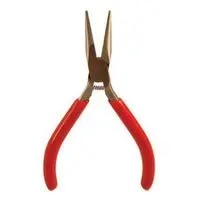
Needle-nose Pliers -

Electronic components are tiny and wiring up those tiny connectors is something our hands are just not built for. Needle-nose pliers are essential for any kind of circuit building.
 

image

Needle Nose Pliers


Wire Stripper

One of my lab partners use to strip wires with his teeth. With a few bites, a twist, and a pull, he'd have any gauge wire stripped and ready to go. For us regular people, wire strippers are mandatory.

image

Wire Strippers


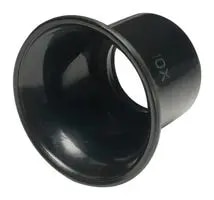
Loupe or Magnifying Glass

Loupes or magnifying glasses are incredibly helpful when soldering or working with a breadboard.
image

Loupe or Magnifying Glass


Tweezers

I don't envy anyone who has to modify a circuit made up of surface mount components, but for those types of jobs, eagle eyes, steady hands, patience, and a good set of tweezers are required.

image

Tweezers Six Pack


Breadboard

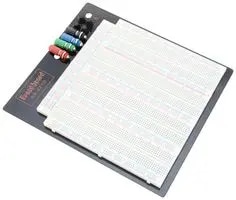
A breadboard is a quick prototyping tool where you can plug components and wires into holes to quickly connect them. Most labs will provide the necessary breadboard, but having one at your disposal is very handy.
image

Multicomp 1mm ABS Breadboard


DC Power Supply

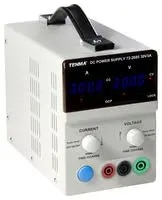
Circuits need a power source and for classroom projects, 5-12V should be sufficient.
image

Bench Power Supply


Soldering

Every EE should keep their soldering tools handy. Whether it's building cables or modifying/repairing equipment, soldering tools get a lot of use on the workbench.


Soldering Iron -

Soldering starts with a good iron. Because they're main task is melting things, they need to have enough power; 40W should do the job. A higher wattage iron doesn't get hotter, it maintains its temperature better. Every time an iron melts solder, it cools down. A higher wattage iron will heat back up more quickly. There's not much that's more frustrating than blobs of solder are taking forever to melt because the iron isn't getting hot fast enough.

image


Soldering Iron


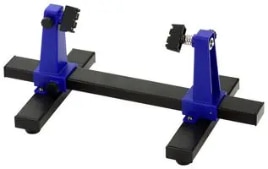
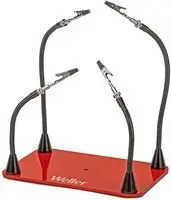
Helping Hand and Circuit Board Holder - You can always tell who likes to solder by the burn marks on their knees. We've all done it; holding a PCB or connector between our knees, with a soldering iron in one hand and a wire in the other. No matter how careful you are, you're going to hit your knee at some point! Growing a third arm is the best solution, but since science isn't quite there yet, save your knees with a Helping Hand setup or a circuit board holder.
 

image

Helping Hand -

Helping Hands


image

Circuit board holder -

Circuit Board Holder


Wicks and Desoldering Pumps -

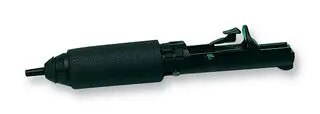
Sometimes things won't go right, and you'll find that you accidentally shorted two pins on an IC. Use a wick or a desoldering pump (or both) to remove that extra solder after you've heated it up.

 

image

Solder Wick

Solder Wick


image

Desoldering pump

Desoldering pump


Soldering Iron cleaner -

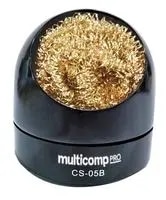
Soldering irons quickly get oxidized. To keep them clean, brass shavings are more effective than a wet sponge (although a wet sponge does make that cool sizzling sound).
image

Soldering Iron Tip Cleaner


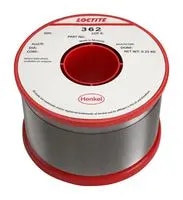
Solder - Of course, don't forget the solder!
image

Solder


Test Equipment

Testing is tricky with complex circuits. In order to make sure the different parts of the circuit are doing what you want them to, you need tools to measure the signal at each point.


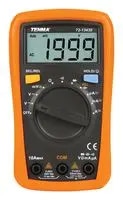
Multimeter -

Multimeters measure voltage, resistance, and current, the basic and most important measurements in electronics. Want to know if a component is broken? Measure across it; if the voltage drop is 0V, then it's broken.
image

Digital Multimeter


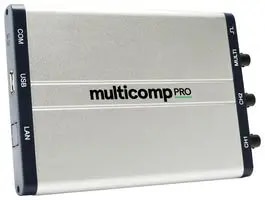
Oscilloscope - Oscilloscopes measure electrical signals mapped against time, useful for viewing the outputs of capacitors and inductors, distortion and noise, and clocked digital signals.


PC USB Oscilloscope -
image

USB Oscilloscope


Software

A big part of electrical engineering in the modern world is software. Most designs can be modeled and optimized before the first resistor even gets plugged into the breadboard.


PSpice - a SPICE (Simulation Program with Integrated Circuit Emphasis) circuit simulator that lets you design and simulate circuits built from a library of almost every component and IC available.

https://www.pspice.com


MATLAB - MATLAB (MATrix LABoratory) is used by many EEs to solve the complex math that arises from engineering problems. MATLAB simplifies matrix manipulations, graphing, creating algorithms, and with add-on toolkits, differential equations and linear algebra.

https://www.mathworks.com


Simulink - Simulink is a GUI add-on for MATLAB from Mathworks, the maker of MATLAB. It lets you combine graphical and textual programming, making MATLAB easier to use.

https://www.mathworks.com


LabVIEW - LabVIEW (Laboratory Virtual Instruments Engineering Workbench) from National Instruments is software that connects with measurement devices in order to control, retrieve, and analyze their data.

Labview


PI Expert - PI Expert from Power Integrations is a free tool that lets you design power supplies based on the specifications you need. It's a great learning tool in that you can switch parts in and out to see their effect on the circuit. It can even automatically optimize your design.

https://www.power.com/piexpert/


3D Printer

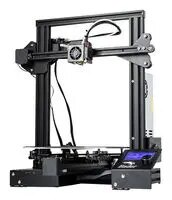
3D printers are on everyone's wishlist, but for EEs, they are especially useful. EEs are always in need of custom enclosures, mounts, risers, shims, and more. 3D printers can even print out entire sets of tools for the workbench. Because of advancing technology, prices have come down in recent years.
image

Ender 3 PRO 3D Printer


Microcontrollers and Single Board Computers

The integration of hardware and software has produced some of the most innovative devices out there. Microcontrollers and single board computers (SBC) are powerful learning tools to get you familiar with combining software and hardware.


Arduino

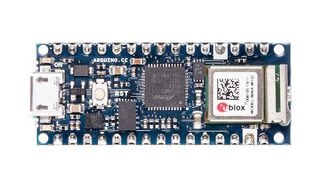
Arduino is a microcontroller that functions as an interface for a variety of hardware, including sensors, robots, displays, and more. It comes with its own development environment where you can write code (C++) to control the hardware attached to it. You can find Arduinos everywhere, from classrooms to automated factory floors.
image

Arduino Nano 33 IoT


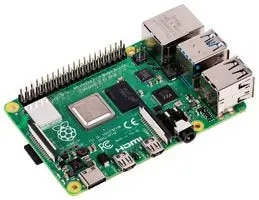
Raspberry Pi is entire computer packed onto a single board, capable of running any software compatible with the Linux operating system. Several manufacturers build "hats", small boards designed to interface with Pi that connect specifically to different types of hardware.
image

Raspberry Pi 4 2GB


Scientific Calculator

Last but not least, a good scientific calculator is mandatory for any EE student.

Mine was the legendary Hewlett Packard 28S (https://www.hpmuseum.org/hp28c.htm).

This $235 beast did everything, graphing, unit conversions, and it was the first Reverse Polish Lisp (RPL) (https://www.hpmuseum.org/rpl.htm) calculator.


However, the feature you really need as an EE student is solving matrices; any basic circuits class will have you solving hundreds. No one wants to solve matrices by hand! Luckily, these days, you don't need to pay $200 for a scientific calculator. Whether you're using iOS or Android, pop on your App Store and search for "scientific calculator" to pull up some low cost or even free alternatives to the monster HP.

  • what should i buy?
  • students
  • stem
  • electrical engineering
  • wishlist
  • Share
  • History
  • More
  • Cancel
  • Sign in to reply

Top Comments

  • maxpowerr
    maxpowerr over 4 years ago +4
    I figured out what was missing on this list.
  • kmikemoo
    kmikemoo over 4 years ago in reply to maxpowerr +2
    maxpowerr That got an audible laugh! That's funny!
  • phoenixcomm
    phoenixcomm over 4 years ago +2
    I have a bone to pick with you and your choice of wire strippers. both of these strippers do a better job with no twisting, razor blades, etc. ~~ Cris BTW By the best iron, you can afford. A ten - 20 hobby…
  • robogary
    robogary over 4 years ago in reply to shabaz

    Grades are important as well as effort, but the most important thing is survival  !  I knew alot of students smarter than me,  more talented than me, but didnt survive or just lost the love.

    • Cancel
    • Vote Up 0 Vote Down
    • Sign in to reply
    • More
    • Cancel
  • dougw
    dougw over 4 years ago in reply to shabaz

    I don't think we were even introduced to oscilloscopes in my first introductory course on electricity - because it was a physics course. When we finally did get to use scopes they had what would be called pitiful performance today, but they worked as learning tool. (The lowest model of Gould oscilloscope - 10 MHz)

    • Cancel
    • Vote Up 0 Vote Down
    • Sign in to reply
    • More
    • Cancel
  • Jan Cumps
    Jan Cumps over 4 years ago in reply to shabaz

    image

    Procrastinating since the 90s image

    • Cancel
    • Vote Up 0 Vote Down
    • Sign in to reply
    • More
    • Cancel
  • shabaz
    shabaz over 4 years ago

    I don't want to be added to the giveaway draw, but here are my first term/semester first pages.. not a great start : ) although this report ended up as a grade B. We studied other things too of course, but in the area of analog, this was my first lab project I guess.

    image


    image

    • Cancel
    • Vote Up 0 Vote Down
    • Sign in to reply
    • More
    • Cancel
  • gayatrik
    gayatrik over 4 years ago

    I am an engineering student currently in 2nd year. I still remember I started learning electronics in jr college itself. The first thing was bjt. I can still say that anyone who understands the working of a bjt in all the 3 modes of operation can easily complete the basic electronics courses.

    I would suggest to add a digital multimeter in this list. My seniors always today me that a multimeter is to an engineer like a stethoscope is to a doctor. 

    • Cancel
    • Vote Up 0 Vote Down
    • Sign in to reply
    • More
    • Cancel
  • fouzanalvi
    fouzanalvi over 4 years ago

    The most important thing  which I learnt in my first year electrical  engineering is laws of electrical engineering (ohm's law etc) and basics of electrical engineering

    I would say both of them are highly conceptual and many students would make these mistakes by not learning it during the first year and then experiment won't work.

    The things missing in the list are

    1. LEDs (to make the led projects)

    2. Soldering Flux (the most important thing required to get good solder joints.)

    3.wires (for breadboarding circuits)

    4.projects book

    5.simple circuit

    6.voltmeter

    • Cancel
    • Vote Up 0 Vote Down
    • Sign in to reply
    • More
    • Cancel
  • lukilarson
    lukilarson over 4 years ago

    1) - The first thing I've learned and I use it every day for my job is the Omhs Law. I use it for solving problems on cards and engineering prototypes.


    2) - I thing adding a B.F. and H.F. generator is a good idea because we have already the oscilloscope. And in amplification circuits having these is a good plan for testing and repairs!


    I'm very sorry for my english, I'm French so if there are some mistakes I'm sorry..


    Best regards

    • Cancel
    • Vote Up 0 Vote Down
    • Sign in to reply
    • More
    • Cancel
  • yaseenullakhan
    yaseenullakhan over 4 years ago

    1) What was the first thing you learned in engineering school that stuck with you throughout your career?

                              As an electrical engineering candidate the basic thing is Ohm's Law, KCL, KVL etc.. Which are very important to learn or solve any circuit.


    2) What is missing from this list?

                              A Tachometer for measuring the speed of motor, IC testing kit for testing an ic before using it, a computer/laptop for programming the microcontroller boards, safety gloves and glasses....

    • Cancel
    • Vote Up 0 Vote Down
    • Sign in to reply
    • More
    • Cancel
  • embeddedguy
    embeddedguy over 4 years ago

    In the engineering school I had a lab session in which we were being familiarised with soldering and other electronic components and PCB making. These things were new at that time  but now it has become quite common for me.


    One of the thing that always stayed with me is the soldering even if I try to refrain from it by purchsing some male-female wires so that I do not have to solder.


    Later, I also used Ultimaker Cura 3D printer to make an assembly for accoustic levitation project with ultrasound sensors. In the University it was nice that it was available. A working Low cost 3D printer is always missing from my list!!

    • Cancel
    • Vote Up 0 Vote Down
    • Sign in to reply
    • More
    • Cancel
  • arshahmad
    arshahmad over 4 years ago

    1. It was a month of my college , I was studying about diode and suddenly I flipped the page to last chapters and it was "555-Timer IC". When I started to read about 555 I was so fascinated that next day  I went to market to get one with some lEDs and resistor and I made my first blinky. That drove me to my extreme love for engineering and electronics. Even now in vacant times just for fun I make 555 timer projects like synthesiser, etc. I think 555 has now became a hobby time buddy of mine.

    2. I think a multimeter is missing because it is most important tool for prototyping.

    • Cancel
    • Vote Up 0 Vote Down
    • Sign in to reply
    • More
    • Cancel
<>
element14 Community

element14 is the first online community specifically for engineers. Connect with your peers and get expert answers to your questions.

  • Members
  • Learn
  • Technologies
  • Challenges & Projects
  • Products
  • Store
  • About Us
  • Feedback & Support
  • FAQs
  • Terms of Use
  • Privacy Policy
  • Legal and Copyright Notices
  • Sitemap
  • Cookies

An Avnet Company © 2026 Premier Farnell Limited. All Rights Reserved.

Premier Farnell Ltd, registered in England and Wales (no 00876412), registered office: Farnell House, Forge Lane, Leeds LS12 2NE.

ICP 备案号 10220084.

Follow element14

  • X
  • Facebook
  • linkedin
  • YouTube