element14 Community
element14 Community
    Register Log In
  • Site
  • Search
  • Log In Register
  • Community Hub
    Community Hub
    • What's New on element14
    • Feedback and Support
    • Benefits of Membership
    • Personal Blogs
    • Members Area
    • Achievement Levels
  • Learn
    Learn
    • Ask an Expert
    • eBooks
    • element14 presents
    • Learning Center
    • Tech Spotlight
    • STEM Academy
    • Webinars, Training and Events
    • Learning Groups
  • Technologies
    Technologies
    • 3D Printing
    • FPGA
    • Industrial Automation
    • Internet of Things
    • Power & Energy
    • Sensors
    • Technology Groups
  • Challenges & Projects
    Challenges & Projects
    • Design Challenges
    • element14 presents Projects
    • Project14
    • Arduino Projects
    • Raspberry Pi Projects
    • Project Groups
  • Products
    Products
    • Arduino
    • Avnet & Tria Boards Community
    • Dev Tools
    • Manufacturers
    • Multicomp Pro
    • Product Groups
    • Raspberry Pi
    • RoadTests & Reviews
  • About Us
  • Store
    Store
    • Visit Your Store
    • Choose another store...
      • Europe
      •  Austria (German)
      •  Belgium (Dutch, French)
      •  Bulgaria (Bulgarian)
      •  Czech Republic (Czech)
      •  Denmark (Danish)
      •  Estonia (Estonian)
      •  Finland (Finnish)
      •  France (French)
      •  Germany (German)
      •  Hungary (Hungarian)
      •  Ireland
      •  Israel
      •  Italy (Italian)
      •  Latvia (Latvian)
      •  
      •  Lithuania (Lithuanian)
      •  Netherlands (Dutch)
      •  Norway (Norwegian)
      •  Poland (Polish)
      •  Portugal (Portuguese)
      •  Romania (Romanian)
      •  Russia (Russian)
      •  Slovakia (Slovak)
      •  Slovenia (Slovenian)
      •  Spain (Spanish)
      •  Sweden (Swedish)
      •  Switzerland(German, French)
      •  Turkey (Turkish)
      •  United Kingdom
      • Asia Pacific
      •  Australia
      •  China
      •  Hong Kong
      •  India
      • Japan
      •  Korea (Korean)
      •  Malaysia
      •  New Zealand
      •  Philippines
      •  Singapore
      •  Taiwan
      •  Thailand (Thai)
      • Vietnam
      • Americas
      •  Brazil (Portuguese)
      •  Canada
      •  Mexico (Spanish)
      •  United States
      Can't find the country/region you're looking for? Visit our export site or find a local distributor.
  • Translate
  • Profile
  • Settings
Publications
  • Learn
  • More
Publications
Blog 2012 BLUR conference
  • Blog
  • Documents
  • Events
  • Files
  • Members
  • Mentions
  • Sub-Groups
  • Tags
  • More
  • Cancel
  • New
Join Publications to participate - click to join for free!
  • Share
  • More
  • Cancel
Group Actions
  • Group RSS
  • More
  • Cancel
Engagement
  • Author Author: DaveYoung
  • Date Created: 20 Nov 2012 4:01 PM Date Created
  • Views 1218 views
  • Likes 1 like
  • Comments 1 comment
  • user_interface
  • 3d_printing
  • conference
  • dyoung
Related
Recommended

2012 BLUR conference

DaveYoung
DaveYoung
20 Nov 2012

The 2012 BLUR conference was held last week in Broomfield, CO to showcase developing technologies in Human Computer Interaction (HCI).  Far from a conference of people developing screens, keyboards, and mice, the topics centered on technology that reveals how much humans have been adapting to their input devices instead of the other way around. image
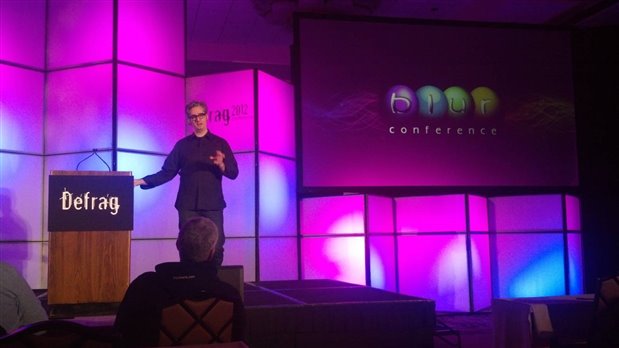
 

Then most striking aspect to the conference was the focus on 3D printing.  The discussions opened up an entirely new way of thinking about the technology.  In addition to using the printers to create parts as an alternative to injection molding or machining, the printers can be thought of as a holography machine that works very, very slowly.  It is a method of bringing something on the screen to life as another interface to the digital world.  As printing time, cost, and obscurity continues to fall it will be easy to think of a printed design as just another means of HCI.


Three of the presenting companies came from different 3D printing business models. PrintrBot was represented by  Brook Drumm introducing how cheap and easy it is to get into 3D printing with his Printrbot JR kit weighing in an just $399.  Bre Pettis, CEO of Makerbot, filled the market for upper-range home 3D printers with their Replicator 2.  Shapeways showed the possibilities of a centrally-based 3D printing company that brings the best technology to the masses by allowing designers to post their products for anyone to have made.


All conferences need a crazy technology that is developing exciting promise for attendees to dream about the future.  InteraXon was just that company.  They displayed the Muse, a thought-controlled input device that has 4 sensors on the brain all packaged in a svelte headband.  The company was even bold enough to allow anyone to use the prototype with a computer display that responded to the user's mind.  A thought-input example of the demo was clenching one's teeth would cause bubbles to appear, and mental focus was indexed in the corner of the screen.  InteraXon is looking to break through the HCI challenges on the consumer level in a big way, offering their Muse for a mere $145.


Orbotix, the company the makes the robotic ball 'Sphero,' came to debut their newest invention 'Sharky'.  Sharky is an iOS app that turns Sphero into an augmented reality system.  Essentially, the iPad displays the camera view with Sphero replaced by a video game character.  Sharky runs around as a representation of Sphero collecting cupcakes in the user's environment.  Adding the real-world robotic ball component takes augmented reality beyond the screen!


Not to ignore the screens that we will continue to interact with, Ideum spoke of how they design interactive displays for various clients including museum education displays.  It is easy to merely gawk at custom technology that only larger marketing/education budgets will be able to afford.  However their talk brought up GestureML (GML), an XML-based gesture interface language.  As many different companies continue to develop touchscreen interfaces, the number of gestures and what they do continues to grow.  GML is way to map gestures to actions in a standardized way.  An application written with GML would enable modification of what gestures do by only tweaking the map instead of the entire application.  It is easy to see how gesture customization per user could be implemented just as any other setting, and follow that user from device to device.


After the conference I came back to my favorite keyboard, mouse, and dual 23” monitors for the first time with a sense of archaic workflow.  It is clear that these technologies are gearing up to reach mainstream adoption in the next decade when we will all look back at the keyboard/mouse combo, and laugh. 

  • Sign in to reply
Parents
  • DAB
    DAB over 13 years ago

    Yes, the keyboard, mouse, monitor interface is a bit dated, but has proven to be reliable and effective.


    I suspect that we will eventually move into a newer style of data transfer with technology, but it will be a while before consensus will be reached as far as what will be acceptable.


    In the meantime, we need to keep an open mind about how and what we need to achieve through the HCI and then assess the technology needed to make it all work.  I look forward to the entertainment that this transition will supply.


    Few people have realized that the mouse oriented point and click interface is four times LESS efficient than the keyboard/hot key approach.  At least for those of us who became keyboard proficient.  So we need to look at each "improvement" with an eye on just what it improves and for whom.


    Just a thought,

    DAB

    • Cancel
    • Vote Up 0 Vote Down
    • Sign in to reply
    • More
    • Cancel
Comment
  • DAB
    DAB over 13 years ago

    Yes, the keyboard, mouse, monitor interface is a bit dated, but has proven to be reliable and effective.


    I suspect that we will eventually move into a newer style of data transfer with technology, but it will be a while before consensus will be reached as far as what will be acceptable.


    In the meantime, we need to keep an open mind about how and what we need to achieve through the HCI and then assess the technology needed to make it all work.  I look forward to the entertainment that this transition will supply.


    Few people have realized that the mouse oriented point and click interface is four times LESS efficient than the keyboard/hot key approach.  At least for those of us who became keyboard proficient.  So we need to look at each "improvement" with an eye on just what it improves and for whom.


    Just a thought,

    DAB

    • Cancel
    • Vote Up 0 Vote Down
    • Sign in to reply
    • More
    • Cancel
Children
No Data
element14 Community

element14 is the first online community specifically for engineers. Connect with your peers and get expert answers to your questions.

  • Members
  • Learn
  • Technologies
  • Challenges & Projects
  • Products
  • Store
  • About Us
  • Feedback & Support
  • FAQs
  • Terms of Use
  • Privacy Policy
  • Legal and Copyright Notices
  • Sitemap
  • Cookies

An Avnet Company © 2026 Premier Farnell Limited. All Rights Reserved.

Premier Farnell Ltd, registered in England and Wales (no 00876412), registered office: Farnell House, Forge Lane, Leeds LS12 2NE.

ICP 备案号 10220084.

Follow element14

  • X
  • Facebook
  • linkedin
  • YouTube