element14 Community
element14 Community
    Register Log In
  • Site
  • Search
  • Log In Register
  • Community Hub
    Community Hub
    • What's New on element14
    • Feedback and Support
    • Benefits of Membership
    • Personal Blogs
    • Members Area
    • Achievement Levels
  • Learn
    Learn
    • Ask an Expert
    • eBooks
    • element14 presents
    • Learning Center
    • Tech Spotlight
    • STEM Academy
    • Webinars, Training and Events
    • Learning Groups
  • Technologies
    Technologies
    • 3D Printing
    • FPGA
    • Industrial Automation
    • Internet of Things
    • Power & Energy
    • Sensors
    • Technology Groups
  • Challenges & Projects
    Challenges & Projects
    • Design Challenges
    • element14 presents Projects
    • Project14
    • Arduino Projects
    • Raspberry Pi Projects
    • Project Groups
  • Products
    Products
    • Arduino
    • Avnet & Tria Boards Community
    • Dev Tools
    • Manufacturers
    • Multicomp Pro
    • Product Groups
    • Raspberry Pi
    • RoadTests & Reviews
  • About Us
  • Store
    Store
    • Visit Your Store
    • Choose another store...
      • Europe
      •  Austria (German)
      •  Belgium (Dutch, French)
      •  Bulgaria (Bulgarian)
      •  Czech Republic (Czech)
      •  Denmark (Danish)
      •  Estonia (Estonian)
      •  Finland (Finnish)
      •  France (French)
      •  Germany (German)
      •  Hungary (Hungarian)
      •  Ireland
      •  Israel
      •  Italy (Italian)
      •  Latvia (Latvian)
      •  
      •  Lithuania (Lithuanian)
      •  Netherlands (Dutch)
      •  Norway (Norwegian)
      •  Poland (Polish)
      •  Portugal (Portuguese)
      •  Romania (Romanian)
      •  Russia (Russian)
      •  Slovakia (Slovak)
      •  Slovenia (Slovenian)
      •  Spain (Spanish)
      •  Sweden (Swedish)
      •  Switzerland(German, French)
      •  Turkey (Turkish)
      •  United Kingdom
      • Asia Pacific
      •  Australia
      •  China
      •  Hong Kong
      •  India
      • Japan
      •  Korea (Korean)
      •  Malaysia
      •  New Zealand
      •  Philippines
      •  Singapore
      •  Taiwan
      •  Thailand (Thai)
      • Vietnam
      • Americas
      •  Brazil (Portuguese)
      •  Canada
      •  Mexico (Spanish)
      •  United States
      Can't find the country/region you're looking for? Visit our export site or find a local distributor.
  • Translate
  • Profile
  • Settings
Publications
  • Learn
  • More
Publications
Blog Acoustic touchscreens come to the Galaxy S3, others in the near future
  • Blog
  • Documents
  • Events
  • Files
  • Members
  • Mentions
  • Sub-Groups
  • Tags
  • More
  • Cancel
  • New
Join Publications to participate - click to join for free!
  • Share
  • More
  • Cancel
Group Actions
  • Group RSS
  • More
  • Cancel
Engagement
  • Author Author: Catwell
  • Date Created: 21 Nov 2012 7:34 PM Date Created
  • Views 610 views
  • Likes 1 like
  • Comments 2 comments
  • android
  • research
  • touch
  • industry
  • hmi
  • cabeatwell
  • prototyping
  • sound
  • ios
  • technology_for_the_disabled
  • multitouch
  • acoustic_touch
  • innovation
  • communication
Related
Recommended

Acoustic touchscreens come to the Galaxy S3, others in the near future

Catwell
Catwell
21 Nov 2012

image

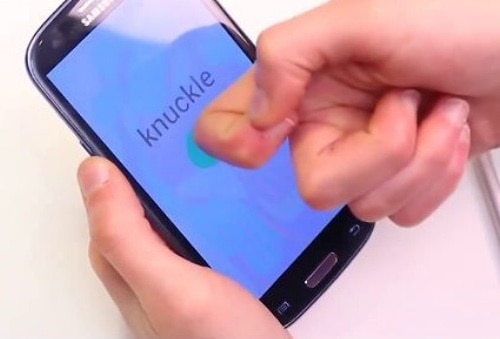
Screenshot: Sensor identifies the type of touch input. (via Qeexo)


In an industry dominated by electrically capacitive interfaces, the Carnegie Mellon spin off company Qeexo, has developed a new touch interface that adds many other dimensions of use to touchscreen phones.


Most common interfaces consist of capacitance touch screens that are activated by the electric properties of fingers. But, in a paper released in 2011, Carnegie Mellon researchers explained that “humans use different parts of their fingers in different ways—to scratch an itch, type on a keyboard, tap a co-worker on the shoulder or knock on a door,” so researchers from the Qeexo Pittsburgh team sought to exploit the wide versatility of the human hand. They figured out a way to make touch screens recognize scratching, knocking as well as tapping or poking with different materials, by equipping the screen with an acoustic sensor.


Rubbing fingernails, knuckles, fingers or any other object against a touch screen creates vibrations that are specific to the object being used. This input is recognized by the tiny acoustic sensor inside the phone. The goal is to set sounds to a specific function.


For example, an on acoustic touch screen, the finger pad can be used for scrolling, fingernail for selecting as in a left-click and knuckle could open a side menu like a right-click. Drawing programs could recognize the type of tool like a thin pencil or thick stylus and draw accordingly while using the fingers to smudge and a rubber eraser to erase; all customizable or programmable possibilities. Qeexo developed a game where player must use different parts of their hand to play. The interface can also detect two simultaneous inputs and these can be programmed to launch applications etc.


So far, the company has developed an Android SDK, but an iOS version will be released soon. Qeexo demonstrated their interface on a Samsun Galaxy S III, but the company is still shopping the idea around so they have not released much info on how it functions. Qeexo did say that the interface works in real-time, has low-latency, is power efficient and reports say it is extremely sensitive to even the slightest touch. Qeexo did reveal that the acoustic touch screen uses a tiny, off-the-shelf acoustic sensor.


You don't have permission to edit metadata of this video.
Edit media
x
image
Upload Preview
image


Cabe

http://twitter.com/Cabe_e14

  • Sign in to reply
  • Catwell
    Catwell over 13 years ago in reply to DAB

    I agree. Not requiring the user to use any type of interface is key. Removing the need for electrical sensing, like in most of today's electronics, is vital. Let's say the user can not hold a stylus, can not have bare skin exposed. I know these are extremes, and a small % of the population, but it should be considered.


    Hope this catches on.


    C

    • Cancel
    • Vote Up 0 Vote Down
    • Sign in to reply
    • More
    • Cancel
  • DAB
    DAB over 13 years ago

    Adding the acoustic capability could be very useful in adapting these devices for the disabled.


    I know with my own nerve damage that holding a stylus steady is sometimes a problem.  Just tapping the screen would indeed be better as it takes less muscle control.


    It will be interesting to see how well this technology evolves.


    Good post.

    DAB

    • Cancel
    • Vote Up 0 Vote Down
    • Sign in to reply
    • More
    • Cancel
element14 Community

element14 is the first online community specifically for engineers. Connect with your peers and get expert answers to your questions.

  • Members
  • Learn
  • Technologies
  • Challenges & Projects
  • Products
  • Store
  • About Us
  • Feedback & Support
  • FAQs
  • Terms of Use
  • Privacy Policy
  • Legal and Copyright Notices
  • Sitemap
  • Cookies

An Avnet Company © 2026 Premier Farnell Limited. All Rights Reserved.

Premier Farnell Ltd, registered in England and Wales (no 00876412), registered office: Farnell House, Forge Lane, Leeds LS12 2NE.

ICP 备案号 10220084.

Follow element14

  • X
  • Facebook
  • linkedin
  • YouTube