


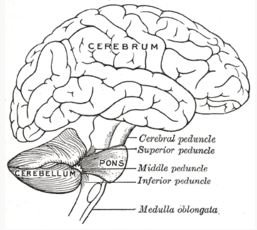
At the University of Tel Aviv, Matti Mintz with a team has constructed a digital cerebellum that restored motor function in rats. Working with Robert Prueckl of Guger Technologies in Graz, Austria, Mintz analyzed brainstem signals both feeding in and out of a real cerebellum. Using this base data, the team constructed a synthetic version housed outside the rat's skull, electrodes on the brain relay the digital signals.
One of the cerebellum's functions is motor control. The goal was to replicate one such reflex. The test setup was a rat that had its cerebellum disabled. They tried to teach the rat a conditioned response to an audio sound, by puffing air into the rat's eye. When the sound is heard, a normal rat would blink. The disabled one did not blink to the sound. Once the artificial system was connected to the rat, it would then blink to the sound after being conditioned as in normal rats.
Prueckl's next step with the system is software tuned to filter out noise, improved electrode connections, mapping of a larger area of the cerebellum, and embedding the chip below the skull. In particular, to teach an animal a series of movements to greater challenge the system.
This is the first step towards a digital replacement of failing brain functions. Alternatively, full external control over someone's movement is also on the way. The tech sounds on the cusp of a science fiction "cyberpunk" type upgrade for the human body. Perhaps a better connection to the rat's cerebellum would come from the recent proton transistor discovery.
Eavesdropper

