


I’ve been a big fan of Microchip PICs for some time now, possible because I use them everyday at ebmpapst. My passion for them seams to have not gone on noticed as Microchip have supplied me we the latested Arduino clone or look a like - The chipKIT Max 32. However Microchip have been a bit hit or miss with development kits so I was intrigued to see how well this would stand up to review especially as they are not developed by themselves but by Digilent.
The two new boards which are avalible are the UNO32 which is aimed at being the alternative to the Arduino UNO and the MAX32 which is up against the Arduino Mega2560. The boards follow the exact same board profile pin layout and connector pitch making Shields designed for the Arduinos fit the new chipKITs. The main selling point as I see it however is that the chipKIT boast a 32bit microcontroller making them a lot faster than standard Arduino clones.
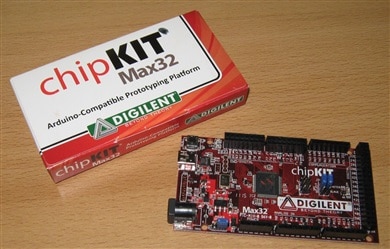
Out the box you get nothing more than the board and a few instruction on the box - so having a original Arduino UNO at home I decided to compare and see if the chipKIT is a true clone?
First off is the USB connector, this may be a fuss about nothing but the new chipKIT has the much smaller USB socket than is used on the Arduino. So I first had to find my camera cable to plug it in. So after plugging it in I then wondered off to get the new IDE you need. This is because the standard Arduino IDE will not support the chipKIT, BUT the new IDE is fully backward compatible and looks and feels 100% the same so you will instantly feel at home with it. I am interested to see if Microchip and or Digilent have a nice talk with Arduino and get themselves on the next IDE release - otherwise I can see two IDEs running along side each other.
Downloading the IDE was not a fluid as I’d hoped. The key thing for me is that the files are not on the Microchip site - who are helping to push this product - but are sort of out the back door and round the corner from the Digilent site. One of the downloads gives a error 404 file not found which can’t inspire confidence in me. I would have liked to see Microchip have a better support page with lots of Digilent logos to support them too.
Keeping the coding till last I next looked at the physical hardware closer. All is pretty good I have to say, well built and very well labeled up with whats what on the board. There are two sets of jumpers, one that allow you to select the power input, bypassing the regulator allowing a higher voltage to the power connector. The other is to allow putting the PIC32 into either master or slave SPI mode due to a little pin shuffling that's required. Both are good however the links stand taller than the connectors around the outside of the board. So plugging in a shield is not going to go home fully and solid. It may only be millimeters but still a design oversight in my view.
On the subject of shields then I have found that the community have been having problems - the chipKIT is not claiming to be 100% compatible and that's because its not. Some of the pin mapping from what I have read manes that some shields will not work. My advice is to visit the chipKIT community - which is very good - and check for compatibility. There is also no Ethernet shield available (at the time of writing this) but Digilent are designing one that is chipKIT compatible. That I think will disappoint some and the other for me was that there is nowhere to fit a 32kHz crystal so I could use the already on chip RTCC and last of all, why is the ICSP socket (not fitted) have staggered holes?
Dispite these minor annoying design features shall we say - I still like the board a lot and think there are going to be a lot of people who will buy these over the Arduino. On reason is price - the chipKIT board comes in under the cost or the original Arduino boards and also less than some of the clones. The difference is not massive but its there.
Running code on the board I have to say is really simple - in fact I’ve written so little because it works so well. From my own experience I was able to write code for my Arduino, run and test - then swap boards and without fault the same code runs on the chipKIT. From reading the community pages I found people running tests of the speed difference of the to boards. This seamed the best comparison to me to show you; its quite simply toggling a pin as fast as possible. The Arduino UNO was able to generate a frequency of 120kHz and the UNO32 clocked up 628kHz, that's around six times faster.
Personally I like the new chipKIT but I don't see it as a 100% replacement for the Arduino clones. For me when you bring out a product designed to compete with another, unless your 100% compatible then you will always be compared for your failings. I do feel the chipKIT has features above that of the Arduino however. Maybe if it was not so close to the design of the Arduino, like comparing mbed to Arduino, then I would not be picking up on small point above.
So if you are considering which was to go - then good luck and there are lots of pro and cons in both camps. For me and looking at the cost - I’d buy both!
Thanks
Paul - aka @monpjc

