element14 Community
element14 Community
    Register Log In
  • Site
  • Search
  • Log In Register
  • Community Hub
    Community Hub
    • What's New on element14
    • Feedback and Support
    • Benefits of Membership
    • Personal Blogs
    • Members Area
    • Achievement Levels
  • Learn
    Learn
    • Ask an Expert
    • eBooks
    • element14 presents
    • Learning Center
    • Tech Spotlight
    • STEM Academy
    • Webinars, Training and Events
    • Learning Groups
  • Technologies
    Technologies
    • 3D Printing
    • FPGA
    • Industrial Automation
    • Internet of Things
    • Power & Energy
    • Sensors
    • Technology Groups
  • Challenges & Projects
    Challenges & Projects
    • Design Challenges
    • element14 presents Projects
    • Project14
    • Arduino Projects
    • Raspberry Pi Projects
    • Project Groups
  • Products
    Products
    • Arduino
    • Avnet & Tria Boards Community
    • Dev Tools
    • Manufacturers
    • Multicomp Pro
    • Product Groups
    • Raspberry Pi
    • RoadTests & Reviews
  • About Us
  • Store
    Store
    • Visit Your Store
    • Choose another store...
      • Europe
      •  Austria (German)
      •  Belgium (Dutch, French)
      •  Bulgaria (Bulgarian)
      •  Czech Republic (Czech)
      •  Denmark (Danish)
      •  Estonia (Estonian)
      •  Finland (Finnish)
      •  France (French)
      •  Germany (German)
      •  Hungary (Hungarian)
      •  Ireland
      •  Israel
      •  Italy (Italian)
      •  Latvia (Latvian)
      •  
      •  Lithuania (Lithuanian)
      •  Netherlands (Dutch)
      •  Norway (Norwegian)
      •  Poland (Polish)
      •  Portugal (Portuguese)
      •  Romania (Romanian)
      •  Russia (Russian)
      •  Slovakia (Slovak)
      •  Slovenia (Slovenian)
      •  Spain (Spanish)
      •  Sweden (Swedish)
      •  Switzerland(German, French)
      •  Turkey (Turkish)
      •  United Kingdom
      • Asia Pacific
      •  Australia
      •  China
      •  Hong Kong
      •  India
      • Japan
      •  Korea (Korean)
      •  Malaysia
      •  New Zealand
      •  Philippines
      •  Singapore
      •  Taiwan
      •  Thailand (Thai)
      • Vietnam
      • Americas
      •  Brazil (Portuguese)
      •  Canada
      •  Mexico (Spanish)
      •  United States
      Can't find the country/region you're looking for? Visit our export site or find a local distributor.
  • Translate
  • Profile
  • Settings
Publications
  • Learn
  • More
Publications
Blog Chirps – Modelling the Spectral Components of Signals Whose Frequency Is Changing
  • Blog
  • Documents
  • Events
  • Files
  • Members
  • Mentions
  • Sub-Groups
  • Tags
  • More
  • Cancel
  • New
Join Publications to participate - click to join for free!
  • Share
  • More
  • Cancel
Group Actions
  • Group RSS
  • More
  • Cancel
Engagement
  • Author Author: gervasi
  • Date Created: 29 Oct 2011 5:04 PM Date Created
  • Views 677 views
  • Likes 1 like
  • Comments 4 comments
  • cgervasi:dit
  • dsp
Related
Recommended

Chirps – Modelling the Spectral Components of Signals Whose Frequency Is Changing

gervasi
gervasi
29 Oct 2011

People who have had a class on DSP or Signals and Systems are aware that any signal can be broken down into a sum of sinusoids of various amplitudes and frequencies.  The Fourier Transform (FT) can break down a signal into its frequency-domain spectral components.  The FT is typically run on a short window of data within which the signal is stationary, i.e. its statistical parameters are not changing.  An example is a speech recognition algorithm analyzing a few milliseconds of a speech phoneme to work out which vowel sound it is.  The window being analyzed must be short enough that the vowel sound and the spectral components present are not changing during the window.  image
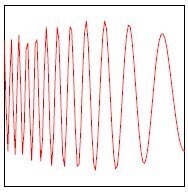

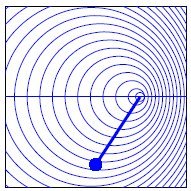
What if the frequency of a spectral component is continuously varying over time?  (The signal to the right is an example.)  For example, consider the sound of a siren passing by.  The Doppler shift decreases slowly to zero when the siren is beside you.  Then it increases in the other direction as the siren moves away.  
image

Doppler-Shifted Frequency of a Siren at Locations Around It


You need a long window of time for the FT to provide good resolution in the frequency domain.  But the longer the window, the more time the frequency components have time to change.  Resolution in frequency and resolution in time always come at the other's expense.  Models that provide an instantaneous frequency as a function of time attempt to get around this uncertainty principle.  This was the subject of the talk Dr. Patrick Flandrin's gave to my local section of the IEEE yesterday.  


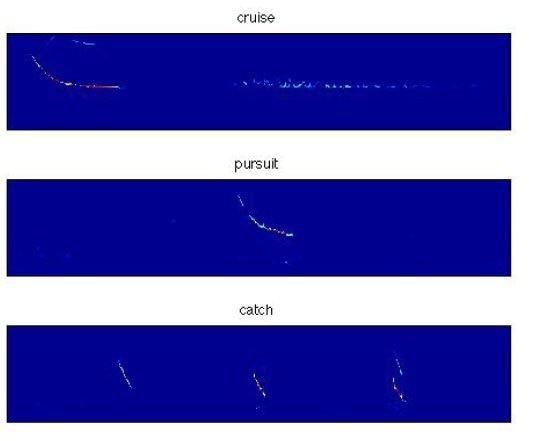
It turns out these continuously varying signals are ubiquitous in nature and engineering problems.  An interesting example is a bat's echolocation.

(Time is on the horizontal axis.  Frequency is on the vertical axis.)
image

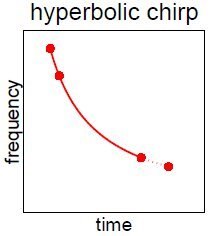
When the bat is scanning the environment, its sonar signals' frequency is constant for much of the time.  This allows it get good speed information by looking at the Doppler shift in the echos.  When it is catching its prey, it sends out short burst of broad spectrum sound. The echos from these signals are good at determining distance but not Doppler shift.  There is an intermediate pursuit period during which the bat emits chirp signals whose frequency vs. time graph is a hyperbola.  The mathematics work out such that this allows the bat to get a balance of some speed information and some position information.   It's amazing that such a complicated system came about through selective pressures.   image


The IEEE Distinguished Lecturer program provides funding for local sections of IEEE to get esteemed event speakers.  If you want more details on chirps, you local IEEE section may be able to get Dr. Flandrin to visit and give a talk in your area.   You can also download his Chirps Everywhere talk and other talks from his website. 

  • Sign in to reply
Parents
  • Former Member
    Former Member over 13 years ago

    Nature invents by evolution, and nature's discoveries are near perfect.


    Chirp is used for improving detection of received/reflected signal. Chirp signal pulse can be compressed to improve accuracy of distance measurements and to improve signal to noise ratio.


    Also, chirp uses less energy fo same quality of signal compared to fixed frequency short pulses : lower energy chirp pulses can be transmitted and fewer chirp pulses need to be transmitted.


    http://en.wikipedia.org/wiki/Pulse_compression

    • Cancel
    • Vote Up 0 Vote Down
    • Sign in to reply
    • More
    • Cancel
Comment
  • Former Member
    Former Member over 13 years ago

    Nature invents by evolution, and nature's discoveries are near perfect.


    Chirp is used for improving detection of received/reflected signal. Chirp signal pulse can be compressed to improve accuracy of distance measurements and to improve signal to noise ratio.


    Also, chirp uses less energy fo same quality of signal compared to fixed frequency short pulses : lower energy chirp pulses can be transmitted and fewer chirp pulses need to be transmitted.


    http://en.wikipedia.org/wiki/Pulse_compression

    • Cancel
    • Vote Up 0 Vote Down
    • Sign in to reply
    • More
    • Cancel
Children
No Data
element14 Community

element14 is the first online community specifically for engineers. Connect with your peers and get expert answers to your questions.

  • Members
  • Learn
  • Technologies
  • Challenges & Projects
  • Products
  • Store
  • About Us
  • Feedback & Support
  • FAQs
  • Terms of Use
  • Privacy Policy
  • Legal and Copyright Notices
  • Sitemap
  • Cookies

An Avnet Company © 2026 Premier Farnell Limited. All Rights Reserved.

Premier Farnell Ltd, registered in England and Wales (no 00876412), registered office: Farnell House, Forge Lane, Leeds LS12 2NE.

ICP 备案号 10220084.

Follow element14

  • X
  • Facebook
  • linkedin
  • YouTube