


People who have had a class on DSP or Signals and Systems are aware that any signal can be broken down into a sum of sinusoids of various amplitudes and frequencies. The Fourier Transform (FT) can break down a signal into its frequency-domain spectral components. The FT is typically run on a short window of data within which the signal is stationary, i.e. its statistical parameters are not changing. An example is a speech recognition algorithm analyzing a few milliseconds of a speech phoneme to work out which vowel sound it is. The window being analyzed must be short enough that the vowel sound and the spectral components present are not changing during the window. 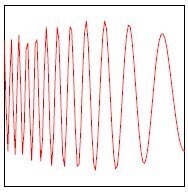
What if the frequency of a spectral component is continuously varying over time? (The signal to the right is an example.) For example, consider the sound of a siren passing by. The Doppler shift decreases slowly to zero when the siren is beside you. Then it increases in the other direction as the siren moves away.
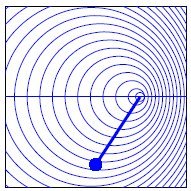
Doppler-Shifted Frequency of a Siren at Locations Around It
You need a long window of time for the FT to provide good resolution in the frequency domain. But the longer the window, the more time the frequency components have time to change. Resolution in frequency and resolution in time always come at the other's expense. Models that provide an instantaneous frequency as a function of time attempt to get around this uncertainty principle. This was the subject of the talk Dr. Patrick Flandrin's gave to my local section of the IEEE yesterday.
It turns out these continuously varying signals are ubiquitous in nature and engineering problems. An interesting example is a bat's echolocation.
(Time is on the horizontal axis. Frequency is on the vertical axis.)
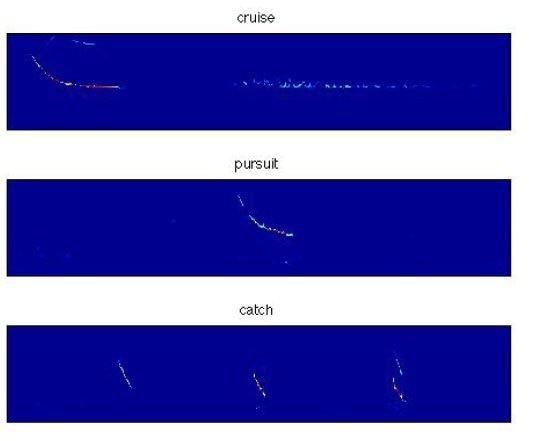
When the bat is scanning the environment, its sonar signals' frequency is constant for much of the time. This allows it get good speed information by looking at the Doppler shift in the echos. When it is catching its prey, it sends out short burst of broad spectrum sound. The echos from these signals are good at determining distance but not Doppler shift. There is an intermediate pursuit period during which the bat emits chirp signals whose frequency vs. time graph is a hyperbola. The mathematics work out such that this allows the bat to get a balance of some speed information and some position information. It's amazing that such a complicated system came about through selective pressures. 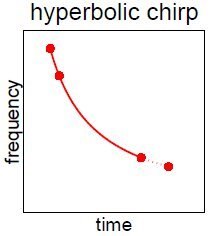
The IEEE Distinguished Lecturer program provides funding for local sections of IEEE to get esteemed event speakers. If you want more details on chirps, you local IEEE section may be able to get Dr. Flandrin to visit and give a talk in your area. You can also download his Chirps Everywhere talk and other talks from his website.


