


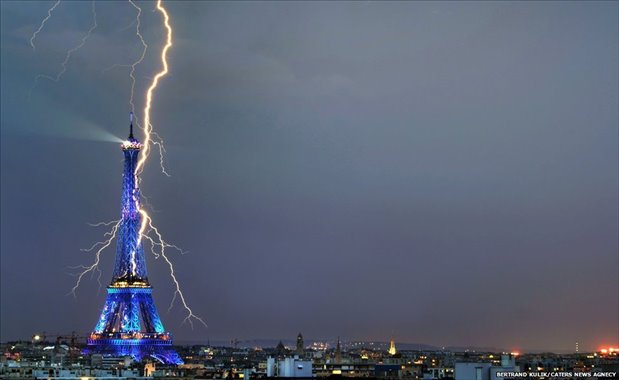
Lightning strike in Paris, France (via Bertrand Kulik)
Possibly the greatest pioneer in the field of electrical engineering, Nikola Tesla, dreamed of one day controlling lightning. During lightning storms, he would sit and watch in amazement as nature demonstrated its powerful electrical discharges. He successfully simulated electrical discharges up to 7 meters in length using millions of volts produced by his infamous coils. However, controlling nature's powerful forces ended up being one of Tesla's unfulfilled dream.
During the 1970s, scientist first began finding ways to trigger lightning strikes. Their methods included shooting small rockets into storm clouds with spools of wire connected to the ground. This method worked only 50% of the time and was not cost-effective or efficient. Therefore, scientist began pondering new ways to trigger lightning strikes. Around this time, it was first suggested that lasers may be used to direct lightning strikes.
As laser technology advanced, the hypothosis of triggering lightning strikes started to become a reality. In 2008 André Mysyrowicz and a team of researchers from École Nationale Supérieure de
Techniques Avancées (ENSTA ParisTech) conducted experiments with promising results. The team used laser pulses to create beams of plasma filaments (ionized air molecules) that could possibly conduct electricity. Though they had the correct idea, the beams were too short to trigger lightning strikes to the ground despite generating electrical discharges within the clouds themselves.
Recently, the same team has conducted "breakthrough experiments." Using more powerful lasers and high-voltage discharges to simulate lightning, they are able to direct the discharge using a filament path. Additionally, directing a laser beam 5 to 20 centimeters from two oppositely charged electrodes over 50 meters, the team successfully intercepted the lightning and kept it from jumping between the electrodes. Controlling the lightning without it touching electrodes demonstrates a more real-life situation (IE: no electronics are in natural strikes).
Lightning can be a powerful tool to understanding mechanisms underlying the natural phenomena. Triggered lightning strikes could help engineers perform sensitivity tests on air-planes and infrastructures such as power lines. Mastery over the planet is inevitable.
Cabe
