


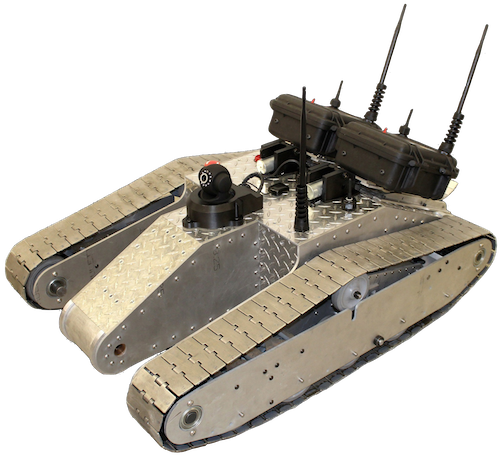
Node.js WiFi-Extending Robot (via Notheastern University)
Electrical and computer engineers from Northeastern University have collaborated on a robotic vehicle that’s designed to bring Wi-Fi into hazardous areas where getting a high-speed connection is next to impossible. Known as the Node.js WiFi-Extending Robot, the team designed the 150lbs mini-tank using a custom-built aluminum frame (using 3D CAD software, a CNC machine and water-jet cutter) with after-market treads that house a couple of 12V brushed DC motors powered by 9 14.8V lithium polymer batteries (45Ah total with a 12 hour run-time) that give it a top speed of 8-10 mph. The robots motor controls make use of an Arduino unit attached to a custom made H-bridge (electronic circuit) which out-puts PWM signals through a serial-port to the robots ASUS EEE PC brain (running Ubuntu) housed inside of a Pelican case (Pelican cases are designed to take a lot of punishment).
The robots Wi-Fi system makes use of a series of Linksys routers that have been adapted to use dd-wrt firmware and outfitted with long range antennas and power amplifiers (for greater range) all housed in their own Pelican cases for communication. One of the routers is used for command and control while the others are attached to aluminum skids that can be deployed (solenoid actuated) off of the robots tail-end and used as repeaters. The user controls the robot through a node.js web server from up to 1km away using any PC and navigates using the robots on-board camera system and is able to see real-time telemetry such as GPS coordinates, signal strength and interface connection status to name a few. Judging from the robots design (it can easily carry a 150lbs man), it’s easy to see why it would be invaluable in places such as battlefields or disaster areas where communication would be crucial in not only saving lives but to place an order for pizza delivery from the nearest FOB (Forward Operating Base).
Cabe

