


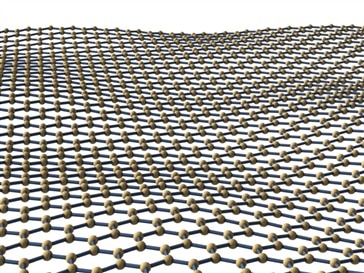
Graphene sheet concept art from James Hedberg
Why has Graphene not over taken Silicon for use in electronics?
Graphene is a single layer of carbon atoms that are only one molecule thick and have extraordinary characteristics. It is stronger than diamonds, can conduct electricity better than copper, and is impenetrable to gases and liquids. The low resistance it offers can create new and better transistors and circuits. The exceptional conductivity allows electrons to flow quicker than the modernly used silicon transistors.
However, with the incredible speed also comes another problem. For transistors to work they have to have a distinct on and off state. Creating a transistor with a consistent off state is difficult due to the great conductivity of the substance. Even with sheets as thin as one molecule electrons often filter through when in the off state. The band-gap cannot get large enough to be effective.
One man, Konstantin Novoselov, leading a group of researchers is working to create an efficient graphene based transistor. His work on Graphene in 2010 helped him, with colleague Andre Geim, win the Nobel Prize in Physics. Currently they are working to develop a transistor by placing a layer of molybdenum in between two sheets of graphene. The molybdenum is an excellent insulator and stops electrons from passing over while the transistor is in the off state. Further research and experimentation is still needed. Successfully creating a graphene transistor could significantly expand our capabilities with hardware engineering.
Take the 155Ghz Graphene transistor as an example of the possibilities.
Cabe

