element14 Community
element14 Community
    Register Log In
  • Site
  • Search
  • Log In Register
  • Community Hub
    Community Hub
    • What's New on element14
    • Feedback and Support
    • Benefits of Membership
    • Personal Blogs
    • Members Area
    • Achievement Levels
  • Learn
    Learn
    • Ask an Expert
    • eBooks
    • element14 presents
    • Learning Center
    • Tech Spotlight
    • STEM Academy
    • Webinars, Training and Events
    • Learning Groups
  • Technologies
    Technologies
    • 3D Printing
    • FPGA
    • Industrial Automation
    • Internet of Things
    • Power & Energy
    • Sensors
    • Technology Groups
  • Challenges & Projects
    Challenges & Projects
    • Design Challenges
    • element14 presents Projects
    • Project14
    • Arduino Projects
    • Raspberry Pi Projects
    • Project Groups
  • Products
    Products
    • Arduino
    • Avnet & Tria Boards Community
    • Dev Tools
    • Manufacturers
    • Multicomp Pro
    • Product Groups
    • Raspberry Pi
    • RoadTests & Reviews
  • About Us
  • Store
    Store
    • Visit Your Store
    • Choose another store...
      • Europe
      •  Austria (German)
      •  Belgium (Dutch, French)
      •  Bulgaria (Bulgarian)
      •  Czech Republic (Czech)
      •  Denmark (Danish)
      •  Estonia (Estonian)
      •  Finland (Finnish)
      •  France (French)
      •  Germany (German)
      •  Hungary (Hungarian)
      •  Ireland
      •  Israel
      •  Italy (Italian)
      •  Latvia (Latvian)
      •  
      •  Lithuania (Lithuanian)
      •  Netherlands (Dutch)
      •  Norway (Norwegian)
      •  Poland (Polish)
      •  Portugal (Portuguese)
      •  Romania (Romanian)
      •  Russia (Russian)
      •  Slovakia (Slovak)
      •  Slovenia (Slovenian)
      •  Spain (Spanish)
      •  Sweden (Swedish)
      •  Switzerland(German, French)
      •  Turkey (Turkish)
      •  United Kingdom
      • Asia Pacific
      •  Australia
      •  China
      •  Hong Kong
      •  India
      • Japan
      •  Korea (Korean)
      •  Malaysia
      •  New Zealand
      •  Philippines
      •  Singapore
      •  Taiwan
      •  Thailand (Thai)
      • Vietnam
      • Americas
      •  Brazil (Portuguese)
      •  Canada
      •  Mexico (Spanish)
      •  United States
      Can't find the country/region you're looking for? Visit our export site or find a local distributor.
  • Translate
  • Profile
  • Settings
Publications
  • Learn
  • More
Publications
Blog Graphene transistor from Nobel Prize winner
  • Blog
  • Documents
  • Events
  • Files
  • Members
  • Mentions
  • Sub-Groups
  • Tags
  • More
  • Cancel
  • New
Join Publications to participate - click to join for free!
  • Share
  • More
  • Cancel
Group Actions
  • Group RSS
  • More
  • Cancel
Engagement
  • Author Author: Catwell
  • Date Created: 6 Feb 2012 8:28 PM Date Created
  • Views 589 views
  • Likes 1 like
  • Comments 2 comments
  • research
  • test
  • graphene
  • nobel_prize
  • transistor
  • industry
  • hmi
  • on_campus
  • embedded
  • cabeatwell
  • prototyping
  • university
  • innovation
Related
Recommended

Graphene transistor from Nobel Prize winner

Catwell
Catwell
6 Feb 2012
image
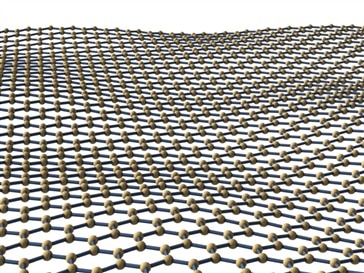
Graphene sheet concept art from James Hedberg
 
Why has Graphene not over taken Silicon for use in electronics?
 
 
Graphene is a single layer of carbon atoms that are only one molecule thick and have extraordinary characteristics. It is stronger than diamonds, can conduct electricity better than copper, and is impenetrable to gases and liquids. The low resistance it offers can create new and better transistors and circuits. The exceptional conductivity allows electrons to flow quicker than the modernly used silicon transistors.
 
 
However, with the incredible speed also comes another problem. For transistors to work they have to have a distinct on and off state. Creating a transistor with a consistent off state is difficult due to the great conductivity of the substance. Even with sheets as thin as one molecule electrons often filter through when  in the off state. The band-gap cannot get large enough to be effective.
 
 
One man, Konstantin Novoselov, leading a group of researchers is working to create an efficient graphene based transistor. His work on Graphene in 2010 helped him, with colleague Andre Geim, win the Nobel Prize in Physics. Currently they are working to develop a transistor by placing a layer of molybdenum in between two sheets of graphene. The molybdenum is an excellent insulator and stops electrons from passing over while the transistor is in the off state. Further research and experimentation is still needed. Successfully creating a graphene transistor could significantly expand our capabilities with hardware engineering.
 
 
Take the 155Ghz Graphene transistor as an example of the possibilities.
 
 
Cabe
http://twitter.com/Cabe_e14
  • Sign in to reply
Parents
  • DAB
    DAB over 13 years ago

    Hi Cabe,


    Getting steady states could just be a matter of technic.  It may be possible to stimulate individual graphene nodes to set their electrons into a high or low state using lasers.  It should be possible to use laser frequencies for setting the states and use the electrostatic interface to find the individual bit states.


    Either way, this technology is moving towards practical applications.

    It will be interesting to see what they come up with next.


    DAB

    • Cancel
    • Vote Up 0 Vote Down
    • Sign in to reply
    • More
    • Cancel
Comment
  • DAB
    DAB over 13 years ago

    Hi Cabe,


    Getting steady states could just be a matter of technic.  It may be possible to stimulate individual graphene nodes to set their electrons into a high or low state using lasers.  It should be possible to use laser frequencies for setting the states and use the electrostatic interface to find the individual bit states.


    Either way, this technology is moving towards practical applications.

    It will be interesting to see what they come up with next.


    DAB

    • Cancel
    • Vote Up 0 Vote Down
    • Sign in to reply
    • More
    • Cancel
Children
  • Catwell
    Catwell over 13 years ago in reply to DAB

    The band-gap ratio for graphene  is around 30.  The larger the band gap, the more of an insulator the  material becomes.  For comparison, the band gap of silicon is 1.11.


    Molybdenite might be a better option all together: Molybdenite to replace silicon, and the 3-atom thick transistor

    It has everything needed to replace silicon now.


    Cabe

    • Cancel
    • Vote Up 0 Vote Down
    • Sign in to reply
    • More
    • Cancel
element14 Community

element14 is the first online community specifically for engineers. Connect with your peers and get expert answers to your questions.

  • Members
  • Learn
  • Technologies
  • Challenges & Projects
  • Products
  • Store
  • About Us
  • Feedback & Support
  • FAQs
  • Terms of Use
  • Privacy Policy
  • Legal and Copyright Notices
  • Sitemap
  • Cookies

An Avnet Company © 2026 Premier Farnell Limited. All Rights Reserved.

Premier Farnell Ltd, registered in England and Wales (no 00876412), registered office: Farnell House, Forge Lane, Leeds LS12 2NE.

ICP 备案号 10220084.

Follow element14

  • X
  • Facebook
  • linkedin
  • YouTube