


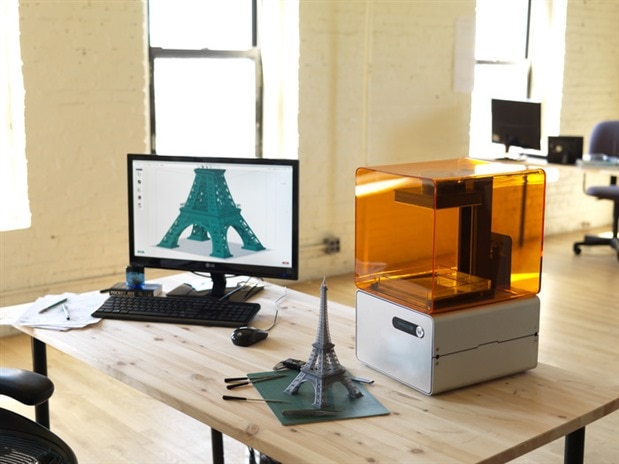
Form1 printer promotional image (via Form1 & Kickstarter)
A revolution is brewing. Current conventional manufacturing involves a removal process that produces more waste than product. Additive methods like those applied by 3D printing are much more resource-efficient. Until now, the technology has either been lacking in quality or extremely expensive. There are an estimated 10 million CAD software users and only 30,000 3D printers in the world. In order to bring these two worlds together, MIT grad students Max Lobovsky, David Cranor and Natan Linder decided to start the company Formlabs and to create a 3D printer that is not only affordable but also excels in performance and resolution.
One of the most successful methods for 3D printing is a method called stereolithography (SL). This method uses a laser to draw on liquid resin, harden, and cure it one layer at a time. Because of complex optical technology, 3D printers that use SL cost tens if not hundreds of dollars, but the team was able to minimize parts and come up with a design that is being offered, via a Kickstarter, for less than $3,000 (though the retail price has not yet been decided).

Examples of high-resolution parts (via Form1 & Kickstarter)
The SL method of production results in super high resolution. Successive layers measure only 25 microns (0.001 inches) and can achieve details of 300 microns (0.012). The printer lays these layers at a rate of approximately 15 mm per hour. The building space is 125x125x165 mm (~5x5x6.5 inches) (LxWxH) in size.
After many generations of prototypes, the team came up with a remarkably sleek and stylish-looking machine called the Form 1. No compromises were made for aesthetics. The printer has a metal brushed base and an orange printing space cover that blocks out UV light, which would otherwise affect the printing resin.
The printer comes with Form software that helps to generate smart support structures used to support complex geometries during the printing process, then easily breaks off. The software cannot be used to design parts, rather it is made to facilitate import of .STL files from any CAD package.
Kickstarter contributors will be supplied with Formlab’s neutral gray matter printing material. Material properties have not yet been determined for this custom resin, but the team says it is similar to acrylate-based SL printing materials and can be used for general look-and-feel models and stand alone parts.
To print all you need to do is pour an adequate amount of Formlab’s resin into the work space and the machine will do the rest. Other resins are not yet supported and it is estimated that Formlab’s resin will cost about $149 per liter (except for Kickstarter contributors who will receive an included liter and also enjoy a price of $129 per liter for the entire life of the Form 1 printer). The team is also working on producing a palate of printing materials to achieve different colors, transparency, flexibility and burnout capability for lost wax casting processes. Kickstarter contributors also get a Form Finish kit that helps the user perform post-processing finishes. The kit is used to remove residue of liquid resin and includes a finishing tray and accessories like a rinsing basket and more.
The project’s Kickstarter set a high goal of $100,000, which was met on the first day. Pre-sales of the entire printing kit, including a full Form 1 printer, software and accessories are still available. Early contributors could buy one for $2,299, but the price has since gone up to $2,699.
Formlabs has received investments by Mitch Kapor, Jio Ito and Eric Schmidt’s Innovation Endeavors. With supporters like these and an incredibly successful Kickstarter, it is safe to say this revolution is well on its way.
Cabe