


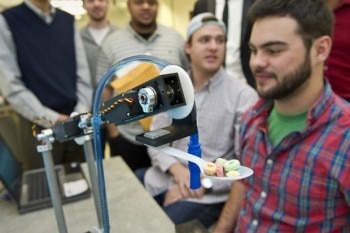
The Team: Ryan LaVoie, James Barron, Pedro Lopes, Nick Aquino, Basel Magfory, Mohammed Kante and advisor electrical and computer engineering professor Waleed Meleis (via Mary Knox Merrill & Northeastern University)
The disabled, as well as their caregivers, know that the simple act of trying to eat can be a daunting task in itself. People eat at different rates (speed) that caregivers have a difficult time trying to match those individual speeds so a team of engineers from Northeastern University in Boston designed a robotic arm that overcomes that problem and provides a personal sense of freedom.
The team, led by Mohamed Kante, designed the robotic arm so that the user can control it by eye movement alone. Called ‘iCRAFT’ (eye Controlled Robotic Arm Feeding Technology), the robot functions using color-coded boxes situated on a monitor which correlates with individual containers of food. A camera positioned next to the user follows the user’s pupil direction with specialized eye-tracking software and detects which colored box (4 in all with 3 associated with two bowls of food and a drinking bottle with the fourth being a pause feature) the subject is looking at and then sends a signal to the robotic arm to scoop up the food from the corresponding food container.
The robotic arm the team used to create iCRAFT (unknown at this time) looks to be a RobotShop M100RAK which features 4 Hitec HS785HB servo motors with four degrees of movement and operates with 4.8 to 6 volts of power depending on torque. Similar configurations of robotic assistive arms can cost around $3,500 US but the team states that building the iCRAFT set them back only $900 US which seems very affordable for the amount of freedom it gives the user. The design won the ECE Capstone Design Competition 2012.
See more about robotics in the element14 Robotics goup.
Cabe

