


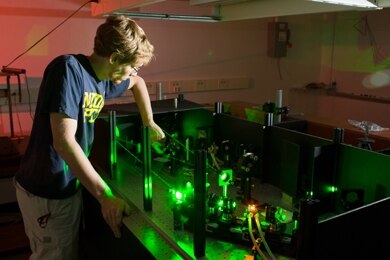
William Fisher (via University of Michigan)
University of Michigan researchers have discovered a way to use a lesser property of light for the production of electricity. Light has weak electric and magnetic components that most have ignored as an important effect. But it was not passed over by Professor Stephen Rand of the school's engineering departments. Rand found that if the light is intense enough, while passing through a non-conductive material, will produce a magnetic field 100 millions time stronger than previously measured.
Doctoral Student William Fisher explains, "It turns out that the magnetic field starts curving the electrons into a C-shape and they move forward a little each time. That C-shape of charge motion generates both an electric dipole and a magnetic dipole. If we can set up many of these in a row in a long fiber, we can make a huge voltage and by extracting that voltage, we can use it as a power source."
Rand states, " This could lead to a new kind of solar cell without semiconductors and without absorption to produce charge separation." Current solar cells absorb light and produce electricity and heat, with only a maximum efficiency, at the moment, of 10%. Rand's magnetic solar effect is also producing a 10% efficiency, but only a small fraction of the heat, and with only glass focusing and fibre optic guides. In other words, no silicone.
Testing will be done with laser light at first, but later with sunlight. The university is seeking patent protection of the intellectual property this has created. Seems to be a lot of rushing to the patent office these days.
Eavesdropper
pic via Webster's dictionary

