


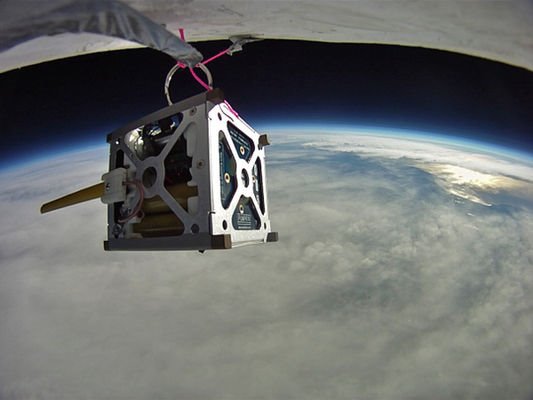
PhoneSat 1.0 (via NASA)
It is said that NASA did its first Apollo missions to the moon using the technology found in a pocket calculator. Well now, NASA is showing off again, making the most of their depleted budget in a project called PhoneSat. A team of engineers at NASA’s Ames Research Center in Moffett Field, California has designed mini satellites that, at their core, have Nexus smartphones as main computers.
The tiny satellites measure around 10 cm cubed and weigh in at a remarkable four pounds. They are being built from nothing but off the shelf parts, no modifications or invented hardware. This allows engineers to explore the capabilities of current technology as well as easily fix and make upgrades. At a cost of about $3,500 per PhoneSat, NASA hopes the project will result in satellites that are built fast and launched frequently.
The agency is planning on beginning this project with two consequent stages, which will involve two different types of experimental satellites, PhoneSat 1.0 and PhoneSat 2.0. Both will have external batteries, external radio beacons and a watchdog circuit to monitor system and reboot as needed. PhoneSat 1.0 will use Google’s Nexus One phones, and if all goes as planned, PhoneSat 2.0 will use the faster Nexus S phone as well as additional hardware.
Two PhoneSat 1.0s will be launched. Their mission will be simple: use the sensors in the smartphones to orient the camera towards Earth and send pictures as well as system health reports back to NASA. Preliminary tests have all been very successful and involved launching phones with rockets and testing PhoneSat 1.0 in a thermal-vacuum chamber, on vibration and shock tables and on high altitude balloons.
If this first stage is successful, NASA will launch PhoneSat 2.0. Apart from its more advanced cell phone, it will sport solar panels, GPS receivers and magnetorquer coils, electro-magnets that interact with Earth’s magnetic field, and include reaction wheels that control the satellites orientation in space. Last but not least, an onboard two-way S-band radio will allow engineers to control the satellite from Earth.
The PhoneSat project is expect to start launching mini satellites later this year from the agency’s Wallops Flight Facility in Wallops Island, Virginia. Even thought the satellites themselves weigh less than four pounds, NASA will be launching them using Orbital Sciences Corporation’s Antares rocket capable of a 15,000 payload (who knows, maybe they will send many PhoneSats). In 2013, NASA will have the Edison Demonstration of Small Satellite Networks mission, which will show that heliophysical measurements and experiments can be made using small spacecraft.
When the budget gets cut, there is now choice but to think small.
Cabe