element14 Community
element14 Community
    Register Log In
  • Site
  • Search
  • Log In Register
  • Community Hub
    Community Hub
    • What's New on element14
    • Feedback and Support
    • Benefits of Membership
    • Personal Blogs
    • Members Area
    • Achievement Levels
  • Learn
    Learn
    • Ask an Expert
    • eBooks
    • element14 presents
    • Learning Center
    • Tech Spotlight
    • STEM Academy
    • Webinars, Training and Events
    • Learning Groups
  • Technologies
    Technologies
    • 3D Printing
    • FPGA
    • Industrial Automation
    • Internet of Things
    • Power & Energy
    • Sensors
    • Technology Groups
  • Challenges & Projects
    Challenges & Projects
    • Design Challenges
    • element14 presents Projects
    • Project14
    • Arduino Projects
    • Raspberry Pi Projects
    • Project Groups
  • Products
    Products
    • Arduino
    • Avnet & Tria Boards Community
    • Dev Tools
    • Manufacturers
    • Multicomp Pro
    • Product Groups
    • Raspberry Pi
    • RoadTests & Reviews
  • About Us
  • Store
    Store
    • Visit Your Store
    • Choose another store...
      • Europe
      •  Austria (German)
      •  Belgium (Dutch, French)
      •  Bulgaria (Bulgarian)
      •  Czech Republic (Czech)
      •  Denmark (Danish)
      •  Estonia (Estonian)
      •  Finland (Finnish)
      •  France (French)
      •  Germany (German)
      •  Hungary (Hungarian)
      •  Ireland
      •  Israel
      •  Italy (Italian)
      •  Latvia (Latvian)
      •  
      •  Lithuania (Lithuanian)
      •  Netherlands (Dutch)
      •  Norway (Norwegian)
      •  Poland (Polish)
      •  Portugal (Portuguese)
      •  Romania (Romanian)
      •  Russia (Russian)
      •  Slovakia (Slovak)
      •  Slovenia (Slovenian)
      •  Spain (Spanish)
      •  Sweden (Swedish)
      •  Switzerland(German, French)
      •  Turkey (Turkish)
      •  United Kingdom
      • Asia Pacific
      •  Australia
      •  China
      •  Hong Kong
      •  India
      • Japan
      •  Korea (Korean)
      •  Malaysia
      •  New Zealand
      •  Philippines
      •  Singapore
      •  Taiwan
      •  Thailand (Thai)
      • Vietnam
      • Americas
      •  Brazil (Portuguese)
      •  Canada
      •  Mexico (Spanish)
      •  United States
      Can't find the country/region you're looking for? Visit our export site or find a local distributor.
  • Translate
  • Profile
  • Settings
Publications
  • Learn
  • More
Publications
Blog Op Ed: Censoring Technology In Education
  • Blog
  • Documents
  • Events
  • Files
  • Members
  • Mentions
  • Sub-Groups
  • Tags
  • More
  • Cancel
  • New
Join Publications to participate - click to join for free!
  • Share
  • More
  • Cancel
Group Actions
  • Group RSS
  • More
  • Cancel
Engagement
  • Author Author: DaveYoung
  • Date Created: 13 Aug 2012 3:05 PM Date Created
  • Views 670 views
  • Likes 1 like
  • Comments 5 comments
  • education
  • censorship
  • dyoung
Related
Recommended

Op Ed: Censoring Technology In Education

DaveYoung
DaveYoung
13 Aug 2012

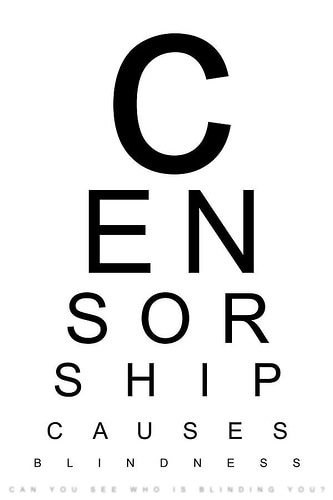
The technical fields have a problem in the training of the next generation of students: internet censorship.  It represents a hesitation in the move from information being something that can be controlled to the free passing of ideas, and it places education in direct conflict with the demands of industry. image
 

There are two ways I've seen internet controlled by high schools during my involvement with the BlueStamp Engineering program:

  1. White list: Administrators decide on the sites that are appropriate for students and only allow them to access approved information.
  2. Black list: Find sites that are known to be problems for high-school aged students such as facebook, porn, etc. and block them while leaving the rest of the internet available.


White listing is an approach to internet control similar to a parent placing a young child in front of television for hours.  It is the most effective way for the authority figure to be sure that the child is safe while requiring minimal effort to maintain a controlled, liability-free environment. The downside to TV is that it limits the number of times the child is exposed to new situations outside, which is an important part of growing up.  Similarly, the burden of a student's internet exploration is increased by having to 'check in' with the administrator each time he or she wants to access a new site, then wait for it to be approved.  A question that should take 5 seconds to answer can take 24 hours in order to attain the go-ahead.  This represents an arrogant display of control when administrators think that they can keep up with students' insatiable thirst for knowledge or the pace of internet expansion.


The intangible result of white-listing may be even more harmful than delaying the rate of learning.  Showing the students that they aren't trusted each time they log on sets an unfortunate tone between the students and administrators.  It also encourages students to focus on defeating the protection system while waiting for access to be granted instead of working on their assignments.  Ultimatly, it can make the learning process less exciting, more arduous, and prevents students from maintaining momentum in their work.


It is true that black-listing does leave students with much less supervision, freeing a mal-intentioned user to find awful things online.  However there are ways to mitigate the risk without chaining students to a white list.  Services exist that maintain a blacklist, helping to keep up with the blistering expansion of online nastiness.  If a student is found to access a site that teachers deem inappropriate, that student's access could then be limited to a white list or taken away all together.  The school could also run weekly/monthly reports on the sites that students visit most often and/or spend the most time on.  If an inappropriate or time-wasting site becomes popular on a large scale, it can be easily be added to the black list.


Black-listing sites have an intangible result opposite to that of white-listing.  Students are given full trust until they slip up, and then face consequences for betraying that trust.  The school takes on a role similar to that of an employer, saying 'We are here to provide you with the resources that enable you to succeed.  Don't abuse them.'  The student then learns to work on their assignments in the fastest way possible, with the pace limited only by their growing ability.  This method does take more work, thought, and engagement with the students, but isn't that what education is really about?


If you are a parent or a young adult with a choice of attending different schools, I suggest that you inquire as to their internet censorship approach.  It could provide insight into the school's risk tolerance in the pursuit of excellence, how much they encourage independent thought, and the amount of trust and respect that is placed before the student.  While it can be scary to think of what could go wrong, remember that there are only 18 short years to teach students to be grown, responsible adults.  Don't waste that time.

  • Sign in to reply
Parents
  • Former Member
    Former Member over 13 years ago

    This is a great op-ed.  Censorship is so often started with good intentions- to protect people but all too often it turns into control.  I was in HS just as the internet was beginning and it was obvious that they defered to the White List approach which was a horrible they went so far as to try to only allow certain parts of online encyclopedias- what a waste of time that must have been for teachers to have to go to the administrators and ask for "Borneo" to be added to the acceptable phrases that we could look up when we were going to be studying that part of the world.  I am with you Dave, better to er on letting the kids slip up with total freedom then to lock them away from information and assume that they won't make good use of it.


    One note from gervasi's point about China- there has been some recent research that has come out that China certainly has black listing of sites- but it is a lot more nuanced then we have been lead to believe.  In the lastest thing that I read about the censorship that China employs, it is primarily based in not allowing people to meet in large groups.  They have recognized the point that you brought up that they need to benefit from the openness of ideas.  I was talking with a friend of mine who was recently in China and he said that there are actually sites that you can find through the Chinese search engine that discuss which governmet buracracies to avoid and which ones are business friendly- the government knows that they are there but that they see the value in letting business owners share ideas and become more efficient.  Now certainly they do block ideas like "Tank Man" from Tienneman Square, and they are likely to block lots of revolutionary literature- no doubt. 

    • Cancel
    • Vote Up 0 Vote Down
    • Sign in to reply
    • More
    • Cancel
Comment
  • Former Member
    Former Member over 13 years ago

    This is a great op-ed.  Censorship is so often started with good intentions- to protect people but all too often it turns into control.  I was in HS just as the internet was beginning and it was obvious that they defered to the White List approach which was a horrible they went so far as to try to only allow certain parts of online encyclopedias- what a waste of time that must have been for teachers to have to go to the administrators and ask for "Borneo" to be added to the acceptable phrases that we could look up when we were going to be studying that part of the world.  I am with you Dave, better to er on letting the kids slip up with total freedom then to lock them away from information and assume that they won't make good use of it.


    One note from gervasi's point about China- there has been some recent research that has come out that China certainly has black listing of sites- but it is a lot more nuanced then we have been lead to believe.  In the lastest thing that I read about the censorship that China employs, it is primarily based in not allowing people to meet in large groups.  They have recognized the point that you brought up that they need to benefit from the openness of ideas.  I was talking with a friend of mine who was recently in China and he said that there are actually sites that you can find through the Chinese search engine that discuss which governmet buracracies to avoid and which ones are business friendly- the government knows that they are there but that they see the value in letting business owners share ideas and become more efficient.  Now certainly they do block ideas like "Tank Man" from Tienneman Square, and they are likely to block lots of revolutionary literature- no doubt. 

    • Cancel
    • Vote Up 0 Vote Down
    • Sign in to reply
    • More
    • Cancel
Children
No Data
element14 Community

element14 is the first online community specifically for engineers. Connect with your peers and get expert answers to your questions.

  • Members
  • Learn
  • Technologies
  • Challenges & Projects
  • Products
  • Store
  • About Us
  • Feedback & Support
  • FAQs
  • Terms of Use
  • Privacy Policy
  • Legal and Copyright Notices
  • Sitemap
  • Cookies

An Avnet Company © 2025 Premier Farnell Limited. All Rights Reserved.

Premier Farnell Ltd, registered in England and Wales (no 00876412), registered office: Farnell House, Forge Lane, Leeds LS12 2NE.

ICP 备案号 10220084.

Follow element14

  • X
  • Facebook
  • linkedin
  • YouTube