


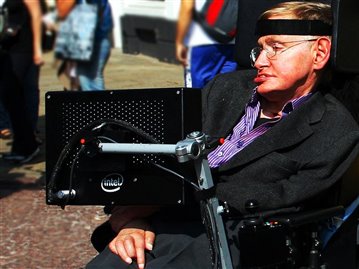
Stephen Hawking at Cambridge (via Hawking & Wikipedia)
A new device may give theoretical physicist Stephen Hawking the ability to speak using only his mind. Called the iBrain, the device was designed and developed by neuro-diagnostics company NeuroVigil to transform thought into speech. Actually the device is a portable EEG (Electroencephalography) machine that is attached to the head of the wearer and monitors brainwaves using two electrodes.
The headgear is capable of recording information for days without requiring a recharge and features a USB port for data transfers that can then be sent over the internet to health professionals for examination. The device is used in conjunction with a special algorithm, called SPEARS (Sleep Parametric EEG Automated Recognition System), which is capable of in-depth analysis and classification of both daytime and nighttime EEG patterns. These patterns can then be used to identify and diagnose sleep related medical conditions or, in the case of Stephen Hawking, central nervous system diseases such as Parkinson’s or amyotrophic lateral sclerosis (a form of motor neuron disease).
Professor Hawking was diagnosed with ALS during when he enrolled at the University of Cambridge and was not expected to live 2 or 3 years beyond his 21st birthday. As he became slowly paralyzed over time, it was necessary for him to incorporate technology that could help him speak such as his trademark voice synthesizer hardware. That device allows him to use his cheek muscle twitches which trigger an infrared sensor to write sentences (at approximately one word per minute) that are then ‘voiced’ by the computer hardware.
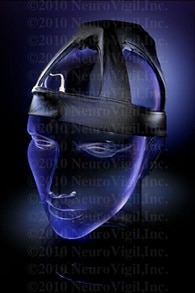
iBrain concept (via Neuro Vigil)
His system uses predictive text input software that can complete a word by typing the words first few letters much like texting with smartphones. However, as his ALS slowly paralyzes his body even his cheek movements will cease to function which is why he is testing the iBrain. Currently, it is being used to detect his brain patterns associated with speech.
The US military is also interested in the device and the company states that the US Navy had sent them an anonymous soldier’s iBrain EEG read-out to be analyzed using NeurVigil’s software. The Navy did not specify if that particular soldier was healthy or not. The company team responsible for the analysis found that the read-out showed that the subject suffered a traumatic brain injury as well as post-traumatic stress disorder. On top of their findings, they were even able to identify patterns associated with taking an antidepressant drug for anxiety!
The iBrain system has promising potential and could give the renowned physicist the capability of talking using way less hardware than he uses now, but the system is still being developed. As it stands, the company states that they are 35% done developing the iBrain 2 (which will also monitor heart-rates) and even have started the planning stages of the iBrain 3 which would be an available commercial version that could be connected to an iPhone or Android-based phone and cost around $100 US.
Cabe
