


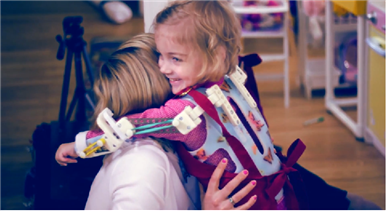
Emma and her 'magic arms' (via DuPont Hospital)
Corporations, garage-based engineers, and hobbyists have taken to 3D –printers like a moth to a flame. They have gone mainstream (they’ve been around since the 80’s), they are affordable. While some have used them to help fabricate some lethal home-defense devices (see post on HaveBlue’s printed lower receiver) others, such as Nemours/Alfred I. DuPont Hospital for Children, have used them in an effort to help children suffering from neuromuscular disabilities gain additional mobility with their arms.
The medical institution designed a functional upper-limb orthosis exoskeleton, known as WREX (Wilmington Robotic Exoskeleton), which assists in arm movement by negating gravity. The WREX unit features a two segmented metal arm that has 4 DOF (Degrees of Movement) and is ‘powered’ by a series of elastic bands. More, or less, bands can be added depending on the strength of the user and the exoskeleton can be either affixed to a wheel-chair or adapted for use on a harness for those that can walk. The unit can also be adjusted using ‘telescopic’ links to accommodate arm length as the child grows.
In the case of two year-old Emma (pictured above), who has arthrogryposis multiplex congenital, the WREX needed to be modified into a light-weight version that could actually fit her tiny stature, as she wasn’t able to effectively use the metal version (and doesn’t require a wheel-chair for mobility). The team of researchers from Nemours turned to the Stratasys Dimension 3D printer and switched out the metal arm segments for a plastic version (akin to the same non-toxic polymer that makes up LEGOs). The plastic version also makes use of the same tension bands, along with light-weight telescopic struts that allow her to move freely. The team then attached the arms to a specially designed plastic harness that allows Emma to move about freely without being encumbered by the otherwise bulky metal version. Using the printing method also allows for parts to be replaced if they become damaged with relative ease and can be either be mailed or picked up in a matter of hours rather than days or weeks. Printing also allows for the WREX to be adjusted as the child grows (Emma’s already on her second version) simply by inputting new measurements into the facilities computer and then printing out the larger parts.
The research team is already working to develop the WREX II which will have a motor built in to assist the user with heavy lifting by creating ‘just the right tension’ based on the user’s strength. The WREX is certainly an ingenious design that incorporates the use of 3D printing. Parents and children, on the other hand, see it as a truly ‘magical gift’ that can help in overcoming some of the obstacles of neuromuscular disabilities.
Cabe