


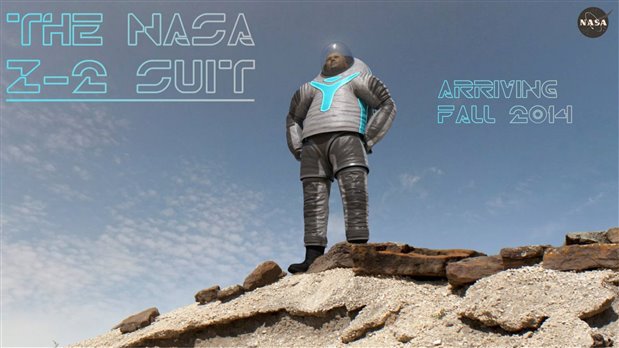
ILC Dover’s New Z-2 space suit protects against micrometeor strikes and features fashionable shorts. (via NASA)
NASA has had roughly nine spacesuits designed for astronauts to travel into space with since Alan Shepard was chucked into orbit during the Project Mercury back in the early 60s. The current suit used by American astronauts is the Enhanced Mobility Unit (EMU) designed by ILC Dover and has been the ‘go-to’ suit for space-faring humans since 1981. That suit however, is nearing its end and really isn’t sufficient for otherworldly ventures, such as the exploration of Mars. In an effort to get up to date with a better, modern spacesuit that can handle the rigors of kicking rocks on other planets as well as taking a beating while floating in space, NASA recently held a $4.4-million design challenge for a replacement.
Three suits made the finals and the general public was invited to vote for the winner, with 63% of the vote going to ILC Dover and their peculiar-looking Z-2 Spacesuit. A slight upgrade from the prototype Z-1, dubbed the ‘Buzz Lightyear’ suit because of the fluorescent green stripping used for identification. The cleverly named Z-2 features a hard-shell composite torso section (over the Z-1’s soft-shell) that’s comparable to body armor in that it will protect against micrometeor impacts, extreme temperatures and radiation when performing EVAs (Extravehicular Activities). The shoulder and hip joints have been redesigned for increased mobility and the boots have been reengineered for increased performance in the vacuum of space and ruggedized for the rocky surfaces found on the moon and Mars. The suit will sport some functional fashionable identifiers, such as light-emitting panels and Luminex wiring to help locate astronauts if trouble arises. It will also feature ‘classic’ connections to interface with existing airlocks and suit-ports. A prototype is expected to be delivered to NASA by November of this year and human-rated vacuum tested with an included PLSS (Portable Life Supporting System) by 2020.
C
See more news at:

