


Ellen Ochoa, the first Hispanic female astronaut to fly in space. (Image Credit: Bill Stafford - NASA – JSC)
Ellen Ochoa is famous for breaking barriers as the first Hispanic woman to launch into space. But for engineers, it’s more about how she got there. Before her journey really started, she developed advanced optical patents and managed special research teams. That trajectory began in 1980.
After obtaining her BS in Physics from San Diego State University, Ochoa attended graduate school at Stanford University. While studying (MS and PhD in Electrical Engineering) at Stanford University, Sally Ride was the first woman to become a U.S. astronaut. This inspired Ochoa to pursue her dreams. At Stanford, she developed optical systems. These interpreted the visual data and identified patterns within the images they captured. In 1985, she earned her PhD in electrical engineering and worked at Sandia National Laboratory.
Generally, optical engineering is about light-based systems that capture and process visual data. Using mirrors and lenses to bend light predictably allows cameras and other systems to collect very precise data from a distance. In space, researchers use this technology to study planets or analyze atmospheric chemistry. Ochoa’s breakthrough combined this hardware with computer processing. Rather than capturing an image, her systems used algorithms to analyze images in real-time and identify patterns. This helped machines interpret visual information more effectively.
Eventually, Ochoa earned patents for co-inventing three optical systems: an object-inspecting system, a system that identifies objects, and a system that removes noise in images of objects. Inventions like these allowed optical systems to do more than capture images. In such cases, machine vision enables computers to examine objects for defects, find features in an image, or remove unwanted noise. These technologies are important in fields where accuracy and reliability can’t be compromised, like aerospace, manufacturing, and scientific research.
After Sandia, she worked at NASA’s Ames Research Center in Mountain View, California, studying light-based systems for data processing. She also designed optical systems and computer models that recorded and analyzed complex space phenomena.
NASA recognized her strong background in optics and computer hardware. Future space missions were more reliant on automation, advanced imaging, and computer systems, making Ochoa’s experience valuable. Spacecraft need technology for data collection in harsh environments with limited human intervention. At Ames, she managed the Intelligent Systems Technology Branch and led a team of 35 scientists at NASA studying computer systems for spaceflight missions. And it wasn’t until 1990 that NASA chose her to join its astronaut training program.
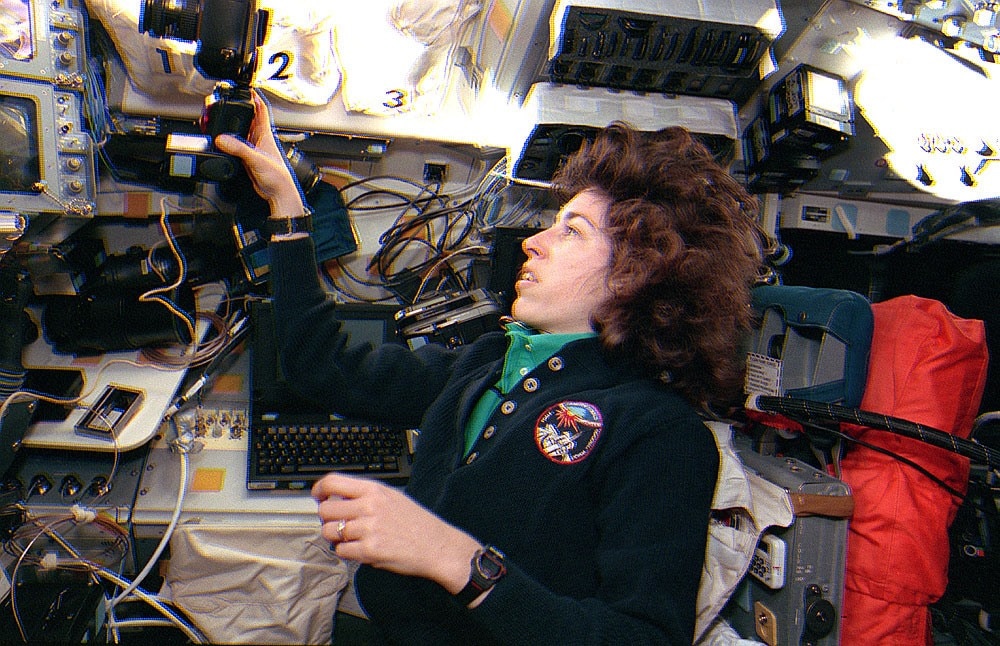
Ellen Ochoa on the STS-56 mission holding a 35mm camera. (Image Credit: NASA)
In April 1993, Ochoa became the first Hispanic woman to fly in space, serving as a Mission Specialist. This STS-56 mission on Space Shuttle Discovery, which carried the ATLAS-2 payload, involved studying how the Sun affected the Earth’s atmosphere, climate, and ozone layer. After that, she flew on the STS-66, STS-96, and STS-110 missions. She was the Payload Commander on the ATLAS-3 mission and oversaw atmospheric and solar science research. Her role across those missions was to operate the Space Shuttle’s Canadarm to deploy and retrieve payloads and support assembly work on the ISS. Then, on the fourth mission, she installed the S0 truss using the ISS’s arm, which also allowed her to move astronauts during extravehicular activities or spacewalks.
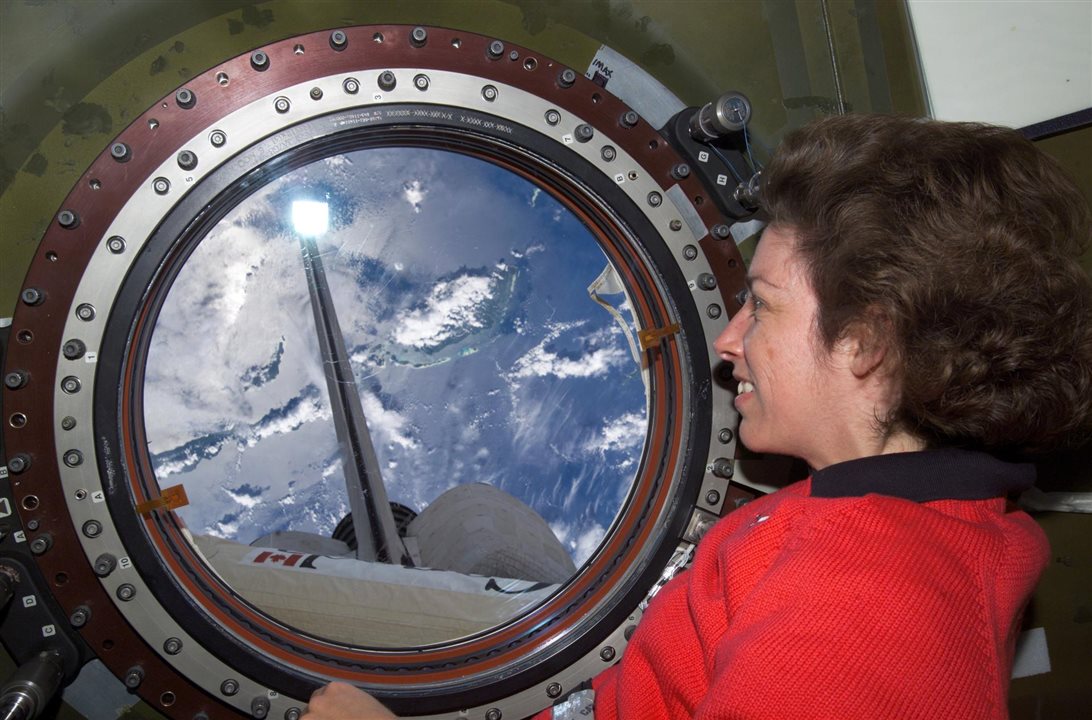
Ochoa aboard the International Space Station during the STS-110 mission. (Image Credit: NASA)
Her last spaceflight was in 2002, when she switched roles at NASA, becoming deputy director of the Flight Crew Operations Directorate. With this role, Ochoa supported human spaceflight missions, which included launches and landings. After the Space Shuttle Columbia disaster on February 1, 2003, she established the directorate’s contingency action plan. She became deputy director of the Flight Crew Operations Directorate in 2006, continuing to guide NASA’s astronaut and space operations.
She then took on a bigger role for NASA’s human spaceflight operations. On a shuttle mission, she decided to delay a launch after engineers found a hydrogen leak that surpassed safety limits. Ochoa proved her leadership and judgement by prioritizing safety and following engineering standards. Her role changed to director of the Flight Crew Operations Directorate in 2013.
While serving as director of the Johnson Space Center (2013-2018), Ochoa established the JSC 2.0 initiative. Due to changes in the space industry and government funds, she believed the JSC couldn’t operate in the same manner as before. Employees were also urged to push human spaceflight forward via agility, responsiveness, and adaptation. Under JSC 2.0, she guided milestones, including the Orion spacecraft’s first flight test called Exploration Flight-Test 1, choosing four veteran astronauts for crew capsules that sent crews to the ISS, and completing a one-year International Space Station mission.
Women interested in STEM can learn a lot from Ochoa’s career. She developed her skills over time, applying them in different areas from research to inventions and spaceflight to leadership. Ochoa knew great engineering wasn’t just about hardware. It’s also a team effort. As NASA grew, she pushed her crew to experiment and keep learning. As expected, leading in STEM is more than building spacecraft parts. It’s also about bringing the team together to build technology that may seem impossible.
Ochoa’s career success and how she got there does not always focus on just one field. Before boarding a space shuttle, she worked on optical systems and image processing. This helped computers analyze visual information. She then used that engineering knowledge with her role at NASA, flew to space four times, and managed the Johnson Space Center.
Have someone in mind we should cover? Message me here at element14.

