


Research Mathematician Katherine Johnson worked for NASA, contributing to various missions, including Project Mercury and John Glenn’s Friendship 7. She calculated trajectories, launch windows, and return paths for the safe, successful early crewed spaceflight. (Image Credit: NASA)
Born in 1918 in White Sulphur Springs, West Virginia, Katherine Johnson was the youngest in her family. At a young age, she counted everything, including the steps to the road and the silverware and dishes she washed. Because of how well she did in her early academics, especially in math, she started school in the second grade. However, the town she lived in didn’t provide school beyond grade eight for those of color. Her parents then enrolled Katherine in high school in Institute, West Virginia, at just ten years old, as she possessed a strong mathematical ability. Miss Turner, Johnson’s geometry teacher, inspired her to join Alpha Kappa Alpha Sorority.
When she was 13, Johnson went to high school on the campus of West Virginia State College. At 14 years old, she did extremely well and graduated from high school. The following year, she entered West Virginia State University. While attending college, she took every math class possible to fully pursue her passion. She also met mathematics professor Dr. William Schieffelin Claytor, her mentor, who told her she’d be a good research mathematician. Claytor also created an Analytic Geometry of Space class, and it further developed her skills for the space exploration career. In 1937, when she was 18, Johnson graduated from college summa *** laude with degrees in mathematics and French.
Once she graduated from the university, Johnson took on a teaching role at a public school in Marion, Virginia. Later, she left to obtain a graduate degree after being chosen as one of the first three African Americans to attend West Virginia’s graduate school. In June 1953, NACA offered her a position as a “computer”, where her quick learning style made her stand out. She would always ask questions and wanted to learn as much as possible about NACA and her role. Additionally, she was attending meetings, even as the only woman in the room, and eventually became a team member working on NASA projects. She stayed with NASA for over 30 years and retired in 1986.
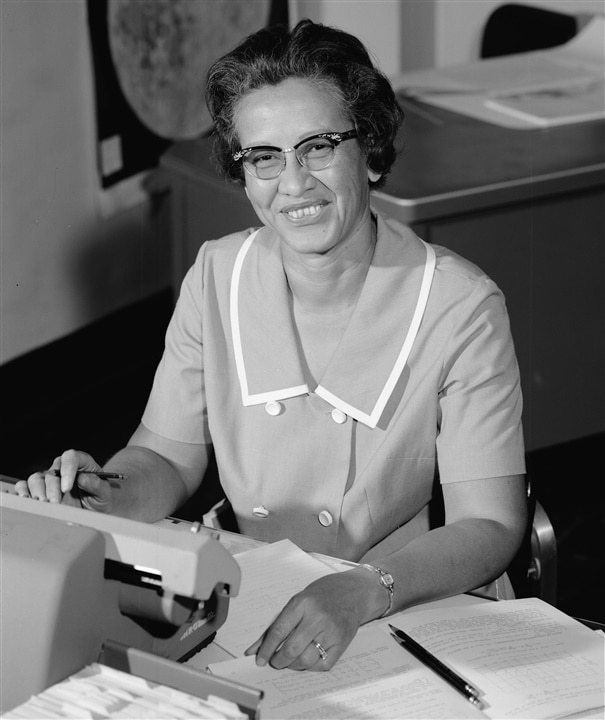
A 1966 photo of Katherine Johnson, who was known as the “human computer” working for NASA. (Image Credit: NASA)
In 1961, she contributed to Project Mercury for Alan Shepard’s Freedom 7 flight. According to Johnson, the initial Mercury Project trajectories worked like a parabola. That meant engineers could project where the capsule would be at various points during its flight. Since NASA wanted to land it at a specific location after reentry, Johnson worked backward from the desired landing point to determine the best launch time for the spacecraft. She said, “Let me do it. You tell me when you want it and where you want it to land, and I’ll do it backward and tell you when to take off.” That was my forte.”
She helped calculate and verify trajectories, which included launch windows and reentry or splashdown areas. To model the capsule’s trajectory as a curved path through Earth’s gravitational field, she used analytical geometry and orbital mechanics---all done by hand. Johnson refined calculations iteratively and adjusted variables like launch angles, velocity components, and target coordinates until the trajectory met mission requirements. This allowed NASA scientists to predict Freedom 7’s splashdown location.
Additionally, she created backup navigation charts in case onboard systems ever stopped working. Astronauts would then need to rely on star sightings and other manual methods. This was crucial as Mercury capsules were still early spacecraft. So, getting the astronauts safely back to Earth was as important as sending them into space on an Earth-orbital mission.
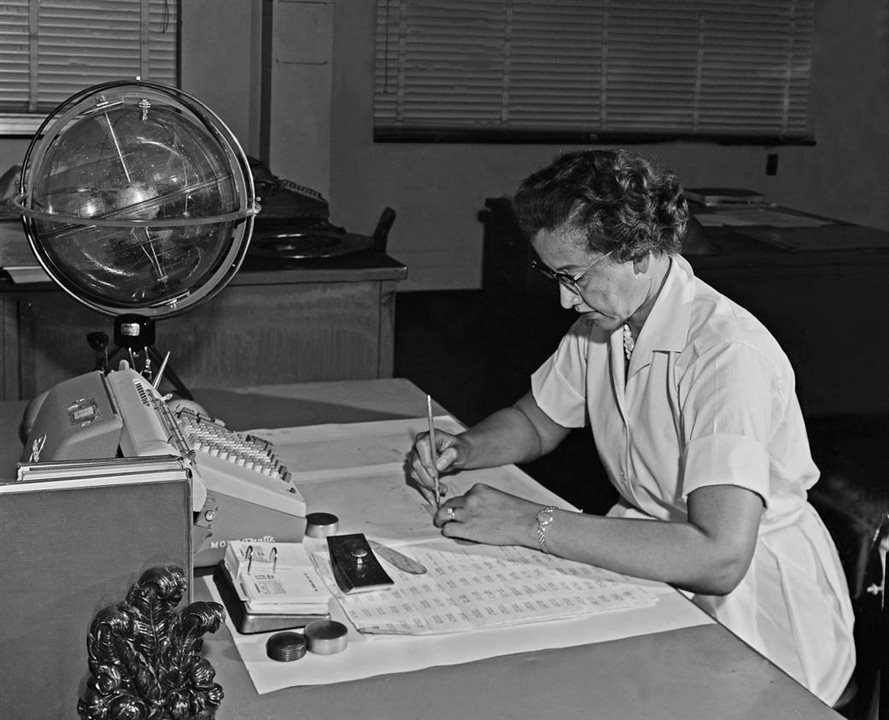
Katherine Johnson working at her desk at NASA Langley Research Center with a Celestial Training Device in 1962. (Image Credit: NASA)
Johnson’s title as the “human computer” came into play in 1962 as well. To prepare for John Glenn’s Friendship 7 mission, NASA programmed computers to calculate the orbital flight path---from liftoff to splashdown---of the capsule. However, the astronauts, particularly John Glenn, didn’t trust this method as the electronic calculating machines could be hit with blackouts and glitches. As a workaround, Glenn instructed the engineers to get Johnson to calculate those orbital flight equations by hand on her desktop mechanical calculating machine. To pull this off, she worked through the flight’s physics and geometry. She also calculated the capsule’s path, reentry point, and timing. Her numbers were checked against the new computer’s output. Glenn then asked to confirm the calculations were correct, and her math reassured the team before launch.
For the 1969 Apollo 11 mission, Johnson helped with the spacecraft’s flight path calculations and verification. Specifically, her efforts supported the navigation from the Earth to the Moon, lunar orbit, rendezvous between the lunar module and command module, and the return trip home. This allowed the command module to safely exit lunar orbit and reenter the Earth’s atmosphere at the right angle. If a number was miscalculated or slightly off, the astronauts may have been put in a risky flight. Although she used the same trajectory calculating methods in previous missions, Apollo proved to be more challenging due to the moving parts.
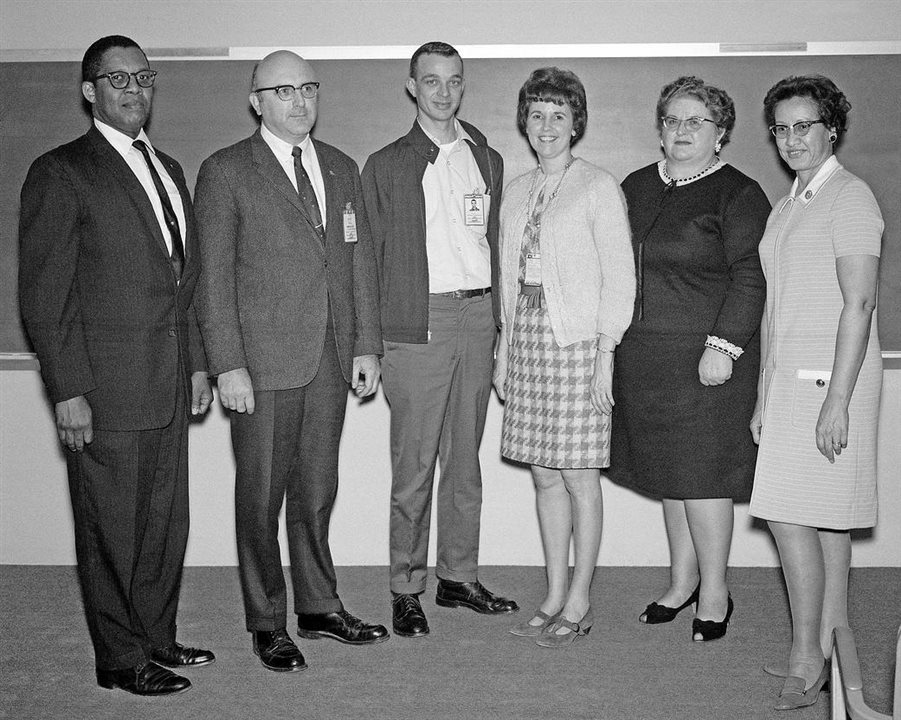
Katherine Johnson (far right) and her NASA Langley colleagues in 1970. (Image Credit: NASA)
When Apollo 13 had to abort its lunar mission in 1970, Johnson’s previous work on backup parameters and navigation charts helped the crew return to Earth four days later. Johnson also helped with deploying the Earth Resources Satellite and supported the Space Shuttle program in the early stages. She helped with spacecraft motion calculations and mission planning. Her work involved building on the trajectory calculations for the Mercury and Apollo missions. In doing so, she relied on her mathematical expertise for the shuttle’s flight operations and return planning. According to Johnson, her proudest work comes from coordinating the Apollo lunar module with the command and service module during lunar orbit.
Later in life, Johnson was widely recognized for her contributions after retiring from NASA. Barack Obama presented her with the Presidential Medal of Freedom in 2015. That year, she also received the NCWIT Pioneer in Tech Award. In 2019, Johnson was awarded the Congressional Gold Medal and several NASA awards, such as the Lunar Orbiter Award and NASA Special Achievement Awards. Additionally, NASA recognized Katherine Johnson by renaming its Independent Verification and Validation Facility in West Virginia. This represented the impact of her mathematical work on spaceflight. The movie Hidden Figures, made and released in 2016, is a tribute to her story and contributions throughout her life and career.
Katherine Johnson passed away on February 24th, 2020, at 101 years old. Her career as the “human calculator” was remarkable, as her calculations helped make human spaceflight possible and safer. Beyond the numbers, her efforts shattered barriers for black women in the science field. It also inspired future scientists to pursue STEM.
Have a story tip? Message me here at element14.
