element14 Community
element14 Community
    Register Log In
  • Site
  • Search
  • Log In Register
  • Community Hub
    Community Hub
    • What's New on element14
    • Feedback and Support
    • Benefits of Membership
    • Personal Blogs
    • Members Area
    • Achievement Levels
  • Learn
    Learn
    • Ask an Expert
    • eBooks
    • element14 presents
    • Learning Center
    • Tech Spotlight
    • STEM Academy
    • Webinars, Training and Events
    • Learning Groups
  • Technologies
    Technologies
    • 3D Printing
    • FPGA
    • Industrial Automation
    • Internet of Things
    • Power & Energy
    • Sensors
    • Technology Groups
  • Challenges & Projects
    Challenges & Projects
    • Design Challenges
    • element14 presents Projects
    • Project14
    • Arduino Projects
    • Raspberry Pi Projects
    • Project Groups
  • Products
    Products
    • Arduino
    • Avnet & Tria Boards Community
    • Dev Tools
    • Manufacturers
    • Multicomp Pro
    • Product Groups
    • Raspberry Pi
    • RoadTests & Reviews
  • About Us
  • Store
    Store
    • Visit Your Store
    • Choose another store...
      • Europe
      •  Austria (German)
      •  Belgium (Dutch, French)
      •  Bulgaria (Bulgarian)
      •  Czech Republic (Czech)
      •  Denmark (Danish)
      •  Estonia (Estonian)
      •  Finland (Finnish)
      •  France (French)
      •  Germany (German)
      •  Hungary (Hungarian)
      •  Ireland
      •  Israel
      •  Italy (Italian)
      •  Latvia (Latvian)
      •  
      •  Lithuania (Lithuanian)
      •  Netherlands (Dutch)
      •  Norway (Norwegian)
      •  Poland (Polish)
      •  Portugal (Portuguese)
      •  Romania (Romanian)
      •  Russia (Russian)
      •  Slovakia (Slovak)
      •  Slovenia (Slovenian)
      •  Spain (Spanish)
      •  Sweden (Swedish)
      •  Switzerland(German, French)
      •  Turkey (Turkish)
      •  United Kingdom
      • Asia Pacific
      •  Australia
      •  China
      •  Hong Kong
      •  India
      • Japan
      •  Korea (Korean)
      •  Malaysia
      •  New Zealand
      •  Philippines
      •  Singapore
      •  Taiwan
      •  Thailand (Thai)
      • Vietnam
      • Americas
      •  Brazil (Portuguese)
      •  Canada
      •  Mexico (Spanish)
      •  United States
      Can't find the country/region you're looking for? Visit our export site or find a local distributor.
  • Translate
  • Profile
  • Settings
Community Hub
Community Hub
Member's Forum Datasheet confusion, re: layout instructions
  • Blog
  • Forum
  • Documents
  • Quiz
  • Events
  • Leaderboard
  • Polls
  • Files
  • Members
  • Mentions
  • Sub-Groups
  • Tags
  • More
  • Cancel
  • New
Join Community Hub to participate - click to join for free!
Actions
  • Share
  • More
  • Cancel
Forum Thread Details
  • Replies 14 replies
  • Subscribers 574 subscribers
  • Views 926 views
  • Users 0 members are here
Related

Datasheet confusion, re: layout instructions

Andrew J
Andrew J over 6 years ago

Hopefully someone can take a look and help me get some insight into what is being stated.  This is in relation to layout of a DC-DC switching regulator LTC1624 (for my power supply build).  The data sheet, pages 20 and figure 9 on page 21, seem to conflict or, at least, not make sense in respect to the reference made to power and signal grounds.


Layout instructions state:

  1. Power ground and signal ground must be segregated.
  2. Ground pin of LTC1624 must return to -ve of Cout.
  3. The resistive divider must connect between +ve of Cout and signal ground
  4. Cin must connect to Vin and Ground of LTC1624

(I've summarised somewhat but that's the essential gist - they make reference to a POWER ground and a SIGNAL ground). 


Figure 9:

image

Looking at the layout figure 9, you can see that it follows these instructions and it would imply that -ve of Cout is signal ground; however this is directly linked to Schottky -ve pin, Cin-ve and back to the Vin - terminal


I've found a demo board for this chip. Unfortunately, the gerbers don't load into any viewer I can find, but there are images here on page 8 (last page.) 

Silk Screen:

image

Component Side (top):

image

Solder Side (bottom):

image


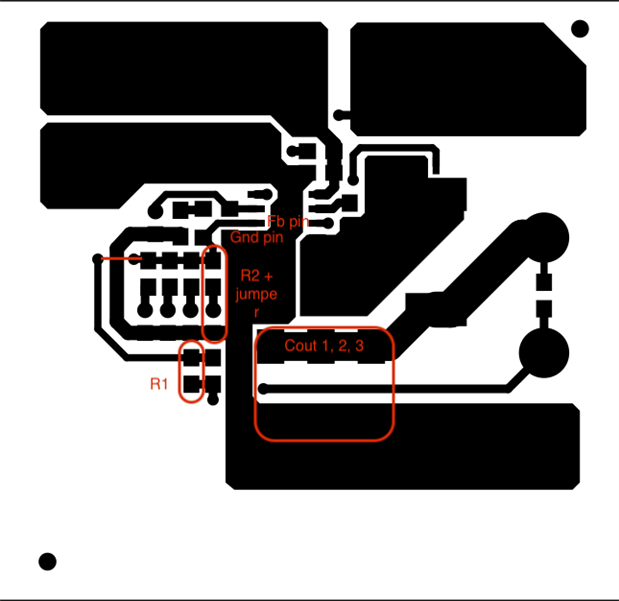
Looking at the Component Side (top) and Solder Side (bottom), there are two ground planes: a 'Z' like structure from Vin GND terminal E2, top left, under the LTC1624, to the Vout GND out terminal bottom right E5; the biggest copper area on Solder Side is Ground, also tied into E2 and E5.  I know 'Z' ground isn't a technical term but bear with me - I want to call it POWER ground but I'm not sure that would be right!  Looking at the Component Side silkscreen, it is clear Cout -ve is tied to the component side 'Z' ground; the feedback divider is also connected to the 'Z' ground where the sideways-U trace is.  It's worth noting also that the loop compensating resistor/capacitor is tied to the 'Z' ground.


Looking at Figure 9 and the PCB layout, it would seem that everything is tied into the same ground - it isn't clear if anything is tied into the ground plane on the Solder Side (except at terminals E2 and E5) and I've traced every component that has a ground connection to the Component Side 'Z' ground.  In other words, it's not clear what they mean by tying the resistor divider to signal ground. 


Anyone who has been following along with my build will know I've right-royally screwed up the grounding and layout and I don't want to do it again.  It's been clear that I've not fully understood how Switching Regulators work so I've been doing a lot of reading and now have a better idea.  I understand why the feedback divider should stretch across Cout so why it is tied to the -ve of Cout and figure 9 actually makes sense to me (except for the ground symbol under the Schottky plus a link to Vin GND.)  What doesn't make sense are the layout instructions reference to Power and Signal grounds and the layout of their PCB - it would seem that the way both the feedback and compensation components are tied to the ground plane, right by Schottky, would be inviting noise and poor behaviour.  It's also tying noise onto the Vout GND terminal as well.


I'd have to assume that the PCB layout is purely for the purposes of demonstrating the functionality of the LTC1624 and is less concerned with the quality of the output.  Thus, I would expect that I would tie the Feedback and LTC1624 grounds to Cout -ve along a different Ground route.  That would also be the point for tying downstream ground components (so basically, like Figure 9 where the Vout -ve is deemed signal ground and Cout -ve becomes the star ground point for signal.)


Is this clear to anyone else?

  • Sign in to reply
  • Cancel

Top Replies

  • genebren
    genebren over 6 years ago +5
    Andrew, I did not completely analyze the PCB, but you are right, they did not follow their own instructions. The ground in particular does not show a separation of the high and low current paths. It also…
  • shabaz
    shabaz over 6 years ago +4
    Hi Andrew, I've not looked in detail yet, but here's an overlay in case it helps (this was with ViewMate, great software but not intuitive to use): (the green is top layer, becomes yellowish when the bottom…
  • shabaz
    shabaz over 6 years ago +4
    Hi Andrew, This text might help, from "Fundamentals of Power Supply Design" which is a TI book that I won in a competition a while back. It places the resistors away from the switching area, to keep them…
Parents
  • shabaz
    shabaz over 6 years ago

    Hi Andrew,


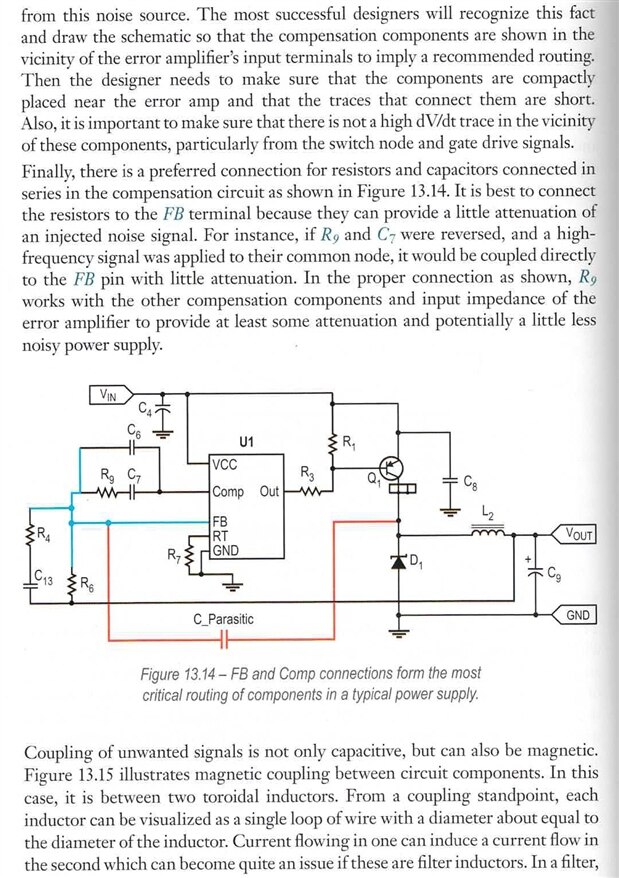
    This text might help, from "Fundamentals of Power Supply Design" which is a TI book that I won in a competition a while back.

    It places the resistors away from the switching area, to keep them away from the MOSFET and diode, to reduce switching noise pickup on that resistor node.

    It agrees with the style of layout in the TI design mentioned earlier, but disagrees with the style of topology drawn in the LT datasheet.


    image

    image

    • Cancel
    • Vote Up +4 Vote Down
    • Sign in to reply
    • Cancel
  • mike-0rc
    mike-0rc over 6 years ago in reply to shabaz

    I would recommend looking at LT spice, this is a DC to DC converter not AC to DC, make sure that you have a bridge rectifier in line with the input along with filter and bulk cap, diode ect. the use of an inline coupling filter to get rid of incoming noise on the 0V, connect the incoming 0V to the filter to GND to that the noise is filtered out through the GND plain then connect the output 0V from the filter to the 0V (This is not GND You use that for the shielding and PCB noise suppression).

    The switching reg LT uses a MOSFET and the sence resistor to generate a voltage and a specific frequency (Not DC) the reason for this is that if you get a short circuit on the output the MOSFET only sees a small amount of current and can run like this for ever due to it taking miliWatts instead of Watts that would heat up and cause heat damage or fire. The diode is for stopping the output voltage from over voltage and also sinks back to the reg in-case the 0V rail is lifted above 0V due to floating output voltages as the 0V is not GND...


    Hope this helps.


    Mike C.

    • Cancel
    • Vote Up +1 Vote Down
    • Sign in to reply
    • Cancel
Reply
  • mike-0rc
    mike-0rc over 6 years ago in reply to shabaz

    I would recommend looking at LT spice, this is a DC to DC converter not AC to DC, make sure that you have a bridge rectifier in line with the input along with filter and bulk cap, diode ect. the use of an inline coupling filter to get rid of incoming noise on the 0V, connect the incoming 0V to the filter to GND to that the noise is filtered out through the GND plain then connect the output 0V from the filter to the 0V (This is not GND You use that for the shielding and PCB noise suppression).

    The switching reg LT uses a MOSFET and the sence resistor to generate a voltage and a specific frequency (Not DC) the reason for this is that if you get a short circuit on the output the MOSFET only sees a small amount of current and can run like this for ever due to it taking miliWatts instead of Watts that would heat up and cause heat damage or fire. The diode is for stopping the output voltage from over voltage and also sinks back to the reg in-case the 0V rail is lifted above 0V due to floating output voltages as the 0V is not GND...


    Hope this helps.


    Mike C.

    • Cancel
    • Vote Up +1 Vote Down
    • Sign in to reply
    • Cancel
Children
No Data
element14 Community

element14 is the first online community specifically for engineers. Connect with your peers and get expert answers to your questions.

  • Members
  • Learn
  • Technologies
  • Challenges & Projects
  • Products
  • Store
  • About Us
  • Feedback & Support
  • FAQs
  • Terms of Use
  • Privacy Policy
  • Legal and Copyright Notices
  • Sitemap
  • Cookies

An Avnet Company © 2026 Premier Farnell Limited. All Rights Reserved.

Premier Farnell Ltd, registered in England and Wales (no 00876412), registered office: Farnell House, Forge Lane, Leeds LS12 2NE.

ICP 备案号 10220084.

Follow element14

  • X
  • Facebook
  • linkedin
  • YouTube